SEAFDEC/AQDINSTITUTIONAL REPOSITORY
    • English
    • 日本語
    • ไทย
    • Bahasa Indonesia
  • English 
    • English
    • 日本語
    • ไทย
    • Bahasa Indonesia
  • Login
View Item 
  •   SEAFDEC/AQD Institutional Repository Home
  • 03 SEAFDEC/AQD External Publications
  • Journal Articles, Conference Papers and Book Chapters by SEAFDEC Staff
  • Journal Articles
  • View Item
  •   SEAFDEC/AQD Institutional Repository Home
  • 03 SEAFDEC/AQD External Publications
  • Journal Articles, Conference Papers and Book Chapters by SEAFDEC Staff
  • Journal Articles
  • View Item
JavaScript is disabled for your browser. Some features of this site may not work without it.

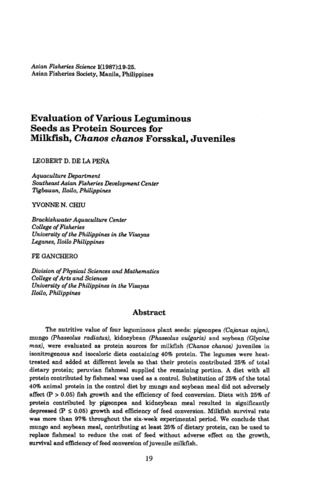
Evaluation of various leguminous seeds as protein sources for milkfish, Chanos chanos Forsskal, juveniles
  • Global styles
  • MLA
  • Vancouver
  • Elsevier - Harvard
  • APA
  • Help
Thumbnail
Download URL
www.asianfisheriessociety.org
Date
1987
Author
de la Peña, Leobert D.
Chiu, Yvonne N.
Ganchero, Fe
Page views
611
ASFA keyword
artificial feeding ASFA
diet ASFA
feed conversion efficiency ASFA
juveniles ASFA
protein sources ASFA
growth ASFA
survival ASFA
milkfish culture ASFA
fishmeal ASFA
AGROVOC keyword
Chanos chanos AGROVOC
Phaseolus vulgaris AGROVOC
Cajanus cajan AGROVOC
Glycine max AGROVOC
Philippines AGROVOC
Taxonomic term
Chanos chanos GBIF
Phaseolus vulgaris GBIF
Cajanus cajan GBIF
Glycine max GBIF
Phaseolus radiatus GBIF
Geographic names
Philippines TGN
Metadata
Show full item record


Share 
 
Abstract
The nutritive value of four leguminous plant seeds: pigeonpea (Cajanus cajan), mungo (Phaseolus radiatus), kidneybean (Phaseolus vulgaris) and soybean (Glycine max), were evaluated as protein sources for milkfish (Chanos chanos) juveniles in isonitrogenous and isocaloric diets containing 40% protein. The legumes were heat-treated and added at different levels so that their protein contributed 25% of total dietary protein; peruvian fishmeal supplied the remaining portion. A diet with all protein contributed by fishmeal was used as a control. Substitution of 25% of the total 40% animal protein in the control diet by mungo and soybean meal did not adversely affect (P > 0.05) fish growth and the efficiency of feed conversion. Diets with 25% of protein contributed by pigeonpea and kidneybean meal resulted in significantly depressed (P ≤ 0.05) growth and efficiency of feed conversion. Milkfish survival rate was more than 97% throughout the six-week experimental period. We conclude that mungo and soybean meal, contributing at least 25% of dietary protein, can be used to replace fishmeal to reduce the cost of feed without adverse effect on the growth, survival and efficiency of feed conversion of juvenile milkfish.
Keywords
various leguminous seeds protein sources for milkfish Chanos chanos juveniles
URI
http://hdl.handle.net/10862/6513
Suggested Citation
de la Peña, L. D., Chiu, Y. N., & Ganchero, F. (1987). Evaluation of various leguminous seeds as protein sources for milkfish, Chanos chanos Forsskal, juveniles. Asian Fisheries Science, 1(1), 19-25. https://doi.org/10.33997/j.afs.1987.1.1.002 
DOI
10.33997/j.afs.1987.1.1.002
Type
Article
ISSN
0116-6514; 2073-3720
Collections
  • Journal Articles [1276]

Related items

Showing items related by title, author, creator and subject.

  • Thumbnail

    Digestibility in milkfish, Chanos chanos (Forsskal): Effects of protein source, fish size and salinity 

    Ferraris, Ronaldo P.; Catacutan, Mae R.; Mabelin, Rey L.; Jazul, Adan P. (Elsevier, 1986)
    The true digestibility of casein, gelatin, fish meal, defatted soybean meal and Leucaena leucocephala leaf meal was measured in 60- and 175-g milkfish (Chanos chanos Forsskal) in fresh- and seawater. The diets contained 45% of these feedstuffs and 1.3% of the indicator substance, chromic oxide. The intestinal dissection method was used to collect fecal material. Results showed that the length of time between initial feeding and fish sacrifice did not significantly affect digestibility. Gelatin was the most digestible (90–98%) protein, regardless of size. Casein, defatted soybean meal and fish meal were moderately digestible (50–90%) and digestibility coefficients tended to increase as a function of fish size. L. leucocephala was the least digestible (−10–40%). The digestibility of most of these feedstuffs was less in the anterior than in the posterior intestine, and tended to be lower in seawater than in freshwater. Rate of food movement was similar in both size groups, but was significantly faster when milkfish were in seawater rather than in freshwater. The effect of salinity on digestibility may in part be due to food motility changes necessitated by alterations in osmoregulatory processes when fish are in seawater.
  • Thumbnail

    Potential of feed pea (Pisum sativum) meal as a protein source in practical diets for milkfish (Chanos chanos Forsskal) 

    Borlongan, Ilda G.; Eusebio, Perla S.; Welsh, Tim (Elsevier, 2003)
    A 12-week feeding trial was conducted to evaluate the use of feed pea meal as a dietary protein source for juvenile milkfish. Six isonitrogenous (30% crude protein) and isocaloric (16.5 kJ/g) practical diets were formulated. The control diet contained fish meal, soybean meal, meat and bone meal and copra meal as principal protein sources. Feed pea meal was progressively substituted at 0%, 5%, 10%, 15%, 20%, 25% and 30% of total protein. A leading commercial milkfish feed was also tested as an additional control. The experimental diets were fed to triplicate groups of milkfish fingerlings (mean initial weight of 0.42±0.01 g) at 10% body weight/day. Growth performance (expressed as percentage of weight gain and SGR), survival, feed conversion ratio (FCR) and protein efficiency ratio (PER) of milkfish fed diets with up to 10% substitution of the dietary protein with feed pea meal were not significantly different (P>0.05) compared to fish fed the control diet. Replacement with feed pea meal at 15% and higher levels led to milkfish fed these diets showing a significantly lower growth response compared to fish fed with the control without any feed pea meal. Nevertheless, it was observed that milkfish fed diets with up to 20% of total dietary protein substitution with feed pea meal showed better growth rates and feed conversion ratios than the commercial feed control. Whole body composition (crude protein, crude fat, crude fiber, nitrogen-free extracts and ash content) of milkfish fed the various test diets was not significantly different. Apparent digestibility coefficients of feed pea meal and experimental diets in milkfish were also determined. Results indicate that feed pea meal is an acceptable protein source and can replace up to 20% of the total dietary protein in milkfish diets.
  • Thumbnail

    Leaf meals as protein sources in diets for milkfish Chanos chanos (Forsskal) 

    Borlongan, I. G.; Coloso, R. M. (Asian Fisheries Society, 1994)
    The protencial of partial replacement of fish meal protein with protein indigenous leaf meals in practical diets for milkfish, Chanos chanos (Forsskal) was studied. Five isocaloric (375 kcal/100 g diet), isonitrogenous (40% protein), and isolipidic (10%) diets were formulated to contain leaf meals from either swamp cabbage (kangkong, Ipomea reptans), sweet potato (kamote, Ipomea batatas), ipil-ipil (Leucaena leucocephala), and cassava (kamorng kahoy, Manihot esculenta), or a combination of swamp cabbage, sweet potato and cassava. The control diet contained fish meal and soybean meal as sources of protein while thw test diets contained fish meal, soybean meal, and leaf meals erplacing 15% of the fish meal protein. The protein sources were incorporated in levels that gives optimal essential amino acid patterns to the diets. Each diet was fed to reiplcate groups of fish (about 0.3 g) maintained at 20 ppt salinity and 29oC in a recirculating system for twelve weeks. Growth, feed conversion ratio (FCR), protein efficiency ratio (PER), and survival of fish fed the diet contaning cassava leaf meal showed the best groth FCR, PER and survival. the data sugest that these leaf meals can be used to partially replace fish meal in a diet for juvenile milkfish if the requirments for essential amino acids are met.

© SEAFDEC/AQD  2026
Send Feedback | Subscribe


Browse

All of SAIRCommunities & CollectionsBy Issue DateAuthorsTitlesSubjectsThis CollectionBy Issue DateAuthorsTitlesSubjects

My Account

LoginRegister

Statistics

View Usage Statistics

© SEAFDEC/AQD  2026
Send Feedback | Subscribe


Export citations

Export the current results of the search query as a citation list. Select one of the available citation styles, or add a new one using the "Citations format" option present in the "My account" section.

The list of citations that can be exported is limited to items.

Export citations

Export the current item as a citation. Select one of the available citation styles, or add a new one using the "Citations format" option present in the "My account" section.

Export Citations

EXTERNAL LINKS DISCLAIMER

This link is being provided as a convenience and for informational purposes only. SEAFDEC/AQD bears no responsibility for the accuracy, legality or content of the external site or for that of subsequent links. Contact the external site for answers to questions regarding its content.

If you come across any external links that don't work, we would be grateful if you could report them to the repository administrators.

Click DOWNLOAD to open/view the file. Contact us in case the link we provided don't work.

Download

DOCUMENT REQUEST NOT AVAILABLE

This publication is still available (in PRINT) and for sale at AQD bookstore. The library is currently restricted to send PDF of publications that are still for sale.

You may contact bookstore@seafdec.org.ph or visit AQD bookstore for orders.

FILE UNDER EMBARGO

This file associated with this publication is currently under embargo. This will be available for download after the embargo date.