Perlihatkan publikasi sederhana
Comparative analysis of the temporal abundance of the epiphytic pest, Melanothamnus thailandicus, affecting farmed Kappaphycus striatus: Visual and molecular detection approaches
| dc.contributor.author | Faisan, Jr., Joseph | |
| dc.contributor.author | Sibonga, Rema | |
| dc.contributor.author | Luhan, Maria Rovilla | |
| dc.contributor.author | Ferriols, Victor Marco Emmanuel | |
| dc.contributor.author | Mateo, Jonalyn | |
| dc.contributor.author | Brakel, Janina | |
| dc.contributor.author | Brodie, Juliet | |
| dc.contributor.author | Ward, Georgia | |
| dc.contributor.author | Bass, David | |
| dc.contributor.author | Ross, Stuart | |
| dc.contributor.author | Stentiford, Grant | |
| dc.contributor.author | Gachon, Claire | |
| dc.contributor.author | Hurtado, Anicia | |
| dc.coverage.spatial | Iloilo | en |
| dc.coverage.spatial | Philippines | en |
| dc.coverage.spatial | Southeast Asia | en |
| dc.date.accessioned | 2025-09-05T01:51:45Z | |
| dc.date.available | 2025-09-05T01:51:45Z | |
| dc.date.issued | 2025-09-02 | |
| dc.identifier.citation | Faisan, J. P., Jr., Sibonga, R. C., Luhan, M. R. J., Ferriols, V. M. E. N., Mateo, J. P., Brakel, J., Brodie, J., Ward, G. M., Bass, D., Ross, S., Stentiford, G. D., Gachon, C., & Hurtado, A. Q. (2025). Comparative analysis of the temporal abundance of the epiphytic pest, Melanothamnus thailandicus, affecting farmed Kappaphycus striatus: Visual and molecular detection approaches. Journal of Applied Phycology. https://doi.org/10.1007/s10811-025-03620-y | en |
| dc.identifier.issn | 0921-8971 | |
| dc.identifier.uri | http://hdl.handle.net/10862/6611 | |
| dc.description.abstract | Kappaphycus striatus is a widely cultivated red eucheumatoid seaweed in Southeast Asia. However, infestations of epiphytic filamentous algae (EFA) have become a significant challenge, reducing biomass yields during harvest and resulting in income loss for farmers. This study evaluated and identified the EFA affecting farmed K. striatus in northern Iloilo, Philippines. Bi-monthly collections of representative individuals from a single site in a shallow water area were conducted for nine months (June 2019‒February 2020). Seaweed samples from different time points, including both visibly healthy and infested algal thalli, were further analyzed using molecular techniques to assess the effectiveness of visual examination in detecting these epiphytes. Visually, red filamentous epiphytic pests were observed during the rainy months, particularly between September and December. In K. striatus showing clear signs of infestation, these appeared as “goosebump-like” structures with epiphytic filaments protruding from the host. Molecular analysis revealed that this EFA was present in different regions of the seaweed thallus. Interestingly, the target epiphyte was also detected in thallus tissues that appeared visually healthy. PCR detection of EFA yielded higher results (25.7%) than visual examination (20.0%) (p < 0.001). Phylogenetic analysis identified the filamentous epiphyte as Melanothamnus thailandicus‒ a species not previously recorded affecting farmed eucheumatoid seaweed in the Philippines. These findings suggest that molecular identification of epiphytes is more reliable than visual inspection. Therefore, it is recommended that molecular detection methods be incorporated into biosecurity protocols, farm management practices, and seedling movement to prevent the spread and unintentional introduction of epiphytic pests in seaweed farming areas. | en |
| dc.description.sponsorship | This study was supported by the United Kingdom Research and Innovation–Global Challenges Research Fund (UKRI-GCRF) “GlobalSeaweedSTAR” Programme (Grant No. BB/P027806/1) and implemented at SEAFDEC/AQD with a Study Code: FH-01-S2017T. | en |
| dc.language.iso | en | en |
| dc.publisher | Springer | en |
| dc.subject | Philippines | en |
| dc.subject | South East Asia | en |
| dc.subject | Rhodophyta | en |
| dc.subject | farm management | en |
| dc.title | Comparative analysis of the temporal abundance of the epiphytic pest, Melanothamnus thailandicus, affecting farmed Kappaphycus striatus: Visual and molecular detection approaches | en |
| dc.type | Article | en |
| dc.identifier.doi | 10.1007/s10811-025-03620-y | |
| dc.citation.spage | 1 | en |
| dc.citation.journalTitle | Journal of Applied Phycology | en |
| dc.subject.asfa | seaweed culture | en |
| dc.subject.asfa | seaweeds | en |
| dc.subject.asfa | aquaculture | en |
| dc.subject.asfa | epiphytes | en |
| dc.identifier.essn | 1573-5176 | |
| dc.subject.scientificName | Melanothamnus | en |
| dc.subject.scientificName | Kappaphycus striatus | en |
| local.subject | Aquaculture | en |
| local.subject | Epiphytic filamentous algae | en |
| local.subject | Farmed seaweed | en |
| local.subject | Kappaphycus striatus | en |
| local.subject | Melanothamnus thailandicus | en |
| local.subject | Polysiphonieae | en |
| local.subject | Rhodophyta | en |
| dc.subject.sdg | SDG 14 - Life below water | en |
Files in this item
| Files | Size | Format | View |
|---|---|---|---|
|
There are no files associated with this item. |
|||
Publikasi ini ada di koleksi berikut
-
Journal Articles [1267]
These papers were contributed by Department staff to various national and international journals.
Related items
Showing items related by title, author, creator and subject.
-
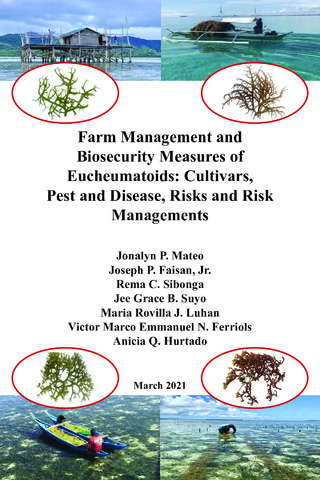
Farm management and biosecurity measures of Eucheumatoids: Cultivars, pest and disease, risks and risk managements
; Faisan, Joseph P., Jr.This brochure was prepared and written after four years of research of the seaweed industry of the Philippines by the GlobalSeaweedSTAR Philippine Team in a layman’s language. This provides the different stakeholders of ... ; Sibonga, Rema ; ; ; ; (United Kingdom Research and Innovation-Global Challenge Research Fund (UKRI-GCRF), 2021-03)
-
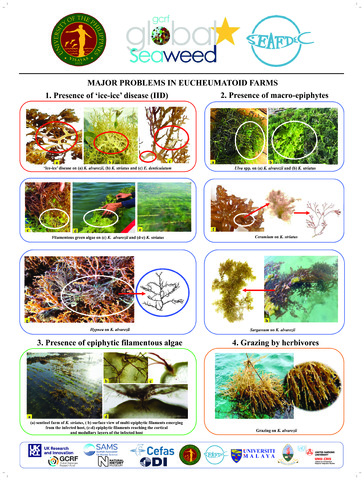
Major problems in Eucheumatoid farms
(GlobalSeaweedSTAR Philippines, 2021) -
Biyah diin in pagparagan sin pagtanuman agal agal iban pag'ayad ha pag' urulan sin kabuhi: Binhi atawa tanumun agal agal, manga mangangaun iban kumakangii' iban sakit, manga anib atawa makamula' iban biyah diin in pagpahilunnah sin anib atawa piligru ha pagtanum agal agal
; Faisan, Joseph P., Jr.In buwk-buwk pahati ini nahinang iban kiyasulat paglabay upat tahun ha pagsaliksik ha pag’usaha agal agal ha Pilipinas hinang sin tumpukan sin GlobalSeaweedSTAR Philippine ha bitsara kahatihan sin kamatauran. Makatagama ...; Sibonga, Rema ; ; ; ; (United Kingdom Research and Innovation-Global Challenge Research Fund (UKRI-GCRF), 2021-03)