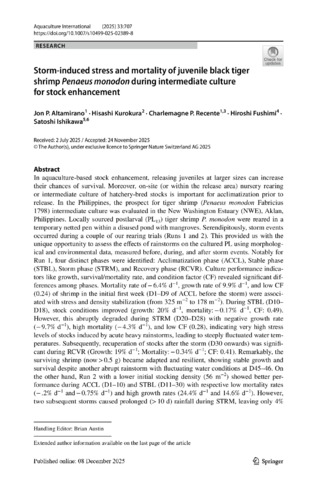
Storm-induced stress and mortality of juvenile black tiger shrimp Penaeus monodon during intermediate culture for stock enhancement
View/
Date
2025-12-08Page views
274ASFA keyword

AGROVOC keyword
Taxonomic term

Geographic names

Metadata
Show full item recordShare
Abstract
In aquaculture-based stock enhancement, releasing juveniles at larger sizes can increase their chances of survival. Moreover, on-site (or within the release area) nursery rearing or intermediate culture of hatchery-bred stocks is important for acclimatization prior to release. In the Philippines, the prospect for tiger shrimp (Penaeus monodon Fabricius 1798) intermediate culture was evaluated in the New Washington Estuary (NWE), Aklan, Philippines. Locally sourced postlarval (PL13) tiger shrimp P. monodon were reared in a temporary netted pen within a disused pond with mangroves. Serendipitously, storm events occurred during a couple of our rearing trials (Runs 1 and 2). This provided us with the unique opportunity to assess the effects of rainstorms on the cultured PL using morphological and environmental data, measured before, during, and after storm events. Notably for Run 1, four distinct phases were identified: Acclimatization phase (ACCL), Stable phase (STBL), Storm phase (STRM), and Recovery phase (RCVR). Culture performance indicators like growth, survival/mortality rate, and condition factor (CF) revealed significant differences among phases. Mortality rate of − 6.4% d−1, growth rate of 9.9% d−1, and low CF (0.24) of shrimp in the initial first week (D1–D9 of ACCL before the storm) were associated with stress and density stabilization (from 325 m−2 to 178 m−2). During STBL (D10–D18), stock conditions improved (growth: 20% d−1, mortality: − 0.17% d−1, CF: 0.49). However, this abruptly degraded during STRM (D20–D28) with negative growth rate (− 9.7% d−1), high mortality (− 4.3% d−1), and low CF (0.28), indicating very high stress levels of stocks induced by acute heavy rainstorms, leading to steeply fluctuated water temperatures. Subsequently, recuperation of stocks after the storm (D30 onwards) was significant during RCVR (Growth: 19% d−1; Mortality: − 0.34% d−1; CF: 0.41). Remarkably, the surviving shrimp (now > 0.5 g) became adapted and resilient, showing stable growth and survival despite another abrupt rainstorm with fluctuating water conditions at D45–46. On the other hand, Run 2 with a lower initial stocking density (56 m−2) showed better performance during ACCL (D1–10) and STBL (D11–30) with respective low mortality rates (− .2% d−1 and − 0.75% d−1) and high growth rates (24.4% d−1 and 14.6% d−1). However, two subsequent storms caused prolonged (> 10 d) rainfall during STRM, leaving only 4% survival at D38 with no RCVR phase. We showed that acute (~ 2 d) intense rainstorms can be detrimental to young (< 0.2 g) PL, but the stable environmental conditions after storms can allow the surviving stocks to recuperate, grow fast (> 0.5 g), then become quite resilient even to a subsequent acute (2 d) rainfall. However, extended rainstorms (> 10 d) cause continuous decline in salinity and temperature, leading to high mortality of shrimp. Therefore, careful programming of future on-site intermediate culture activities is important, considering the space and duration required for culture, initial densities and target sizes of PL, and cautious account of rainstorm seasonality.
Contributes to SDGs
Subjects
Rainstorms
Suggested Citation
Altamirano, J., Kurokura, H., Recente, C., Fushimi, H., & Ishikawa, S. (2025). Storm-induced stress and mortality of juvenile black tiger shrimp Penaeus monodon during intermediate culture for stock enhancement. Aquaculture International , 33(8), 707. https://doi.org/10.1007/s10499-025-02389-8
Type
ArticleISSN
0967-6120; 1573-143XCollections
- Journal Articles [1267]
Related items
Showing items related by title, author, creator and subject.
-
An overview of the nutrition, feed and feeding techniques of prawn penaeid/shrimps
(Philippine Council for Aquatic and Marine Research and Development, 1989)This paper echoes what transpired during the first International Conference of Penaeid Prawns/Shrimps held in Iloilo City in December 4-7, 1984, particularly on the Nutrition nd Feed Development. Around 25 papers were presented during the conference. The nutrient requirements of P. japonicus and to some extent, P. monodon have been studied quite extensively compared to other penaeid species. Requirements for protein, carbohydrates fats, amino acids and essential fatty acids for juveniles and larvae have been defined compared to those of the broodstock. Optimum protein levels for prawn juveniles vary from 28-38% for P. kerathurus, 40-46% for P. monodon, 43% for P. indicus and 50-54% for P. japonicus. Dissacharides like sucrose and trehalose have been found to be good source of carbohydrates at 20-25% in the diet. Crustacean diets require around 0.5% cholesterol. There are few studies on vitamine and mineral requirements. There are artificial diets for juveniles and microencapsulated diets that can completely replace live organisms as larval feed. Microencapsulated diets have been field-tested for P. vannamei, P. stylirostris, P. monodon, P. indicus and P. merguiensis in Ecuador, Taiwan, Malaysia, Thailand and the Philippines. When a commercial diet for the broodstock becomes available ther will be an artificial diet for athe life cycle of tha prawn. -
Series: Aquaculture extension manual; No. 19
Prawn hatchery operations
; Quinitio, Emilia T. ; (Aquaculture Department, Southeast Asian Fisheries Development Center, 1996-05)
The manual, an updated version of the 1984 SEAFDEC/AQD manual, presents the underlying principles and step-by-step instructions of prawn larval and post-larval rearing. The techniques described are not only applicable to Penaeus monodon, but may also be modified and applied to other penaeid and metapenaeid species. The following aspects are covered: Site selection; Life cycle; Hatchery design and planning; Hatchery operations; Diseases; and Economics.
; (Aquaculture Department, Southeast Asian Fisheries Development Center, 1996-05)
The manual, an updated version of the 1984 SEAFDEC/AQD manual, presents the underlying principles and step-by-step instructions of prawn larval and post-larval rearing. The techniques described are not only applicable to Penaeus monodon, but may also be modified and applied to other penaeid and metapenaeid species. The following aspects are covered: Site selection; Life cycle; Hatchery design and planning; Hatchery operations; Diseases; and Economics. -
The lowdown on world shrimp culture - II
(INFOFISH, 2001)This paper introduces some new members of the international shrimp culture club and goes on to discuss some recent technological innovations in the industry, particularly the polyculture of tilapia (mainly Oreochromis mossambicus) and shrimp.