Aqua Farm News: Recent submissions
Now showing items 261-280 of 286
-
Glucans and disease resistance
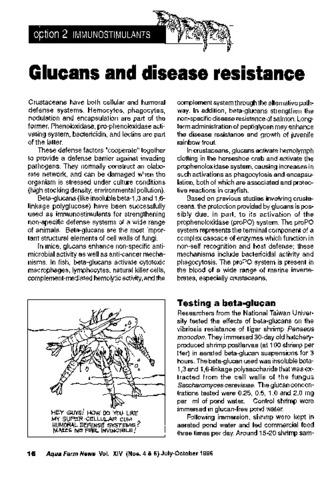
(Aquaculture Department, Southeast Asian Fisheries Development Center, 1996)The paper presents the usefulness of beta-glucans as immunostimulants for strengthening the non-specific defense system of a wide range of animals. In Taiwan, researchers tested the effects of beta-glucans on the vibriosis resistance of tiger shrimp Penaeus monodon which yield promising results. They suggest that supplementation of beta-glucan at 0.5 mg per ml is sufficient in strengthening the non-specific defense mechanism of postlarval shrimp. -
The trouble with antibiotics and pesticides is...
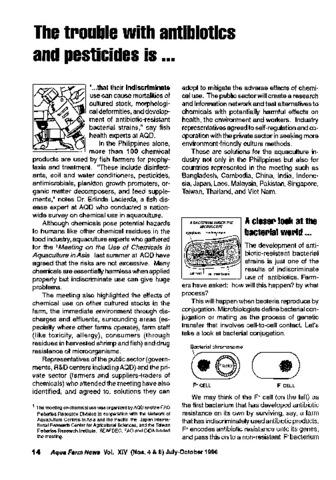
(Aquaculture Department, Southeast Asian Fisheries Development Center, 1996)The paper discusses the output of the meeting on the use of chemicals in aquaculture in Asia. The effects of chemical use on cultured stocks in the farm, the immediate environment through discharges and effluents, surrounding areas, farm staff, consumers and drug resistance organisms are also discussed. It also shows how an antibiotic-resistant microorganism develops as the result of indiscriminate use of antibiotics. -
Using bacteria to fight bacteria
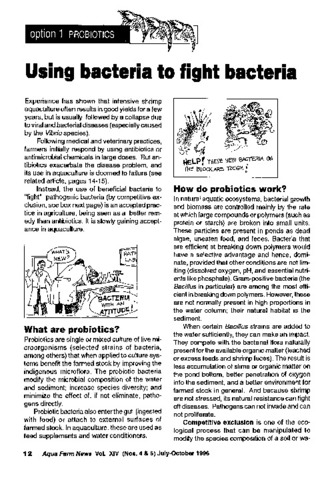
(Aquaculture Department, Southeast Asian Fisheries Development Center, 1996)The paper discusses about probiotics and its possible use in shrimp aquaculture. The paper also provides information on how the probiotics work and presents the preliminary results of the field tests conducted by Southeast Asian Fisheries Development Center, Aquaculture Department and BIOPOND Systems. The general characteristics of Bacillus are also discussed. -
Go slow, check your technology
(Aquaculture Department, Southeast Asian Fisheries Development Center, 1996)The paper presents the outlooks and experiences of veteran shrimp farmers from Negros, west central Philippines after its collapse in the late 1980s due to the luminous bacteria. -
Pathogens after shrimp: A rogue's gallery of the industry's four most destructive adversaries
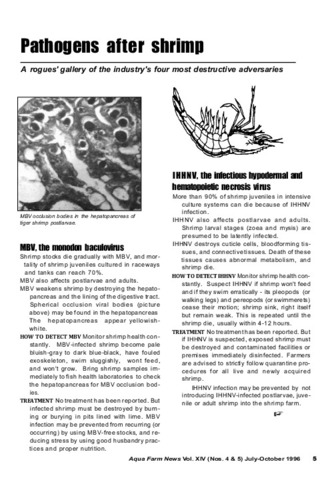
(Aquaculture Department, Southeast Asian Fisheries Development Center, 1996)The paper discusses the four most destructive shrimp pathogens, such as MBV, the monodon baculovisrus, IHHNV, the infectious hypodermal and hematopoietic necrosis virus, Vibrio harveyi, the luminous bacteria, and WSBV, the white spot syndrome-associated baculovirus. The effects, detection method and treatment for the four pathogens were also briefly discussed. -
Quo vadis, shrimp?
(Aquaculture Department, Southeast Asian Fisheries Development Center, 1996)The paper discusses the shrimp culture practices of Thailand, the top producing country of cultured shrimp. These shrimp culture techniques include the use of reservoirs for better waste management, utilization of undiluted seawater for culture, low-cost pumping systems, measures to neutralize acid sulfate soils, proper treatment of pond bottom, and solutions to disease problems. -
CRM in the Philippines: Lessons learned
(Aquaculture Department, Southeast Asian Fisheries Development Center, 1996)Philippine coastal communities can become capable fishery resource managers and that their management practices can become largely self-sustaining if the project approach focuses on assisting fishermen to learn how to help themselves. Community organization is an essential part of the process and should not be viewed as an end product in itself. There are also no quick fixes, and projects require a complex array of activities if large numbers of coastal residents are to be assisted. In some of these projects, the control of illegal fishing combined with limiting of commercial fishing to offshore areas and good coastal habitat management resulted in a doubling of daily fish catch and income for small-scale fishermen. However, even with the best of management, the total fishery harvest is limited and further increases in individual fishing income can only come from reducing total fishing effort. This will require a system of control on access to the resource to limit the number and kind of fishing gears and to divide the resource equitably. Assisting coastal communities to devise and implement realistic equitable access controls is the major challenge facing coastal resource co-management. -
What needs to be done?: Guide in mangrove reforestation
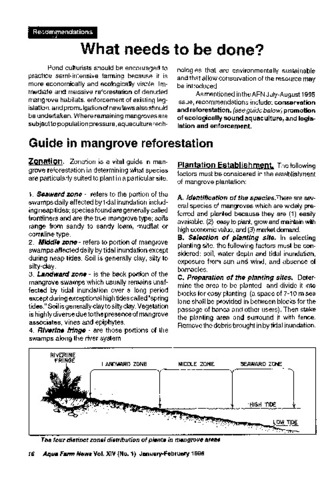
(Aquaculture Department, Southeast Asian Fisheries Development Center, 1996)The article presents a two-part guideline in mangrove reforestation. The first part is zonation, which is the process of determining what species are particularly suited to plant in a particular site. While, plantation establishment is the second part, it includes guides in the identification of species, selection of planting site, preparation of the planting sites, seed collection, handling and transporting of seeds, and planting. -
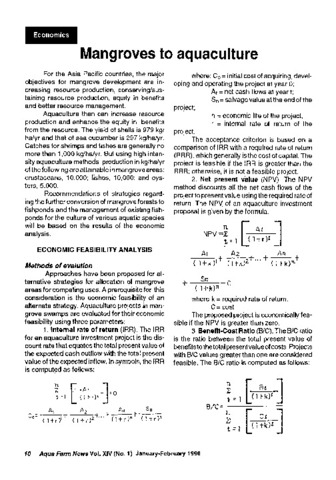
Mangroves to aquaculture
(Aquaculture Department, Southeast Asian Fisheries Development Center, 1996)The paper discusses the recommended strategies regarding the further conversion of mangrove forests to fishponds and the management of existing fishponds for the culture of various aquatic species based on economic feasibility analysis. Strategy for the management of Philippine mangrove and the guidelines for the selection of mangrove areas for preservation, conservation and fishpond development are also presented. -
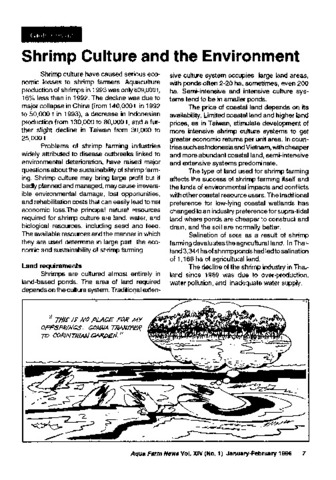
Shrimp culture and the environment
(Aquaculture Department, Southeast Asian Fisheries Development Center, 1996)The paper discusses the impacts of shrimp culture to the environment in some countries in Asia. Specifically, it highlights the land requirements suitable for shrimp farming and the impacts of shrimp culture on mangroves. The positive effects of mangroves such as its filtering capacity and as a protective buffer are also discussed. -
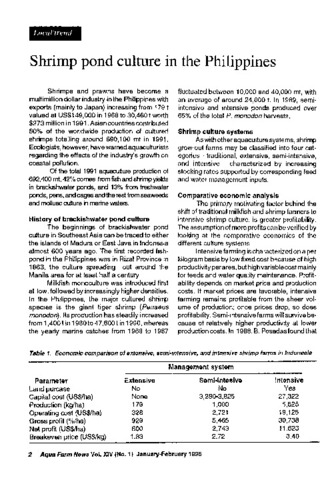
Shrimp pond culture in the Philippines
(Aquaculture Department, Southeast Asian Fisheries Development Center, 1996)The document reviews and evaluates the development of shrimp culture in the Philippines. It also discusses the ecological and socioeconomic effects of shrimp culture industry in the country. -
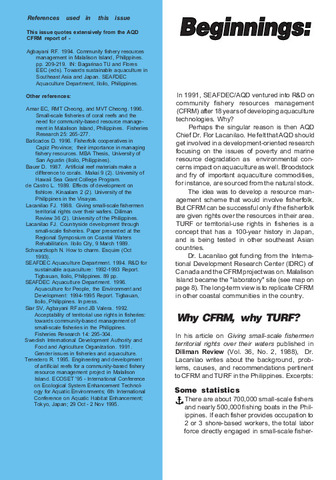
Beginnings: SEAFDEC/AQD, CFRM, and Malalison Island
(Aquaculture Department, Southeast Asian Fisheries Development Center, 1996)The paper documents the community fishery resources management activities of Southeast Asian Fisheries Development Center, Aquaculture Department (SEAFDEC/AQD) in Malalison Island, Antique, Philippines. -
Aqua Farm News Volume 10(01) January - February 1992
(Aquaculture Department, Southeast Asian Fisheries Development Center, 1992)This issue takes a look first at the economics of the world trade of ornamental fish. Virtually, no complete statistics are known to have been compiled on world trade in tropical aquarium fish other than the assessment ... -
Aqua Farm News Volume 14(06) November - December 1996
(Aquaculture Department, Southeast Asian Fisheries Development Center, 1996) -
Aqua Farm News Volume 14(4-5) July - October 1996
(Aquaculture Department, Southeast Asian Fisheries Development Center, 1996)This issue presents the shrimp production trends in Asia-Pacific, along with notes on the diseases devastating the industry and interviews with shrimp farmers in the Philippines. The options of shrimp farmers -- which are really quite limited and largely experimental - are discussed. These options include probiotics, the use of beta-glucans as immunostimulant, closed recycling systems. Farmers may also opt to farm other high-value species like grouper, mudcrab, or even milkfish to make use of the ponds they have invested quite a lot on. This issue also discusses Philippine government efforts to revive the shrimp industry, as well as AQD's R&D priorities for shrimp as worked out in various consultations with AQD's program partners and industry practitioners. -
Aqua Farm News Volume 14(02-03) March - June 1996
(Aquaculture Department, Southeast Asian Fisheries Development Center, 1996)This issue takes a close look at one fishing village working hard to manage its resources by itself. There are interviews with the village head or Barangay Captain, women leaders, a schoolkid, and a primary grade teacher. ... -
Aqua Farm News Volume 11(02) March - April 1993
(Aquaculture Department, Southeast Asian Fisheries Development Center, 1993)The milkfish Chanos chanos is a food of the common tao (man) and one of the most important fishes farmed in the Philippines. It is also a cultural symbol in the country, a national fish no less. To develop the milkfish industry, the Philippine Government established the National Bangus Breeding Program (NBBP) in 1981. NBBP was undertaken by the Department of Agriculture and the SEAFDEC Aquaculture Department with funding support from the International Development Research Centre of Canada. NBBP's target is commercial production of fry using the milkfish breeding and hatchery techniques developed by SEAFDEC. NBBP has twelve project sites, one in each of the country's regions. The Philippine Government recently decided to privatize the NBBP stations when technical and administrative problems remain unsolved. There was no commercial production of milkfish fry in most of the stations despite almost 10 years of operation. The questions that potential investors are now asking themselves are: • What is the economic prospect of milkfish breeding in the country? • Is the bangus breeding technology "ripe"? • How much money will be invested? • Where are these stations to be privatized? • What about their status? • What are the mechanics of the privatization? • Where will we get the human resources to run the business? This issue on milkfish breeding attempts to answer these questions. -
Aqua Farm News Volume 09(06) November - December 1991
(Aquaculture Department, Southeast Asian Fisheries Development Center, 1991) -
Aqua Farm News Volume 13(06) November - December 1995
(Aquaculture Department, Southeast Asian Fisheries Development Center, 1995)In this issue, traditional culture is discussed along with AQD's modifications. A summary of AQD's research on the natural life history of milkfish is presented as well as the issue on fry shortage. This issue also takes ... -
Aqua Farm News Volume 12(04) July - August 1994
(Aquaculture Department, Southeast Asian Fisheries Development Center, 1994)In this issue, we take a look at the hatchery technology for tiger shrimp, milkfish, and sea bass developed by AQD; some improvements in hatchery operations; the new trends in disease control; fry quality criteria; and the ...