SEAFDEC Asian Aquaculture: Recent submissions
21-40 / 305
-
Asian Aquaculture Volume 2(9) September 1979
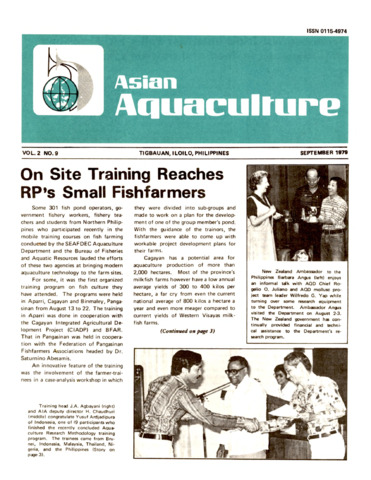
(Aquaculture Department, Southeast Asian Fisheries Development Center, 1979-09)In this issue: On site training reaches RP's small fishfarmers; Japanese nutrition scientist talks on directions and advances in feed and nutrition research; Farming lobsters in compartments; 18 from Asia, 1 from Africa ... -
Asian Aquaculture Volume 2(7) July 1979
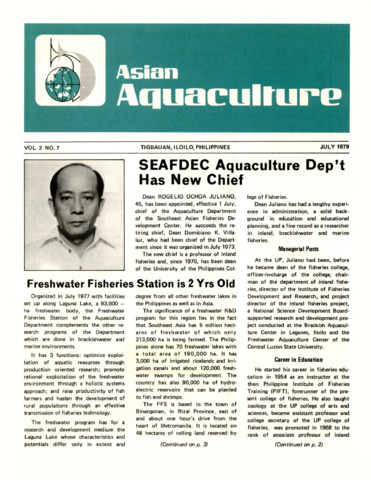
(Aquaculture Department, Southeast Asian Fisheries Development Center, 1979-07)In this issue: SEAFDEC Aquaculture Dep't has new chief; Freshwater Fisheries Station is 2 yrs old; Cage farming of Penaeus monodon in freshwater; Cage fish culture in Nepal; ADB provides assistance to Nepal Aquaculture Project -
Asian Aquaculture Volume 2(4) April 1979
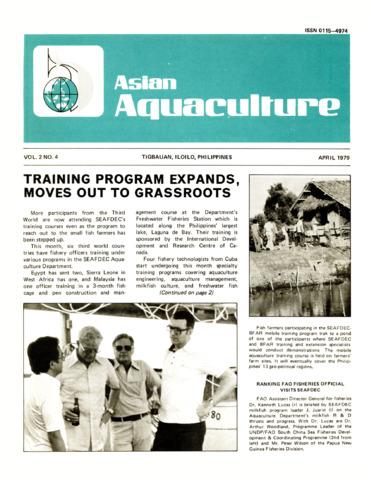
(Aquaculture Department, Southeast Asian Fisheries Development Center, 1979-04)In this issue: 1) Training program expands, moves out to grassroots; 2) Cage and pen culture in India; 3) Aquaculture in Hawaii: Species and systems; 4) Available technology, technology gaps, and production potentials of ... -
Asian Aquaculture Volume 2(5) May 1979
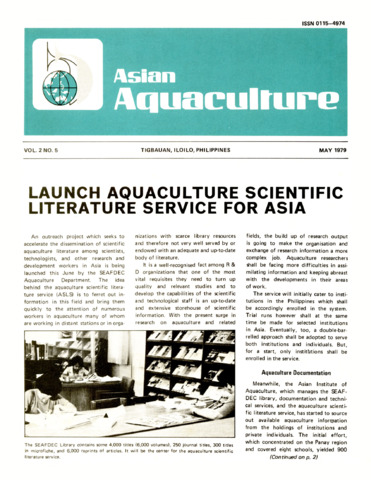
(Aquaculture Department, Southeast Asian Fisheries Development Center, 1979-05)In this issue: Launch aquaculture scientific literature service for Asia; Available technology, technology gaps, and production potentials in mollusc aquaculture; Development of aquaculture in Sierra Leone with a brief ... -
Asian Aquaculture Volume 2(6) June 1979
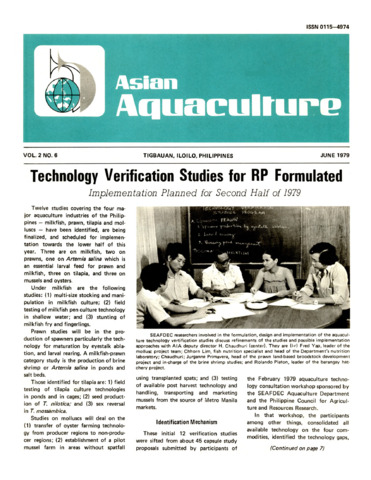
(Aquaculture Department, Southeast Asian Fisheries Development Center, 1979-06)In this issue: Technology verification studies for RP formulated; Available technology and technology gaps in tilapia farming in the Philippines; The use of aquatic plants as feed for Tilapia nilotica in floating cages; ... -
Cuba expands her aquaculture industry
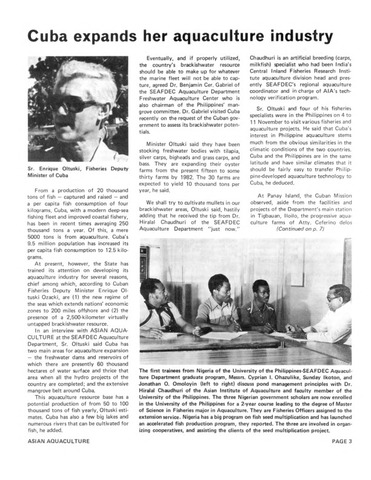
(Aquaculture Department, Southeast Asian Fisheries Development Center, 1978-12)Despite a thriving deep-sea and coastal fishery and high per capita fish consumption in Cuba, aquaculture is relatively undeveloped and will therefore be a target for future expansion following the impact of other nations' new economic zones on the fisheries. Two main areas for expansion exist: the freshwater dams and reservoirs, and the extensive mangrove belt around Cuba, which together have a potential annual production of 50 to 100 thousand tons of fish. At present, stocking programmes are concentrated on tilapia, silver carps, bigheads and grass carps, bass, and oysters; while mullets may be cultivated in brackishwater areas. Cuba has developed a particular interest in the Philippine aquaculture industry owing to the similar climatic conditions of the two countries. -
Fish farming can help conserve mangrove
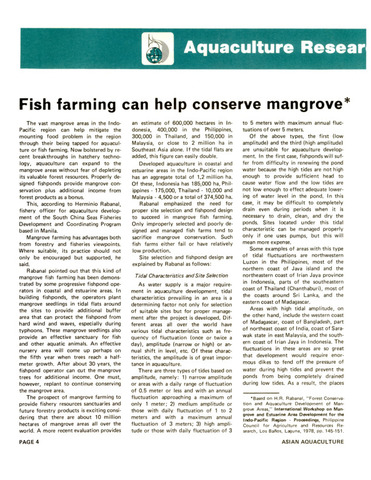
(Aquaculture Department, Southeast Asian Fisheries Development Center, 1978-12)Recent breakthroughs in hatchery technology allow aquaculture developments which are not merely compatible with mangrove areas, but actually improve mangrove conservation and concurrently permit the exploitation of forestry products. This article discusses the important implications of aquaculture development in mangrove areas, and the rationale underlying site selection, project design and technology. -
Edible crustaceans in the Philippines
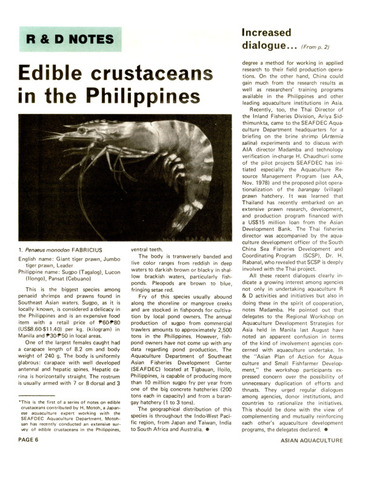
(Aquaculture Department, Southeast Asian Fisheries Development Center, 1978-12)Cursory information on the biology and economic value of sugpo (Penaeus monodon ) relevant to aquaculturists is presented. -
Freshwater fisheries expands program
(Aquaculture Department, Southeast Asian Fisheries Development Center, 1978-12)The SEAFDEC Aquaculture Department Freshwater Fisheries Station, located at Binangonan, on the shores of Laguna Lake, has drafted a programme for expansion. These include the piloting of a fish feed mill and the establishment of a pilot freshwater sugpo (Penaeus monodon) cage culture. Tilapia breeding, which aims to come up with a suitable and fast-growing cross, has also been started. Other freshwater programmes touch on the development of larval rearing techniques for shrimp species, and the setting up of a model eco-community in a fishing village. -
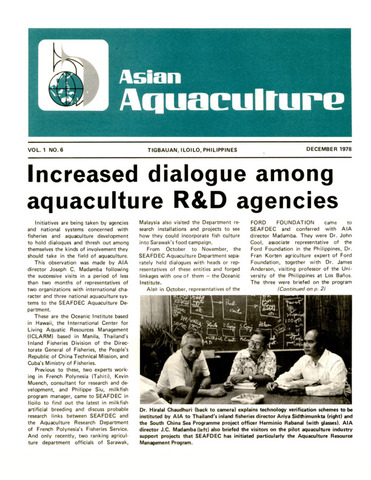
Increased dialogue among aquaculture R&D agencies
(Aquaculture Department, Southeast Asian Fisheries Development Center, 1978-12) -
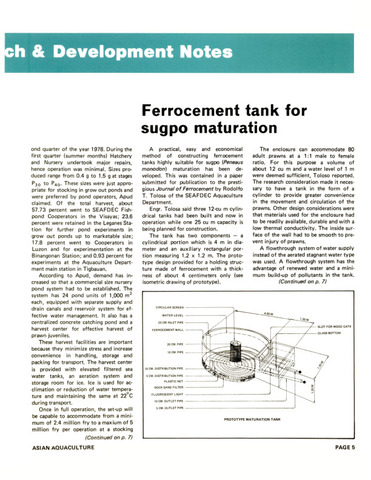
Ferrocement tank for sugpo maturation
(Aquaculture Department, Southeast Asian Fisheries Development Center, 1978-11)A practical, easy, and economical method of constructing ferrocement tanks highly suitable for sugpo (Penaeus monodon) maturation has been developed. The tank incorporates a cylindrical portion and an auxiliary rectangular portion and can accommodate 80 adult prawns at a 1:1 male-to-female ratio. Design considerations are aimed at ease of use and construction. A flowthrough water supply system, plus an oxygenation and filter system, are included. -
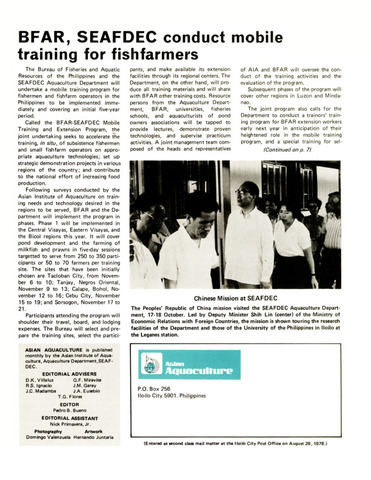
BFAR, SEAFDEC conduct mobile training for fishfarmers
(Aquaculture Department, Southeast Asian Fisheries Development Center, 1978-11)The Bureau of Fisheries and Aquatic Resources of the Philippines and SEAFDEC Aquaculture Department are proposing to undertake a mobile training program for fishermen and fish farm operators in the Philippines to be implemented immediately and covering an initial 5-year period. The program seeks to accelerate the training, in situ, of subsistence fishermen and small fish farm operators on appropriate aquaculture technologies; set up strategic demonstration projects in various regions of the country; and contribute to the national effort of increasing food production. -
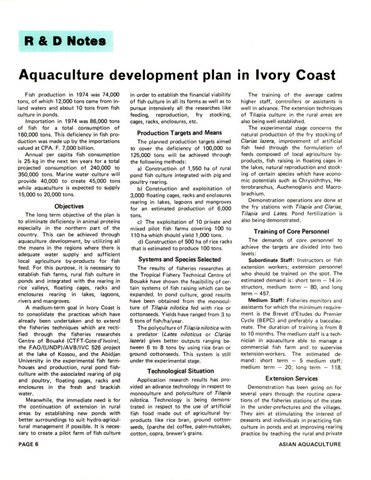
Aquaculture development plan in Ivory Coast
(Aquaculture Department, Southeast Asian Fisheries Development Center, 1978-11)An aquaculture development plan has been formulated to eliminate, in the long term, protein deficiency especially in the northern part of the country. It is proposed to establish fish farms, rural fish culture in ponds, and integrated with the rearing in rice valleys, floating cages, racks, and enclosures rearing in lakes, lagoons, rivers, and mangroves. Tilapia nilotica, possibly combined with a predator (Lates niloticus or Clarias lazera), is the most promising species for culture. Brief details of the objectives and organization of the plan are presented in this article. -
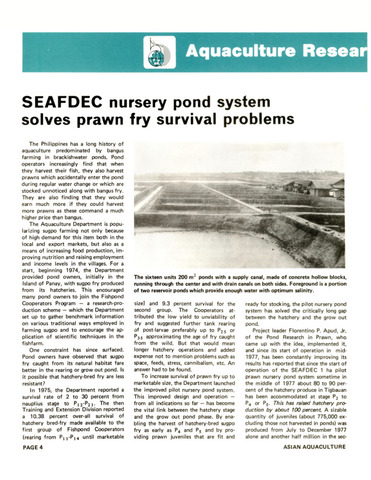
SEAFDEC nursery pond system solves prawn fry survival problems
(Aquaculture Department, Southeast Asian Fisheries Development Center, 1978-11)Prawn culture has been encouraged in the Philippines as an alternative to fish (bangus), since the former provides a higher income, better nutrition, and increased employment. The Aquaculture Department has made sugpo fry (Penaeus monodon ) available to pond owners, but these hatchery-bred fry are found to be much less viable than those from natural habitats. This has prompted the launching of an improved pilot nursery pond system which enables fry to be harvested as early as P4 and P5 stages, using improvements in design and operation to solve the critically long gap between the hatchery and the grow-out pond. By this method, hatchery production has been raised by about 100 percent, and a commercial size nursery has now been established capable of accommodating 2.4 to 5 million fry per operation, or 15 to 40 million per year. -
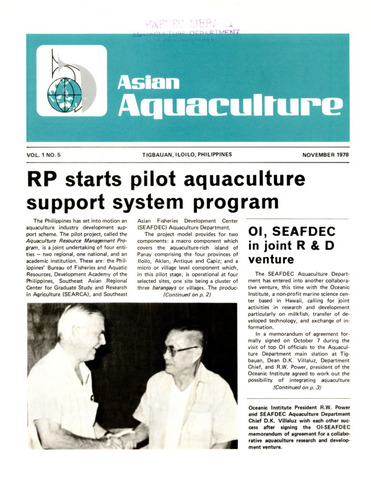
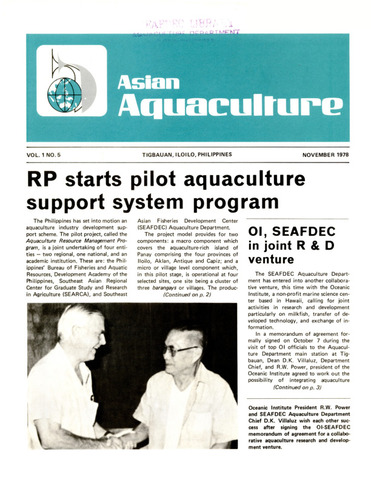
OI, SEAFDEC in joint R & D venture
(Aquaculture Department, Southeast Asian Fisheries Development Center, 1978-11)The SEAFDEC Aquaculture Department has entered into a collaborative venture with the Oceanic Institute of Hawaii, aimed at research and development, particularly on milkfish (Chanos chanos), transfer of developed technology, and exchange of information. Each institution has a background in aquaculture research activities. -
RP starts pilot aquaculture support system program
(Aquaculture Department, Southeast Asian Fisheries Development Center, 1978-11)The Philippines has set into motion an aquaculture industry development support scheme, jointly undertaken by 4 institutions. The project model provides for two components: a macro component which covers the island of Panay, and a micro or village level component concerned with milkfish, crustacean (including sugpo, or tiger prawn), and mollusc production. Details of the proposed infrastructure, technology, field implementation and management are given. -
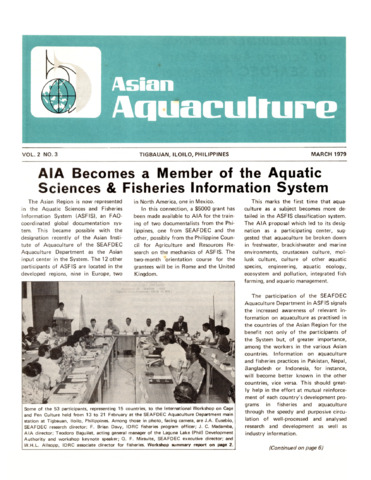
Asian Aquaculture Volume 2(3) March 1979
(Aquaculture Department, Southeast Asian Fisheries Development Center, 1979-03)In this issue: 1) AIA becomes a member of Aquatic Sciences & Fisheries Information System; 2) Cage and pen culture workshop; 3) Technology now available in RP on the culture of milkfish, prawns, molluscs, tilapia; 4) ... -
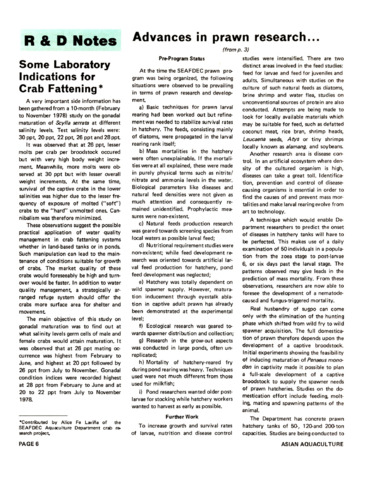
Some laboratory indications for crab fattening
(Aquaculture Department, Southeast Asian Fisheries Development Center, 1979)Contributed by Alice Fe Laviña of the SEAFDEC Aquaculture Department crab research project. -
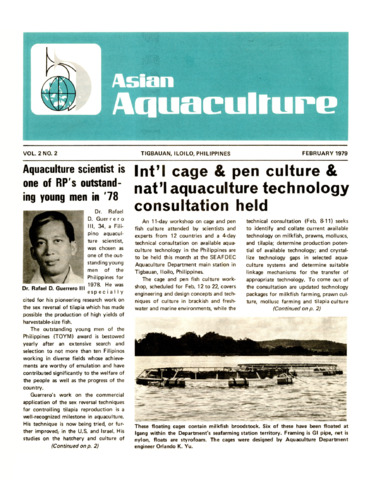
Asian Aquaculture Volume 2(2) February 1979
(Aquaculture Department, Southeast Asian Fisheries Development Center, 1979-02)In this issue: 1) Aquaculture scientist is one of RP's outstanding young men in '78; 2) International cage and pen culture and national aquaculture technology consultation held; 3) Advances in prawn research and development ... -
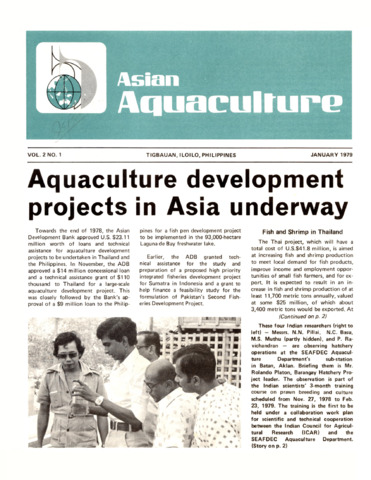
Asian Aquaculture Volume 2(1) January 1979
(Aquaculture Department, Southeast Asian Fisheries Development Center, 1979-01)In this issue: 1) Aquaculture development projects in Asia underway; 2) Four Indian scientists undergo training at SEAFDEC; 3) The milkfish research development program of SEAFDEC; 4) Status of aquaculture in some Latin ...