SEAFDEC Asian Aquaculture: Recent submissions
Now showing items 201-220 of 305
-
Polymerase chain reaction (PCR) in disease diagnosis
(Aquaculture Department, Southeast Asian Fisheries Development Center, 2002) -
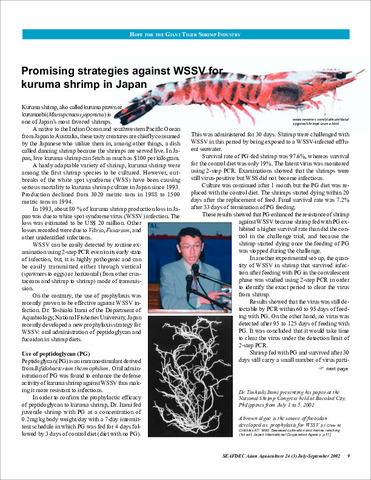
Promising strategies against WSSV for kuruma shrimp in Japan
(Aquaculture Department, Southeast Asian Fisheries Development Center, 2002) -
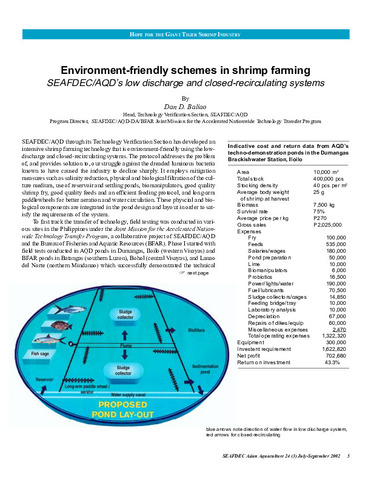
Environment-friendly schemes in shrimp farming
(Aquaculture Department, Southeast Asian Fisheries Development Center, 2002) -
Principles and concepts of mangrove-friendly shrimp culture
(Aquaculture Department, Southeast Asian Fisheries Development Center, 2002) -
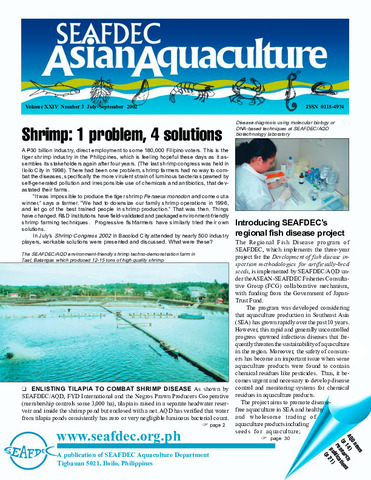
Shrimp: 1 problem, 4 solutions
(Aquaculture Department, Southeast Asian Fisheries Development Center, 2002) -
Price index for milkfish: An info tip for producers and consumers
(Aquaculture Department, Southeast Asian Fisheries Development Center, 2002) -
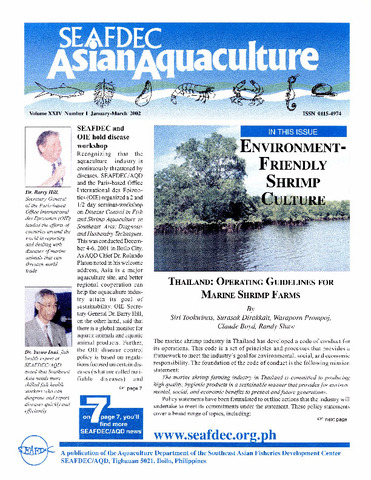
Thailand: Operating guidelines for marine shrimp farms
(Aquaculture Department, Southeast Asian Fisheries Development Center, 2002) -
European Union's special project on mudcrab
(Aquaculture Department, Southeast Asian Fisheries Development Center, 2003) -
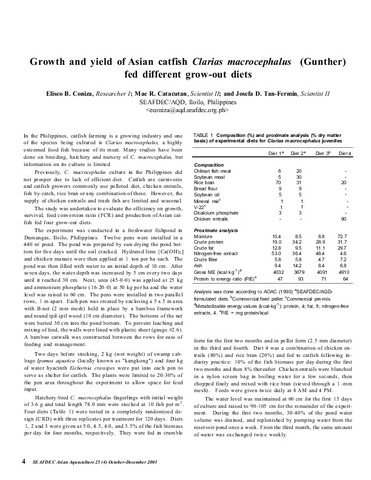
Growth and yield of Asian catfish Clarias macrocephalus (Gunther) fed different grow-out diets
(Aquaculture Department, Southeast Asian Fisheries Development Center, 2003) -
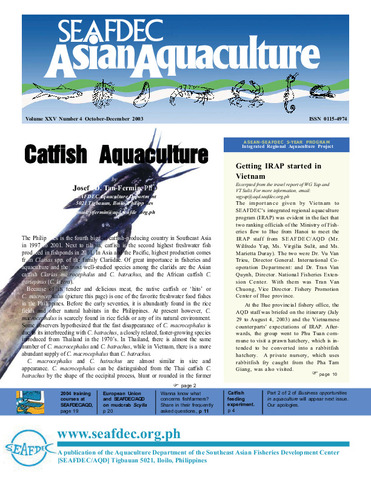
Catfish aquaculture
(Aquaculture Department, Southeast Asian Fisheries Development Center, 2003)This article deals with the biology, broodstock management, seed production techniques and grow-out culture practices in C. macrocephalus. -
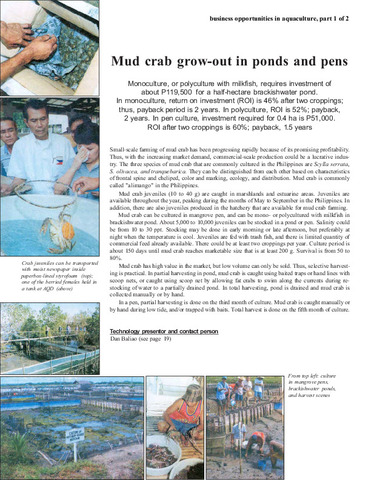
Mud crab grow-out in ponds and pens
(Aquaculture Department, Southeast Asian Fisheries Development Center, 2003) -
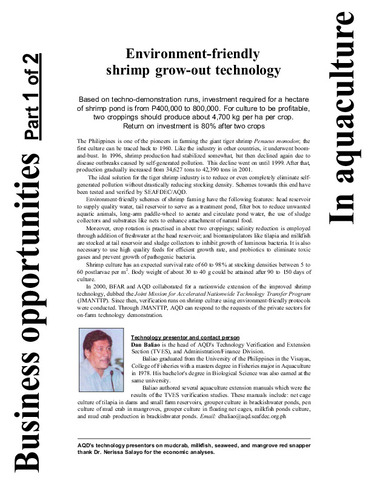
Environment-friendly shrimp grow-out technology
(Aquaculture Department, Southeast Asian Fisheries Development Center, 2003) -
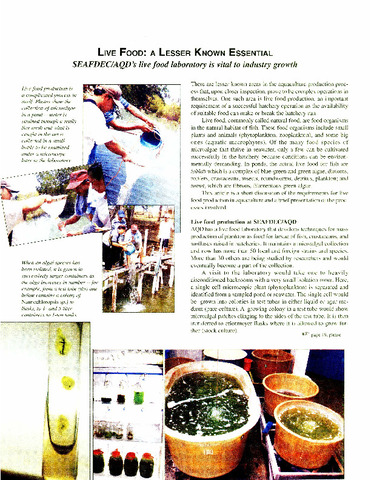
Live food: A lesser known essential
(Aquaculture Department, Southeast Asian Fisheries Development Center, 2003)This article is a short discussion of the requirements for live food production in aquaculture and a brief presentation of the processes involved. -
Endosulfan: a hidden menace
(Aquaculture Department, Southeast Asian Fisheries Development Center, 2003)A clean and healthy environment is paramount to human existence. While pesticide use has successfully sustained agricultural and food production in our lifetime as well as safeguarded human health by controlling insect pests, it has also caused many tragedies including population declines in our wildlife, fatalities in workers exposed to pesticides in its manufacture and use, and the increasing incidence of dreaded human illnesses such as cancer. A delicate balance should be achieved to mitigate the adverse impact of pesticide use to the environment and at the same time ensuring short- and long-term agricultural productivity. Endosulfan has been effectively used as a pesticide, but much evidence on its chronic and sub-lethal effects on humans and wildlife have been gathered in recent years. More research still needs to be done to determine its effects from long-term exposure at very low levels. Endosulfan is highly toxic to fish and other aquatic animals and, thus, not recommended for use in aquatic ecosystems. However, in some countries, it has been incorrectly used as a molluscicide in rice paddies, which could have an adverse impact on the rice-fish farming systems and on other surrounding aquatic ecosystems. It is clear that such practices should be stopped and users must strictly observed the recommended application methods. Agricultural productivity should be achieved with less pesticide by using integrated pest management programs which make use of biological, cultural, and physical control agents and lower doses of safer pesticide on a need only basis. The benefits of biotechnology should also be used to develop more effective and safer products and techniques. This is a valid approach and one that will require a unified and concerted effort among suppliers and users of pesticides in order to ensure that resources are used to our best advantage with minimal risk. -
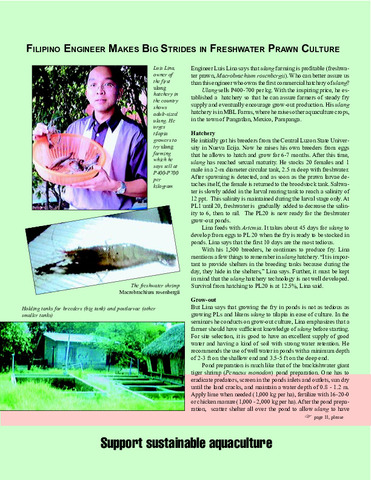
Filipino engineer makes big strides in freshwater prawn culture
(Aquaculture Department, Southeast Asian Fisheries Development Center, 2003) -
SEAFDEC Asian Aquaculture Volume 25(2) April - June 2003
(Aquaculture Department, Southeast Asian Fisheries Development Center, 2003) -
Seaweed markets in southeast Asia
(Aquaculture Department, Southeast Asian Fisheries Development Center, 1998)World seaweed production has steadily increased over the years. The 3 main commercial phycocolloids or processed chemical products from seaweeds marketed in Indonesia, Thailand, Malaysia and the Philippines are agar, alginate and carageenan. A brief account is given of the production of these products in Southeast Asia. -
Seaweeds: Utilization and product applications
(Aquaculture Department, Southeast Asian Fisheries Development Center, 1998)Seaweeds have been used as food, medicine, fertilizers, soil conditioner and source of salt. Realizing the potentials of seaweeds, research and development thrusts have been geared towards improving and developing its product applications. Today, various applications of seaweeds have been developed and improved. The major success in the seaweed industry is the development of phycocolloids with the following specific applications: 1) agar; 2) carrageenans; and, 3) alginates. -
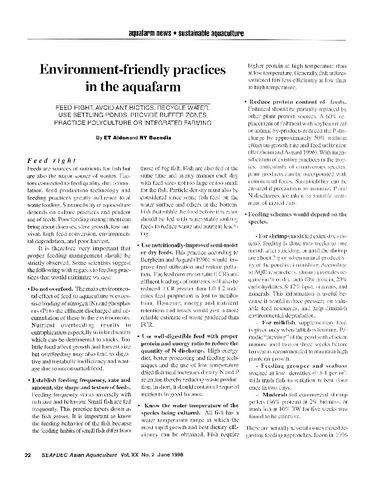
Environment-friendly practices in the aquafarm
(Aquaculture Department, Southeast Asian Fisheries Development Center, 1998)An outline is given of various environment-friendly management practices in aquaculture, considering the following: 1) feed right; 2) avoid antibiotics; 3) reuse and cycle water; 4) use settling or sedimentation ponds; 5) provide mangrove buffer zone; and, 6) practice polyculture or integrated farming. -
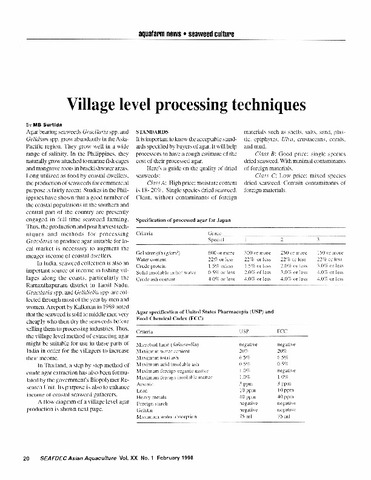
Village level processing techniques
(Aquaculture Department, Southeast Asian Fisheries Development Center, 1998)The agar-bearing seaweeds Gracilaria and Gelidium grow abundantly in the Asia-Pacific region. Production and post-harvest techniques and methods for processing Gracilaria to produce agar suitable for local market is necessary to increase the meager income of coastal dwellers. A flow diagram of a village level agar production is provided. A guide is also given for the quality of dried seaweeds, which are divided into 3 classes.