Mechanisms for lake formation in the Philippine archipelago


Share
Abstract
Topographic depressions, which when filled with water become lakes, can originate in a number of ways as a result of volcanic processes and activities, crustal and fault movements, stream processes, dissolution of rocks, downslope or mass movements, shoreline processes, glaciation, acolian processes, organic or animal activity and meteorite impacts. Man has also made both intentionally and unintentionally artificial depressions and dams that give rise to man-made lakes. But the mechanisms of formation of most Philippine lakes remain unknown although those of some are well established. Examples are cited in this paper. Lakes with similar mechanisms of formation may possess similar geomorphological, geological, and physico-chemical characteristics.
Directions for Philippine lacustrine research should cover issues on 1) the still unknown origin of most Philippine lakes, 2) assessment of lake-related hazards and risk mitigation in order to reduce disasters, 3) history of climate change as recorded in lacustrine sediments, and 4) policies and strategies for better utilization and development of lake resources which must recognize the truth that lakes are but ephemeral features of the landscape and do not last forever.
Description
Abstract only.
Suggested Citation
Punongbayan, R. S., & Listanco, E. L. (2001). Mechanisms for lake formation in the Philippine archipelago (Abstract only). In C. B. Santiago, M. L. Cuvin-Aralar, & Z. U. Basiao (Eds.), Conservation and Ecological Management of Philippine Lakes in Relation to Fisheries and Aquaculture (p. 149). Tigbauan, Iloilo, Philippines: Aquaculture Department, Southeast Asian Fisheries Development Center; Los Baños, Laguna, Philippines: Philippine Council for Aquatic and Marine Research and Development (PCAMRD), Department of Science and Technology; Quezon City, Philippines: Bureau of Fisheries and Aquatic Resources (BFAR), Department of Agriculture, Quezon City, Philippines.
Type
Conference paperISBN
9718511539Related items
Showing items related by title, author, creator and subject.
-
An environmental assessment of the aquaculture potential of Lake Gawaan, Lake Lenneng and Lake Banao/Danum at the Mt. Province
(Aquaculture Department, Southeast Asian Fisheries Development Center; Philippine Council for Aquatic and Marine Research and Development (PCAMRD), Department of Science and Technology; Bureau of Fisheries and Aquatic Resources, 2001)This study reviews the existing conditions of the three Mt. Province lakes: Lake Gawaan, Lake Lenneng and Lake Banao/Danum. Three mechanisms were employed. First is the overview of the resource capabilities. This includes the geographical, physical and biological characteristics, as well as the identification of nearby communities and the possible market distribution channels. The physical characteristics are the watershed type, color of water, kind of shoreline, source of water, water fluctuation levels and transparency/turbidity. Biological and chemical characteristics comprise the primary productivity, dissolved oxygen, nitrate, pH, ammonia, and stock availability (catch composition, gear type, seasonal distribution and production rate). The second mechanism is the understanding of the limitations of the area and development prospects which could cater to the needs of the growing population. This tackles suitable aquaculture practices that may be adopted at the areas concerned in order to increase fish production at the Mt. Province. The last mechanism is to determine if the combined efforts of the non-government organizations, government agencies and other concerned groups could be improved to prevent a piece-rate resource development program. Results showed that favorable conditions for fish culture are present in the three lakes. Culture of fish in net cages and pens appears suitable for the lakes. -
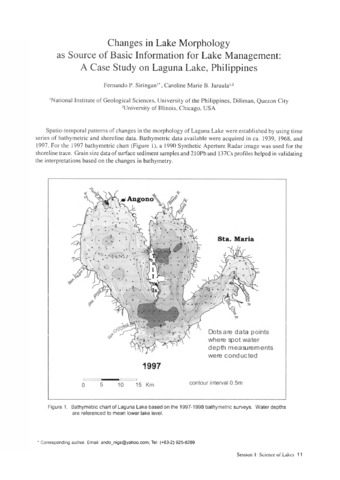
Changes in lake morphology as source of basic information for lake management: A case study on Laguna Lake, Philippines
(Southeast Asian Regional Center for Graduate Study and Research in Agriculture (SEARCA), 2005) -
Assessment of local government's implementation of open access policy in Taal Lake, Philippines: Effects on lake conservation and management
(Aquaculture Department, Southeast Asian Fisheries Development Center; Philippine Council for Aquatic and Marine Research and Development (PCAMRD), Department of Science and Technology; Bureau of Fisheries and Aquatic Resources, 2001)The effects of local government's implementation of the current national policy on open access in municipal fisheries are assessed in terms of their impact on the fishery resources of Taal Lake. Local officials and fisherfolk were interviewed and their responses were analyzed for trends in perceptions on how local open access policies affect fishing practices and productivity in the lake. A policy matrix containing certain areas of concern of local governments related to sound decisionmaking on lake fishery was designed. The study shows that local government implementation of open access policy in Taal Lake tends to have negative effects on the lake's fisheries. Open access allows for the unregulated entry of fishing practices like fish cage culture which tend to increase the pollution load in the lake. Pollution due to fish farming in cages seems to even exceed loads from domestic wastes and agricultural runoff. While fish cages flourished in the lake, the income of small fisher folk has declined because of dwindling catch from capture fisheries. It is recommended that national government agencies (e.g., Department of Agriculture, Bureau of Fisheries and Aquatic Resources, Department of Environment and Natural Resources) should forge an agreement with local government units for a continuing assessment of the fishery resources in Taal. This needs to be coupled with technical assistance to undertake sustained efforts to improve the conservation, productivity and management of the lake's aquatic resources. There is also a need to increase the budgetary allocations for new research and extension activities to address problems and issues of the fishery sector in the lake and for upgrading the capability of local and sectoral policy and decision makers on the lake's fisheries.