Conference Proceedings: Recent submissions
Now showing items 101-120 of 767
-
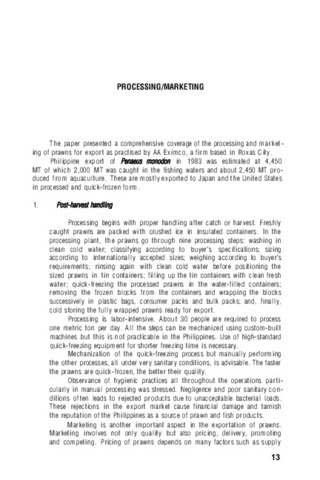
Processing/marketing
(Aquaculture Department, Southeast Asian Fisheries Development Center, 1984)The paper presented a comprehensive coverage of the processing and marketing of prawns for export as practised by AA Eximco, a firm based in Roxas City. Philippine export of Penaeus monodon in 1983 was estimated at 4,450 MT of which 2,000 MT was caught in the fishing waters and about 2,450 MT produced from aquaculture. These are mostly exported to Japan and the United States in processed and quick-frozen form. -
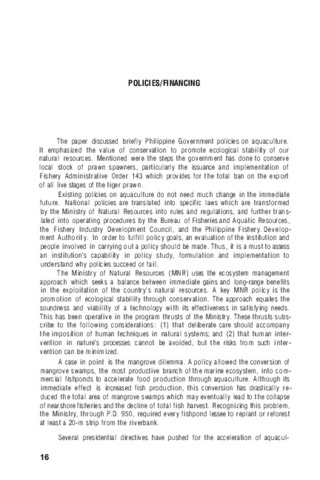
Policies/financing
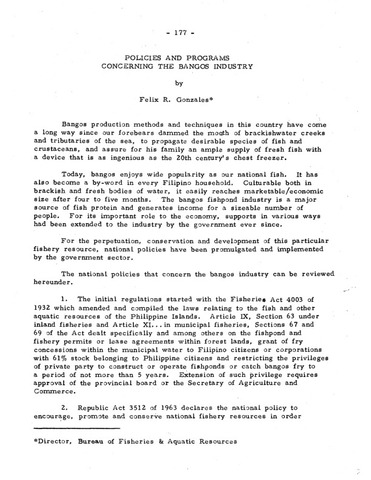
(Aquaculture Department, Southeast Asian Fisheries Development Center, 1984)The paper discussed briefly Philippine Government policies on aquaculture. It emphasized the value of conservation to promote ecological stability of our natural resources. Mentioned were the steps the government has done to conserve local stock of prawn spawners, particularly the issuance and implementation of Fishery Administrative Order 143 which provides for the total ban on the export of all live stages of the tiger prawn. -
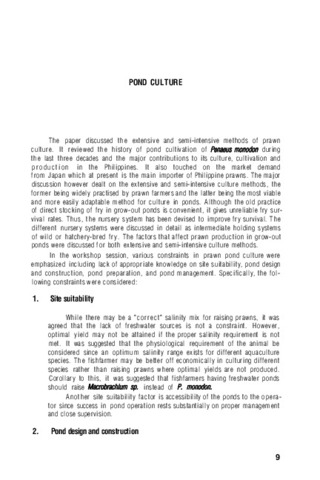
Pond culture
(Aquaculture Department, Southeast Asian Fisheries Development Center, 1984)The paper discussed the extensive and semi-intensive methods of prawn culture. It reviewed the history of pond cultivation of Penaeus monodon during the last three decades and the major contributions to its culture, cultivation and production in the Philippines. It also touched on the market demand from Japan which at present is the main importer of Philippine prawns. The major discussion however dealt on the extensive and semi-intensive culture methods, the former being widely practised by prawn farmers and the latter being the most viable and more easily adaptable method for culture in ponds. Although the old practice of direct stocking of fry in grow-out ponds is convenient, it gives unreliable fry survival rates. Thus, the nursery system has been devised to improve fry survival. The different nursery systems were discussed in detail as intermediate holding systems of wild or hatchery-bred fry . The factors that affect prawn production in grow-out ponds were discussed for both extensive and semi-intensive culture methods. -
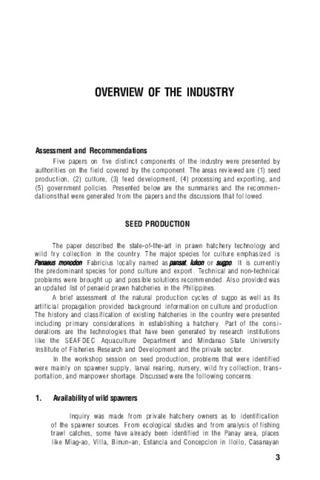
Seed production
(Aquaculture Department, Southeast Asian Fisheries Development Center, 1984)The paper described the state-of-the-art in prawn hatchery technology and wild fry collection in the country. The major species for culture emphasized is Penaeus monodon Fabricius locally named as pansat, lukon or sugpo. It is currently the predominant species for pond culture and export. Technical and non-technical problems were brought up and possible solutions recommended. Also provided was an updated list of penaeid prawn hatcheries in the Philippines. -
Feed development
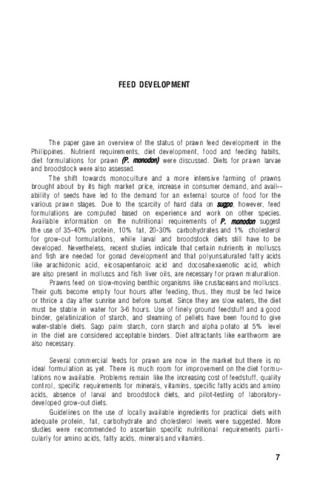
(Aquaculture Department, Southeast Asian Fisheries Development Center, 1984)The paper gave an overview of the status of prawn feed development in the Philippines. Nutrient requirements, diet development, food and feeding habits, diet formulations for prawn (P. monodon) were discussed. Diets for prawn larvae and broodstock were also assessed. -
Statistical data on milkfish
(1975) -
Cost of and returns from bangos production by size of farm and type of climate
(1975)This is a discussion of the production costs, yields, and profitability of different sizes of fish farming operations, and of fish farms operating under different types of Philippine climate. -
Market channels and marketing infrastructures of the bangos industry
(1975)This paper dwells on the catching and handling of bangos fry from the fishing ground to the market. It also includes the harvesting of bangos, handling and final marketing of the product. The problems of market channels and marketing infrastructures inherent in the bangos industry have also been discussed with recommendations for their possible improvement. -
Post-harvest operations and product utilization studies on bangos Chanos chanos (Forskal)
(1975)This paper, although with its limitations, attempts to review in a nutshell the recent investigations made locally on the utilization aspects of bangos. Cost analyses and feasibility studies on the manufacture of various products require more intensive study, however. It is apparent that the development of the bangos processing industry will depend initially on the quantity of raw material made available to the fish processor. -
Bangos pen culture and operations
(1975) -
Bangos nutrition studies
(1975) -
Experiences of a fishpond operator
(1975)