Managing excess capacity in small-scale fisheries: Perspectives from stakeholders in three Southeast Asian countries


Share
Abstract
The management of fishing capacity--in both inland and marine fisheries--is a major policy concern in most countries in Southeast Asia. Excess capacity leads to a number of negative impacts, such as resource use conflicts, overfishing, environmental degradation, economic wastage, and security threats. This paper presents the results of a regional study that examined various approaches to managing excess fishing capacity in small-scale fisheries in Southeast Asia. More specifically, the paper presents an analysis of perceptions of stakeholders in Cambodia, Philippines and Thailand regarding preferred solutions to addressing excess capacity. The paper concludes with a discussion of policy guidance for addressing excess fishing capacity based on the stakeholder-preferred solutions.
Description
SEAFDEC main author, ISI-CC covered journal, non-SEAFDEC study.
Suggested Citation
Salayo, N. D., Garces, L., Pido, M., Viswanathan, K., Pomeroy, R., Ahmed, M., Siason, I., Seng, K., & Masae, A. (2008). Managing excess capacity in small-scale fisheries: Perspectives from stakeholders in three Southeast Asian countries. Marine Policy , 32(4), 692-700. https://doi.org/10.1016/j.marpol.2007.12.001
Type
ArticleISSN
0308-597XCollections
- Journal Articles [1267]
Related items
Showing items related by title, author, creator and subject.
-
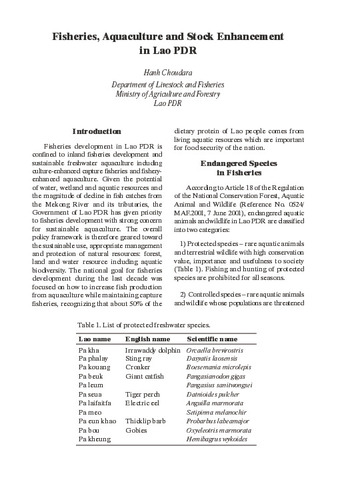
Fisheries, aquaculture and stock enhancement in Lao PDR
(Aquaculture Department, Southeast Asian Fisheries Development Center, 2006)Fisheries development in Lao PDR is confined to inland fisheries development and sustainable freshwater aquaculture including culture-enhanced capture fisheries and fishery-enhanced aquaculture. Given the potential of water, wetland and aquatic resources and the magnitude of decline in fish catches from the Mekong River and its tributaries, the Government of Lao PDR has given priority to fisheries development with strong concern for sustainable aquaculture. The overall policy framework is therefore geared toward the sustainable use, appropriate management and protection of natural resources: forest, land and water resource including aquatic biodiversity. The national goal for fisheries development during the last decade was focused on how to increase fish production from aquaculture while maintaining capture fisheries, recognizing that about 50% of the dietary protein of Lao people comes from living aquatic resources which are important for food security of the nation. -
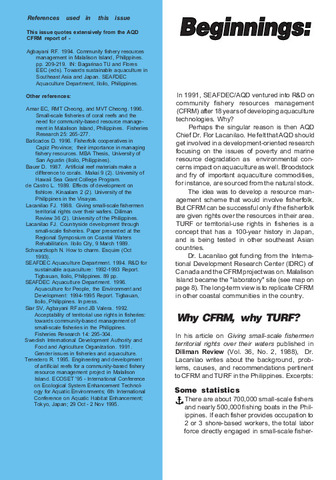
Beginnings: SEAFDEC/AQD, CFRM, and Malalison Island
(Aquaculture Department, Southeast Asian Fisheries Development Center, 1996)The paper documents the community fishery resources management activities of Southeast Asian Fisheries Development Center, Aquaculture Department (SEAFDEC/AQD) in Malalison Island, Antique, Philippines. -
Series: Summary of Proceedings No. 1/2013;
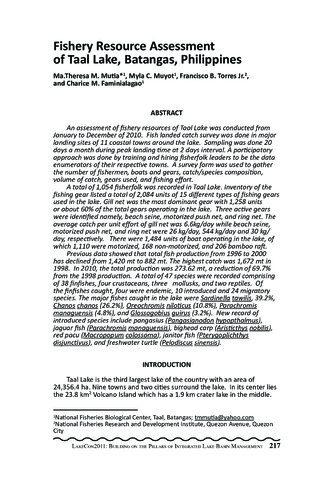
Fishery resource assessment of Taal Lake, Batangas, Philippines
(PCAARRD-DOST, 2013)An assessment of fishery resources of Taal Lake was conducted from January to December of 2010. Fish landed catch survey was done in major landing sites of 11 coastal towns around the lake. Sampling was done 20 days a month during peak landing time at 2 days interval. A participatory approach was done by training and hiring fisherfolk leaders to be the data enumerators of their respective towns. A survey form was used to gather the number of fishermen, boats and gears, catch/species composition, volume of catch, gears used, and fishing effort. A total of 1,054 fisherfolk was recorded in Taal Lake. Inventory of the fishing gear listed a total of 2,084 units of 15 different types of fishing gears used in the lake. Gill net was the most dominant gear with 1,258 units or about 60% of the total gears operating in the lake. Three active gears were identified namely, beach seine, motorized push net, and ring net. The average catch per unit effort of gill net was 6.6kg/day while beach seine, motorized push net, and ring net were 26 kg/day, 544 kg/day and 30 kg/day, respectively. There were 1,484 units of boat operating in the lake, of which 1,110 were motorized, 168 non-motorized, and 206 bamboo raft. Previous data showed that total fish production from 1996 to 2000 has declined from 1,420 mt to 882 mt. The highest catch was 1,672 mt in 1998. In 2010, the total production was 273.62 mt, a reduction of 69.7% from the 1998 production. A total of 47 species were recorded comprising of 38 finfishes, four crustaceans, three mollusks, and two reptiles. Of the finfishes caught, four were endemic, 10 introduced and 24 migratory species. The major fishes caught in the lake were Sardinella tawilis, 39.2%, Chanos chanos (26.2%), Oreochromis niloticus (10.8%), Parachromis managuensis (4.8%), and Glossogobius guirus (3.2%). New record of introduced species include pangasius (Pangasianodon hypopthalmus), jaguar fish (Parachromis managuensis), bighead carp (Aristicthys nobilis), red pacu (Macropopum colossoma), janitor fish (Pterygoplichthys disjunctivus), and freshwater turtle (Pelodiscus sinensis).