Mycoflora of the 'green water' culture system of tiger shrimp Penaeus monodon Fabricius
View/
Date
2005Page views
3,211ASFA keyword

AGROVOC keyword
Taxonomic term

Metadata
Show full item recordShare
Abstract
This study was conducted to quantify and characterize the mycoflora associated with the ‘green water’ culture system of Penaeus monodon. Samples of water, tilapia gut and mucus, and shrimp hepatopancreas from three shrimp farms were collected during 15, 30, 45 and 60 days of culture (DOC). Results showed that high fungal loads were observed in tilapia gut (total: 117–1352 colony forming unit (CFU) 5 cm hind gut−1; yeasts: 0–136 CFU 5 cm hind gut−1) and mucus (total: 12–311 CFU (5 cm2)−1; yeasts: 0–88 CFU (5 cm2)−1), while minimal fungal populations were observed in water samples (total: 0–110CFU mL−1; yeasts: 0–5 CFU ml−1). Shrimp hepatopancreas harboured a very low number of filamentous fungi (0–27 CFU 0.1 g−1) and yeasts (0–7CFU 0.1 g−1) especially at 60 DOC. The filamentous fungal isolates were dominated by Penicillium and Aspergillus species, while the yeast populations were dominated by Rhodotorula and Saccharomyces species. The dominance of these fungi on tilapia mucus and gut and their presence in the rearing water might play an important role in the overall mechanisms involved in the control of luminous Vibrio in the ‘green water’ grow-out culture of P. monodon.
Suggested Citation
Leaño, E. M., Lio-Po, G. D., Nadong, L. A., Tirado, A. C., Sadaba, R. B., & Guanzon, N. G. (2005). Mycoflora of the 'green water' culture system of tiger shrimp Penaeus monodon Fabricius. Aquaculture Research , 36(16), 1581-1587. https://doi.org/10.1111/j.1365-2109.2005.01381.x
Type
ArticleCollections
- Journal Articles [1267]
Related items
Showing items related by title, author, creator and subject.
-
The growth, survival and production of shrimp (Penaeus monodon) cultured with green mussel (Perna viridis) in semi-intensive ponds
(University of Philippines in the Visayas, 1997)The culture of tiger shrimps (Penaeus monodon) with and without green mussels (Perna viridis) was compared in terms of animal growth, survival, production, and pond water quality. Tiger shrimps (2.6 g) were stocked at 50,000/ha in six 1,000 m2 earthen ponds. Green mussels (mean shell-on weight of 11 g) were stocked at 100,000/ha on ropes suspended from bamboo rafts in three of these ponds. The growth and survival of tiger shrimps were not significantly different when cultured with or without mussels. Higher shrimp production (1,528.2 kg/ha) was obtained when these were cultured with mussels than without (1,327.5 kg/ha). Water quality did not vary significantly between treatments but ponds with both shrimp and mussel had lesser algae, lower biological oxygen demand and particulate organic matter levels, and generally higher morning dissolved oxygen concentrations compared with ponds without mussels. Results show the potential of green mussels as biological filters in shrimp ponds. -
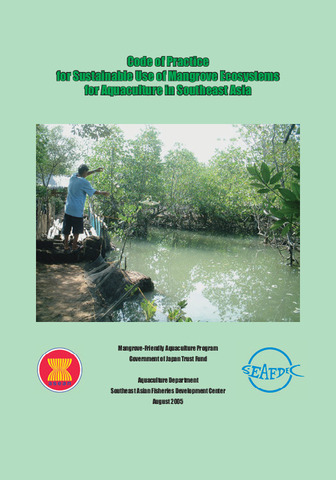
Code of practice for sustainable use of mangrove ecosystems for aquaculture in Southeast Asia
Bagarinao, TeodoraThis 47-page guidebook presents the 22 concepts, principles or policy statements that prescribe the preferred ways of doing and acting to ensure the sustainable use of mangroves for fish farming. It is annotated with ... ; Primavera, Jurgenne (Aquaculture Department, Southeast Asian Fisheries Development Center, 2005)
-
Treatment of shrimp pond effluents by sedimentation and by seaweed and mussel biofiltration
(Bureau of Agricultural Research, Department of Agriculture, 2007)Tiger shrimp Penaeus monodon were stocked in three 1,000 m2 ponds at 12,000 juveniles/pond and grown for 141 days. Water quality in the ponds was monitored over the grow-out period, particularly before and after every water change. BOD, chlorophyll a, and total dissolved solids of the effluent increased over the grow-out period due to increased biomass and feed input. Similar trends were observed for inorganic nitrogen, reactive phosphorus, total suspended solids, and hydrogen sulfide. Concentrations decreased after draining and reflooding. Soil samples also showed increases in organic matter available phosphate, carbon, and nitrogen content over the grow-out period. Effluents from semi-intensive shrimp ponds were discharged into eight treatment ponds (each 200 m2): three sedimentation ponds, three with Gracilaria stocked at 20 kg/pond, and two with mussels stocked at 10/m2. Measurements were made of pH, ammonia, nitrite, nitrate, reactive phosphorus, biochemical oxygen demand, chlorophyll a, total suspended solids, and total dissolved solids in the water in the treatment ponds after effluent addition, one week and two weeks later, and before draining. Soil pH, organic matter, and phosphorus were also analyzed every two weeks. The changes in these variables were similar among the three treatments in the eight ponds. In this study, water quality of effluents improved after one week in the treatment ponds.