Impact of AMPEP on the growth and occurrence of epiphytic Neosiphonia infestation on two varieties of commercially cultivated Kappaphycus alvarezii grown at different depths in the Philippines

View/
Date
2011Page views
4,747ASFA keyword

AGROVOC keyword
Taxonomic term

Metadata
Perlihat publikasi penuhShare
Abstract
Two varieties of the carrageenophyte Kappaphycus alvarezii (Tungawan, TUNG; and Giant tambalang, GTAM) from Zamboanga Sibugay, Philippines were used to test the efficacy of Acadian Marine Plant Extract Powder (AMPEP) as source of nutrients for growth, and to determine if applications had any effect on the percent occurrence of an epiphytic infestation of the red alga Neosiphonia sp. at four different depths in the sea. Results showed that the use of AMPEP significantly (P < 0.05) increased the growth rate of both Kappaphycus varieties tested but decreased the percent occurrence of Neosiphonia sp. The percent occurrence of Neosiphonia sp. infection (6–50% at all depths) of both Kappaphycus varieties with AMPEP treatment was significantly lower than the controls (i.e., 10–75% at all depths). Both the growth rate of the cultivated seaweed and the percent occurrence of the epiphytes decreased as the cultivation depth increased. Plants dipped in AMPEP and suspended at the surface had the highest growth rates (i.e., 4.1%, TUNG; 3.1%, GTAM) after 45 days; those without AMPEP dipping had the highest percent occurrence of Neosiphonia infection (viz. 70–75%). The occurrence of Neosiphonia infestation was found to be correlated with changes in irradiance and salinity at the depths observed. The results suggested that both varieties of K. alvarezii used in this study have the fastest growth rate when grown immediately at the water surface. However, in order to minimize damage caused by the occurrence of epiphytic Neosiphonia, K. alvarezii should be grown within a depth range of 50–100 cm. These observations are important for the improved management of Kappaphycus for commercial farming. Furthermore, the use of AMPEP treatments for enhancement of growth and reduction deleterious Neosiphonia sp. infections is encouraging.
Description
From the issue entitled "Special Issue: Twentieth International Seaweed Symposium".
Suggested Citation
Borlongan, I. A. G., Tibubos, K. R., Yunque, D. A. T., Hurtado, A. Q., & Critchley, A. T. (2011). Impact of AMPEP on the growth and occurrence of epiphytic Neosiphonia infestation on two varieties of commercially cultivated Kappaphycus alvarezii grown at different depths in the Philippines. Journal of Applied Phycology , 23(3), 615-621. https://doi.org/10.1007/s10811-010-9649-9
Type
ArticleISSN
0921-8971Koleksi
- Journal Articles [1266]
Related items
Showing items related by title, author, creator and subject.
-
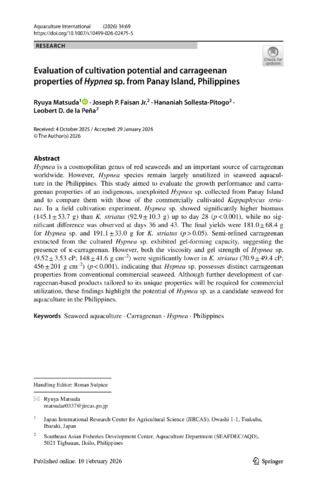
Evaluation of cultivation potential and carrageenan properties of Hypnea sp. from Panay Island, Philippines
Matsuda, Ryuya ; Faisan, Jr., Joseph ; ; (Springer, 2026-02-10)
Hypnea is a cosmopolitan genus of red seaweeds and an important source of carrageenan worldwide. However, Hypnea species remain largely unutilized in seaweed aquaculture in the Philippines. This study aimed to evaluate the growth performance and carrageenan properties of an indigenous, unexploited Hypnea sp. collected from Panay Island and to compare them with those of the commercially cultivated Kappaphycus striatus. In a field cultivation experiment, Hypnea sp. showed significantly higher biomass (145.1 ± 53.7 g) than K. striatus (92.9 ± 10.3 g) up to day 28 (p < 0.001), while no significant difference was observed at days 36 and 43. The final yields were 181.0 ± 68.4 g for Hypnea sp. and 191.1 ± 33.0 g for K. striatus (p > 0.05). Semi-refined carrageenan extracted from the cultured Hypnea sp. exhibited gel-forming capacity, suggesting the presence of κ-carrageenan. However, both the viscosity and gel strength of Hypnea sp. (9.52 ± 3.53 cP; 148 ± 41.6 g cm⁻2) were significantly lower in K. striatus (70.9 ± 49.4 cP; 456 ± 201 g cm⁻2) (p < 0.001), indicating that Hypnea sp. possesses distinct carrageenan properties from conventional commercial seaweed. Although further development of carrageenan-based products tailored to its unique properties will be required for commercial utilization, these findings highlight the potential of Hypnea sp. as a candidate seaweed for aquaculture in the Philippines.
; Faisan, Jr., Joseph ; ; (Springer, 2026-02-10)
Hypnea is a cosmopolitan genus of red seaweeds and an important source of carrageenan worldwide. However, Hypnea species remain largely unutilized in seaweed aquaculture in the Philippines. This study aimed to evaluate the growth performance and carrageenan properties of an indigenous, unexploited Hypnea sp. collected from Panay Island and to compare them with those of the commercially cultivated Kappaphycus striatus. In a field cultivation experiment, Hypnea sp. showed significantly higher biomass (145.1 ± 53.7 g) than K. striatus (92.9 ± 10.3 g) up to day 28 (p < 0.001), while no significant difference was observed at days 36 and 43. The final yields were 181.0 ± 68.4 g for Hypnea sp. and 191.1 ± 33.0 g for K. striatus (p > 0.05). Semi-refined carrageenan extracted from the cultured Hypnea sp. exhibited gel-forming capacity, suggesting the presence of κ-carrageenan. However, both the viscosity and gel strength of Hypnea sp. (9.52 ± 3.53 cP; 148 ± 41.6 g cm⁻2) were significantly lower in K. striatus (70.9 ± 49.4 cP; 456 ± 201 g cm⁻2) (p < 0.001), indicating that Hypnea sp. possesses distinct carrageenan properties from conventional commercial seaweed. Although further development of carrageenan-based products tailored to its unique properties will be required for commercial utilization, these findings highlight the potential of Hypnea sp. as a candidate seaweed for aquaculture in the Philippines. -
Growing the reproductive cells (carpospores) of the seaweed, Kappaphycus striatum, in the laboratory until outplanting in the field and maturation to tetrasporophyte
(Springer Verlag, 2010)Carposporophytes of the seaweed, Kappaphycus striatum, from the wild were made to shed spores in the laboratory and grown in multi-step culture method until they reached maturity. For each succeeding transfer onto increasingly bigger culture vessels, there was a marked increase in the growth of carposporelings. When plantlets were ready for outdoor culture, they were placed in aquaria and concrete tanks and later moved to the sea in net cage and long-line for grow-out culture. Successfully growing sporelings from carposporophytes in the laboratory until they reach market size seems to depend on the stage of sporelings and environmental factors such as photoperiod and temperature. In this study, carpospore progenies (diploids) also matured into tetrasporophytes and haploid progenies showed resistance to higher temperature. -
Culture technologies for some economically important seaweeds
(Aquaculture Department, Southeast Asian Fisheries Development Center, 2000)