SEAFDEC/AQD Institutional Repository: Recent submissions
Now showing items 3641-3660 of 4221
-
Selective breeding program for genetic improvement of Macrobrachium rosenbergii in Thailand.
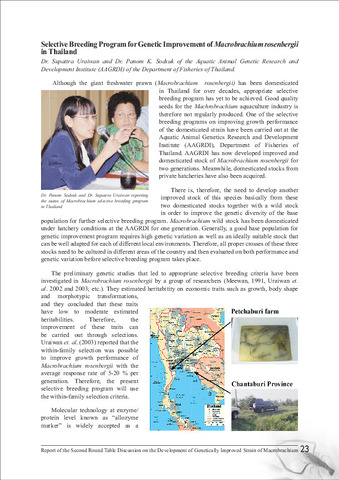
(Aquaculture Department, Southeast Asian Fisheries Development Center, 2005)Although the giant freshwater prawn (Macrobrachium rosenbergii) has been domesticated in Thailand for over decades, appropriate selective breeding program has yet to be achieved. Good quality seeds for the Machrobrachium aquaculture industry is therefore not regularly produced. One of the selective breeding programs on improving growth performance of the domesticated strain have been carried out at the Aquatic Animal Genetics Research and Development Institute (AAGRDI), Department of Fisheries of Thailand. AAGRDI has now developed improved and domesticated stock of Macrobrachium rosenbergii for two generations. Meanwhile, domesticated stocks from private hatcheries have also been acquired. There is, therefore, the need to develop another improved stock of this species basically from these two domesticated stocks together with a wild stock in order to improve the genetic diversity of the base population for further selective breeding program. Macrobrachium wild stock has been domesticated under hatchery conditions at the AAGRDI for one generation. Generally, a good base population for genetic improvement program requires high genetic variation as well as an ideally suitable stock that can be well adapted for each of different local environments. Therefore, all proper crosses of these three stocks need to be cultured in different areas of the country and then evaluated on both performance and genetic variation before selective breeding program takes place. -
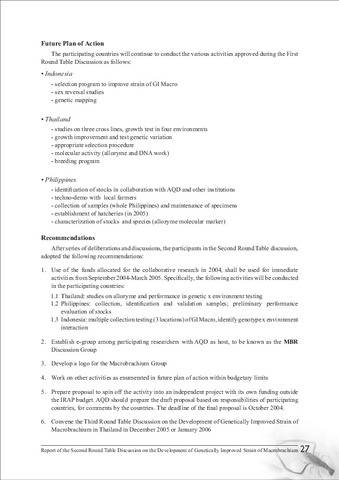
Future plan of action and recommendations
(Aquaculture Department, Southeast Asian Fisheries Development Center, 2005) -
Discussion and field trip
(Aquaculture Department, Southeast Asian Fisheries Development Center, 2005) -
Freshwater prawn program of BFAR
(Aquaculture Department, Southeast Asian Fisheries Development Center, 2005)The giant freshwater prawn (Macrobrachium rosenbengii) is one of the indigenous prawns found in many parts of the country. Locally known as ulang, it is a hardy species that is easily farmed. On the average, farmed ulang weighs from 30 to 100 grams, which translates to 10 to 25 pieces per kilo. This is very much comparable to the medium to large or jumbo sizes of brackishwater tiger shrimps or sugpo. In the wild, ulang grow as much as 500 g and sells at 300 to 350 pesos/kg ($1=P55.50), however, the quantity harvested is limited and is dependent on its seasonality. Despite the development of both hatchery and grow-out technologies for ulang, there is really no significant commercial production in the country yet, except in BFAR-operated hatcheries in Muñoz and in Dagupan. To date, the only private ulang hatchery is MBL Farms producing up to 150,000 PL or post-larvae per run (45 days), although there are entrepreneurs trained in Muñoz who are also operating small backyard hatcheries for prawns. With the emerging global market on this giant freshwater prawn coupled with improved technologies, it is but imperative to speed up the development of the industry in the country. However, the industry is faced with problems and constraints that include: • insufficient breeders • insufficient supply of post-larvae or PL for stocking • limited market supply • limited funds for interested stakeholders • insufficient information • inadequate promotion of technology transfer • very few skilled and/or trained technicians • research and development of ulang hatchery and grow-out are still wanting new technologies -
Hatchery and pond culture of Macrobrachium rosenbergii in Northern Mindanao
(Aquaculture Department, Southeast Asian Fisheries Development Center, 2005) -
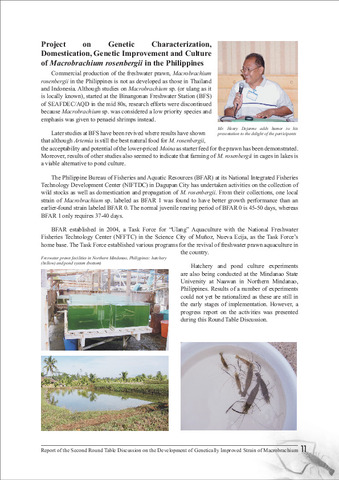
Project on genetic characterization, domestication, genetic improvement and culture of Macrobrachium rosenbergii in the Philippines.
(Aquaculture Department, Southeast Asian Fisheries Development Center, 2005) -
Collection of wild stocks, domestication and propagation of Macrobrachium rosenbergii
(Aquaculture Department, Southeast Asian Fisheries Development Center, 2005)There is an expanding interest in the culture of freshwater prawn in the Philippines. This is attributed to the extensive campaign of the government, the Bureau of Fisheries and Aquatic Resources (BFAR) and some private entrepreneurs to disseminate information and seeds of the prawn nationwide. Although freshwater aquaculture in the Philippines is still dominated by tilapia, which is an exotic fish, the profit from tilapia culture is not well appreciated except for family consumption or nutrition purposes. The freshwater prawn, an indigenous species, remains to be an important species. With freshwater prawn as an alternative species, farmers can diversify and derive higher profit from their ponds. In the Philippines, Macrobrachium rosenbergii stocked in 2,000 m2 ponds may grow to about 45 g after four months and 90 to 100 g in seven months of culture (Rosario, 2002). The price of the species is five times higher than tilapia. During the first Round Table Discussion on the Development of Genetically Improved Strain of Macrobrachium held at the Freshwater Aquaculture Development Center, Sukabumi, West Java, Indonesia in November 2003, the delegates from Thailand reported that the Philippine wild stocks of Macrobrachium, M. rosenbergii rosenbergii Philippine strain could be a better variety and therefore must be protected from contamination by non-indigenous strains. The report supports and confirms the importance of the activity of the National Integrated Fisheries and Development Center (NIFTDC) to collect live specimens of various strains of Macrobrachium in the country and review their performance in terms of growth and fecundity. -
The freshwater prawn research at SEAFDEC/AQD.
Eguia, Maria Rowena (Aquaculture Department, Southeast Asian Fisheries Development Center, 2005)
Research and commercial production of the freshwater prawn, Macrobrachium sp., in the Philippines are yet not well-developed. Although studies on Macrobrachium sp. (or ulang as it is locally known), started at the Binangonan Freshwater Station (BFS) of SEAFDEC/AQD in the mid-1980s, research efforts were discontinued soon thereafter because of: (a) inadequate technical skills; (b) problems with larval rearing and the domestication of wild stocks; and (c) the Macrobrachium sp. is being considered in the Philippines as a low priority species in contrast to commercially important freshwater commodities like tilapia and milkfish. That was two decades ago and in retrospect, researches continued and the freshwater prawn in the Philippines could have been successfully domesticated and current problems concerning the limited aquaculture production of genetically depauperate non-indigenous stocks could have been resolved. With the renewed interest in the culture of alternative species like the freshwater prawn, researchers at the Binangonan Freshwater Station (BFS) started to conduct some studies on the refinement of breeding, larval rearing and culture of Macrobrachium rosenbergii since 2003.
(Aquaculture Department, Southeast Asian Fisheries Development Center, 2005)
Research and commercial production of the freshwater prawn, Macrobrachium sp., in the Philippines are yet not well-developed. Although studies on Macrobrachium sp. (or ulang as it is locally known), started at the Binangonan Freshwater Station (BFS) of SEAFDEC/AQD in the mid-1980s, research efforts were discontinued soon thereafter because of: (a) inadequate technical skills; (b) problems with larval rearing and the domestication of wild stocks; and (c) the Macrobrachium sp. is being considered in the Philippines as a low priority species in contrast to commercially important freshwater commodities like tilapia and milkfish. That was two decades ago and in retrospect, researches continued and the freshwater prawn in the Philippines could have been successfully domesticated and current problems concerning the limited aquaculture production of genetically depauperate non-indigenous stocks could have been resolved. With the renewed interest in the culture of alternative species like the freshwater prawn, researchers at the Binangonan Freshwater Station (BFS) started to conduct some studies on the refinement of breeding, larval rearing and culture of Macrobrachium rosenbergii since 2003. -
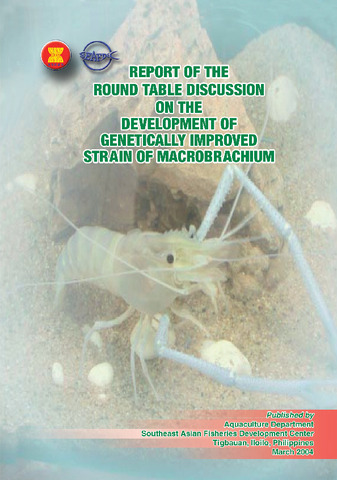
Report of the round table discussion
(Aquaculture Department, Southeast Asian Fisheries Development Center, 2005) -
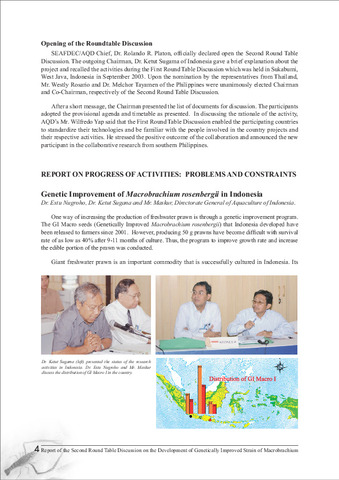
Genetic improvement of Macrobrachium rosenbergii in Indonesia.
(Aquaculture Department, Southeast Asian Fisheries Development Center, 2005)One way of increasing the production of freshwater prawn is through a genetic improvement program. The GI Macro seeds (Genetically Improved Macrobrachium rosenbergii) that Indonesia developed have been released to farmers since 2001. However, producing 50 g prawns have become difficult with survival rate of as low as 40% after 9-11 months of culture. Thus, the program to improve growth rate and increase the edible portion of the prawn was conducted. Giant freshwater prawn is an important commodity that is successfully cultured in Indonesia. Its culture has been developed in several areas of West Java, i.e., Ciamis (Tambaksari, Pamarican and Kalipucang) and Tasikmalaya. The Indonesian Government has developed a hatchery in Jogjakarta province (Central Java), while the private sector control about seven hatcheries. In East Java, freshwater prawn is cultured in brackishwater ponds. Freshwater prawn culture has also spread to some areas of Bali Island, e.g., in Gianyar, Klungkung, Buleleng and Tabanan. Indonesia has been recognized as the center of origin of the giant freshwater prawn because about 19 identified species are found in almost all islands of the country (Holthuis, 1980). However, this genetic resource is not yet fully used in freshwater prawn culture. Although freshwater prawn culture has been widely developed in Indonesia, some problems have been encountered, e.g., declining growth rate, disease, and the small edible portion (abdominal muscle). In recent years, the Government of Indonesia has stressed the need to increase the production of freshwater prawn. One way to increase production is through the genetic improvement program. In 2001, the GI Macro (Genetically Improved Macrobrachium rosenbergii), strain of freshwater prawn has been developed and released to farmers. -
Preliminary pages
(Aquaculture Department, Southeast Asian Fisheries Development Center, 2005) -
Research project proposals
(Aquaculture Department, Southeast Asian Fisheries Development Center, 2004) -
Participants in the Round Table Discussion
(Aquaculture Department, Southeast Asian Fisheries Development Center, 2004) -
Preliminary pages
(Aquaculture Department, Southeast Asian Fisheries Development Center, 2004) -
Report of the round table discussion
(Aquaculture Department, Southeast Asian Fisheries Development Center, 2004) -
Characterization of a virus obtained from snakeheads Ophicephalus striatus with epizootic ulcerative syndrome (EUS) in the Philippines
(Inter Research, 2000)This is the first report of the isolation and characterization of a fish virus from the Philippines. The virus was isolated using snakehead spleen cells (SHS) from severely lesioned epizootic ulcerative syndrome (EUS)-affected snakehead Ophicephalus striatus from Laguna de Bay, in January 1991. The virus induced cytopathic effects (CPE) in SHS cells yielding a titer of 3.02 x 10⁶ TCID50 ml-1 at 25°C within 2 to 3 d. Other susceptible cell lines included bluegill fry (BF-2), catfish spleen (CFS) and channel catfish ovary (CCO) cells. Replication in chinook salmon embryo cells (CHSE-214) was minimal while Epithelioma papulosum cyprini cells (EPC) and rainbow trout gonad cells (RTG 2) were refractory. Temperatures of 15 to 25°C were optimum for virus replication but the virus did not replicate at 37°C. The virus can be stored at -10 and 8°C for 30 and 10 d, respectively, without significant loss of infectivity. Viral replication was logarithmic with a 2 h lag phase; viral assembly in the host cells occurred in 4 h and release of virus occurred 8 h after viral infection. A 1-log difference in TCID50 titer between the cell-free virus and the total virus was noted. Freezing and thawing the virus caused a half-log drop in titer. Viral exposure to chloroform or heating to 56°C for 30 min inactivated the virus. Exposure to pH 3 medium for 30 min resulted in a more than 100 fold loss of viral infectivity. The 5-iododeoxyuridine (IUdR) did not affect virus replication, indicating a RNA genome. Neutralization tests using the Philippine virus, the ulcerative disease rhabdovirus (UDRV) and the infectious hematopoietic necrosis virus (IHNV) polyvalent antisera showed slight cross-reaction between the Philippine virus antiserum and UDRV but established no serological relationship with SHRV and IHN virus. Transmission electron microscopy (TEM) of SHS cells infected with the virus showed virus particles with typical bullet morphology and an estimated size of 65 x 175 nm. The Philippine virus was therefore a rhabdovirus, but the present study did not establish its role in the epizootiology of EUS. -
Horizontal transmission of epizootic ulcerative syndrome (EUS)-associated virus in the snakehead Ophicephalus striatus under simulated natural conditions
(Inter Research, 2003)Natural transmission of the epizootic ulcerative syndrome (EUS) was conducted on naïve snakeheads Ophicephalus striatus (also known as Channa striata) kept (A) in aquifer water, (B) in lakewater, (C) cohabiting with EUS snakeheads in lakewater, and (D) cohabiting with apparently healthy snakeheads in lakewater during the 1994 to 1995 EUS season. The results showed that EUS-like lesions developed in 6 to 14 d among naïve snakeheads cohabiting with EUS snakeheads and with apparently healthy snakeheads in lakewater (Treatments C and D). Among naïve fish exposed to lakewater (Treatment B), similar lesions developed in 16 to 21 d, while naïve fish in aquifer water (Treatment A) did not develop EUS-like lesions. EUS signs began as Grade I (slight) lesions that gradually progressed to Grades III-IV (severe) 3 to 5 d from lesion onset, similar to the naturally affected EUS fish. The virus was recovered from some but not all naturally EUS-affected snakeheads, snakeheads with healing lesions and apparently healthy snakeheads, but not from naïve snakeheads. The results provide evidence of a waterborne horizontal transmission of the EUS-associated virus. This is the first report of a successful horizontal transmission of the EUSassociated virus from apparently healthy snakeheads to naïve fish under natural conditions and of virus recovery in tissue culture from naturally exposed experimental fish. -
Occurrence, histopathology and experimental transmission of hepatopancreatic parvovirus infection in Penaeus monodon postlarvae
(Inter-Research, 2003)Hepatopancreatic parvovirus (HPV) was detected in samples of Penaeus monodon postlarvae (PL-13, PL-18, PL-19, PL-26) from 2 hatcheries in 2 provinces (Samar and Iloilo) in the Philippines. The percentage of infection was 20 to 100% in postlarvae obtained from the hatchery in Samar in August 2001. Postlarvae from the hatchery in Iloilo, sampled in October and November 2001, had 70 to 99% HPV infection. Wet mounts of squashed hepatopancreatic tissue stained with malachite green (wet-mount technique) and histopathology revealed the presence of large, usually single, basophilic intranuclear inclusion bodies in the distal tubules, which led to displacement of the nucleoli. Light microscopy showed ovoid to spherical inclusion bodies, 5 to 11 µm in diameter. Transmission electron microscopy revealed that the inclusion bodies were composed of electron-dense granular material and virions. The virions appeared roughly spherical and averaged 18 to 22 nm in diameter. An experiment was undertaken to induce HPV infection by feeding P. monodon postlarvae with virus-infected postlarvae. P. monodon postlarvae (PL-16), initially determined as free from HPV, were found HPV-positive 24 h after being fed with infected material. The percentage of infection ranged from 30% at Day 1 post-infection (p.i.) to 100% at Day 7 p.i. determined by the wet-mount technique and by histopathology. This is the first report of a successful horizontal transmission of HPV in P. monodon postlarvae. -
Series: Aquaculture extension manual; No. 11 | NACA training manual series; No. 3
Biology and culture of sea bass (Lates calcarifer)
(Network of Aquaculture Centres in Asia, 1986)Information is presented regarding the biology and culture of Lates calcarifer in order to serve as a practical guide for extension workers and farmers. Hatchery design, seed production and hatchery techniques, culture of seabass and financial aspects of the seabass culture industry are described. -
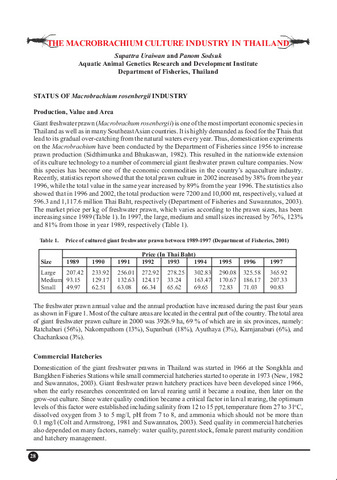
The macrobrachium culture industry in Thailand.
(Aquaculture Department, Southeast Asian Fisheries Development Center, 2004)Giant freshwater prawn (Macrobrachum rosenbergii) is one of the most important economic species in Thailand as well as in many Southeast Asian countries. It is highly demanded as food for the Thais that lead to its gradual over-catching from the natural waters every year. Thus, domestication experiments on the Macrobrachium have been conducted by the Department of Fisheries since 1956 to increase prawn production (Sidthimunka and Bhukaswan, 1982). This resulted in the nationwide extension of its culture technology to a number of commercial giant freshwater prawn culture companies. Now this species has become one of the economic commodities in the country’s aquaculture industry. Recently, statistics report showed that the total prawn culture in 2002 increased by 38% from the year 1996, while the total value in the same year increased by 89% from the year 1996. The statistics also showed that in 1996 and 2002, the total production were 7200 and 10,000 mt, respectively, valued at 596.3 and 1,117.6 million Thai Baht, respectively (Department of Fisheries and Suwannatos, 2003). The market price per kg of freshwater prawn, which varies according to the prawn sizes, has been increasing since 1989. In 1997, the large, medium and small sizes increased by 76%, 123% and 81% from those in year 1989, respectively.