SEAFDEC/AQD Institutional Repository: Recent submissions
2021-2040 / 4221
-
Occurrence of milkfish, Chanos chanos (Forsskal) eggs around Panay Island, Philippines
(Aquaculture Department, Southeast Asian Fisheries Development Center, 1979) -
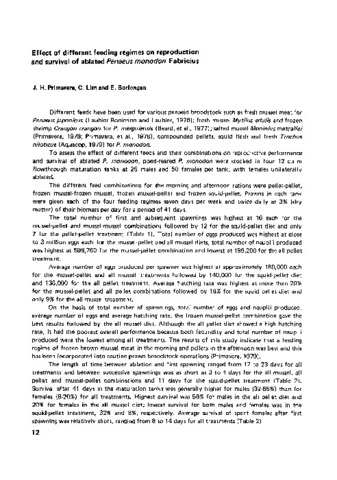
Effect of different sex ratios of ablated wild-stock Penaeus monodon Fabricius on maturation, fecundity and hatching rates
; Primavera, Jurgenne (Aquaculture Department, Southeast Asian Fisheries Development Center, 1979)
-
Acute toxicity of unionized ammonia to milkfish (Chanos chanos Forsskal) fry
(Aquaculture Department, Southeast Asian Fisheries Development Center, 1979) -
Transport of sugpo, Penaeus monodon juveniles
(Aquaculture Department, Southeast Asian Fisheries Development Center, 1979) -
Larval and postlarval development of the window-pane shell, Placuna placenta L. (Bivalvia: Placunidae)
(Aquaculture Department, Southeast Asian Fisheries Development Center, 1979)Stages of development of P. placenta from the straight-hinge veliger to the adult are described. Mature larvae metamorphose at lengths from 220-230 m. Larvae probably attach byssally to the water surface at metamorphosis and remain in the plankton for some time before finally settling on the mud bottom. -
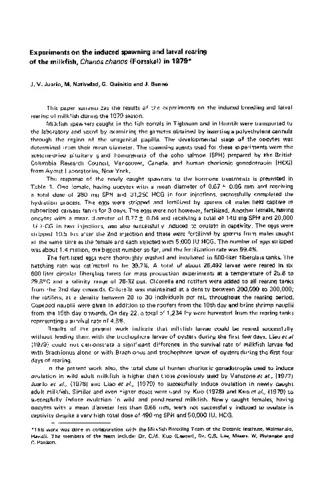
Experiments on the induced spawning and larval rearing of the milkfish, Chanos chanos (Forsskal) in 1979
(Aquaculture Department, Southeast Asian Fisheries Development Center, 1979)This paper summarizes the results of the experiments on the induced breeding and larval rearing of milkfish during the 1979 season. -
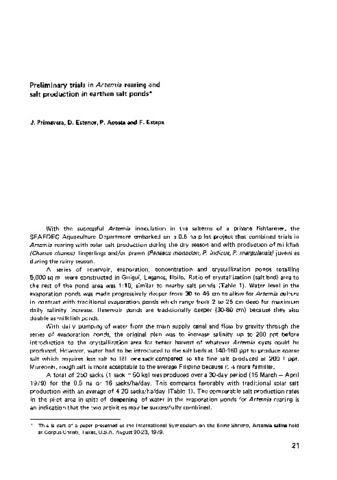
Preliminary trials in Artemia rearing and salt production in earthen salt ponds
(Aquaculture Department, Southeast Asian Fisheries Development Center, 1979)The authors report on the production of Artemia obtained on a 0.5 ha pilot project with combined trials in Artemia rearing with solar salt production during the dry seasons and with production of milkfish (Chanos chanos) fingerlings and/or prawn (Penaeid sp.) juveniles during the rainy season in the Philippines. -
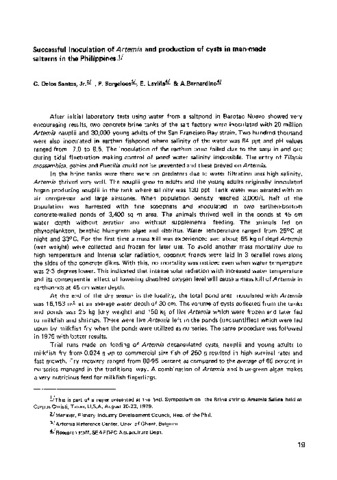
Successful inoculation of Artemia and production of cysts in man-made salterns in the Philippines
(Aquaculture Department, Southeast Asian Fisheries Development Center, 1979)The authors report on inoculation experiments of Artemia nauplii and young adults of the San Francisco Bay strains in earthen fish ponds. The test inoculated proved successful where water salinity ranges from 20 to 32 ‰ during the start of the rainy season in the Philippines. -
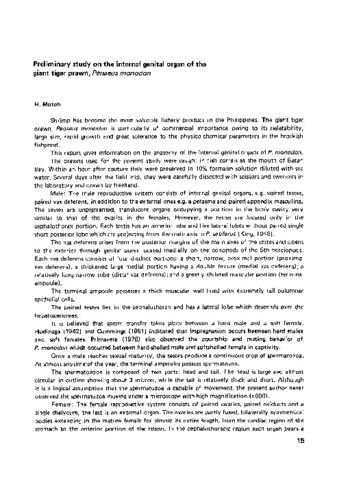
Preliminary study on the internal genital organ of the giant tiger prawn, Penaeus monodon
(Aquaculture Department, Southeast Asian Fisheries Development Center, 1979)This report gives information on the anatomy of the internal genital organs of male and female Penaeus monodon. -
Effect of different feeding regimes on reproduction and survival of ablated Penaeus monodon Fabricius
(Aquaculture Department, Southeast Asian Fisheries Development Center, 1979)Results of experiments conducted on ablated Penaeus monodon, fed with 4 different feeds (pellet-pellet, mussel-mussel, mussel-pellet and squid-pellet), on survival, spawning, fecundity and hatching rate are given and discussed. -
Mass production of Penaeus monodon Fabricius juveniles in earthen nursery ponds
(Aquaculture Department, Southeast Asian Fisheries Development Center, 1979)Different culture techniques were tried for rearing larvae of Penaeus monodon , in order to obtain preliminary data on stocking density, water management, fertilization versus feeding and effect of different types of vertical substrate. The results of the experiments showed that: (1) older fry have greater chances of survival; (2) the traditional nursery pond designs and practices used for milkfish in the Philippines are applicable to prawn only at very low densities and give acceptable high survival rates only when used with the older postlarval stage. -
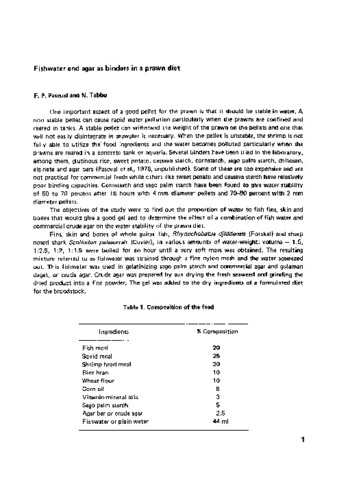
Fishwater and agar as binders in a prawn diet
(Aquaculture Department, Southeast Asian Fisheries Development Center, 1979)The objectives of the study were to find out the proportion of water to fish fins, skin and bones that would give a good gel and to determine the effect of a combination of fish water and commercial crude agar on the water stability of the prawn diet. Under the conditions of the experiments it was concluded: (1) Fish water and commercial agar or agar bar gave the most stable pellet, 65% water stability; (2) a strong gel is obtained when one part shark fin is boiled in 1.5 parts water; (3) more fish water can be obtained from guitar fish than from shark fish. -
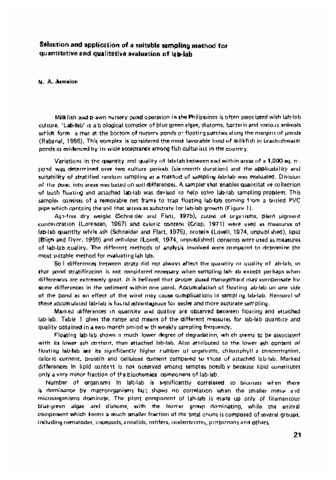
Selection and application of a suitable sampling method for quantitative and qualitative evaluation of lab-lab
(Aquaculture Department, Southeast Asian Fisheries Development Center, 1978)Milkfish and prawn pond operation in the Philippines is often associated with lab-lab culture. Lab-lab is a biological complex of blue-green algae, diatoms, bacteria and various animals which form a mat at the bottom of nursery ponds or floating patches along the margins of ponds. This complex is considered the most favorable food of milkfish in brackishwater ponds. Variations in the quantity and quality of lab-lab between and within areas of a 1,000 sq. m. pond was determined over 2 culture periods (6 month duration) and the applicability and suitability of stratified random sampling as a method of sampling lab-lab was evaluated. -
Effect of feeding rate on the survival and growth of milkfish (Chanos chanos) fry in a controlled environment
(Aquaculture Department, Southeast Asian Fisheries Development Center, 1978)The optimum daily feed allowance varies with species, age, size, frequency of feeding, culture procedures, quality of feed and water quality. This experiment indicated that with a diet containing 40% protein and 3,450 kcal of M.E. per kg, a feeding rate of 16-20% of the biomass is optimum for satisfactory survival and growth of fry raised in a controlled environment. Increasing the feeding level beyond this value was not beneficial but in turn increased the ammonia-nitrogen concentration to a level which is harmful to the fish. -
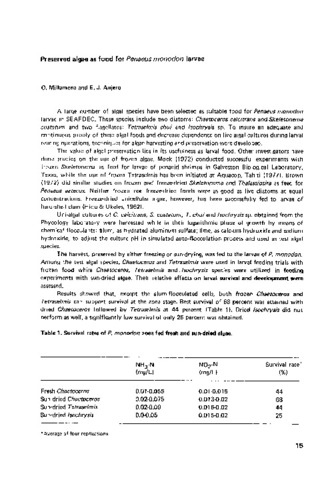
Preserved algae as food for Penaeus monodon larvae
(Aquaculture Department, Southeast Asian Fisheries Development Center, 1978)Uni-algal cultures of C. calcitrans, S. costatum, T. chui and Isochrysis sp. obtained from the laboratory were harvested. The harvest, preserved by either freezing or sun-drying, was fed to the larvae of P. monodon . Among the test algal species, Chaetoceros and Tetraselmis were used in larval feeding trials with frozen food while Chaetoceros, Tetraselmis and Isochrysis species were utilized in feeding experiments with sun-dried algae. Their relative effects on larval survival and development were assessed. Results showed that, except the alum-flocculated cells, both frozen Chaetoceros and Tetraselmis can support survival at the zoea stage. Best survival of 68% was atained with dried Chaetoceros followed by Tetraselmis at 44%. Dried Isochrysis did not perform as well, a significantly low survival of only 25% was obtained. -
The use of decapsulated brine shrimp eggs as food for shrimp larvae
(Aquaculture Department, Southeast Asian Fisheries Development Center, 1978)Decapsulated cysts of Artemia salina were experimentally fed to the larvae of Penaeus monodon, Metapenaeus ensis, M. endeavouri and Macrobrachium rosenbergii and were found to be comparable to freshly hatched brine shrimp nauplii. -
Minimum dissolved oxygen tolerance of four different sizes of milkfish
(Aquaculture Department, Southeast Asian Fisheries Development Center, 1978)Four size groups of milkfish were tested, 4-18 g, 20-34 g, 35-95 g and 200-300 g. A number of fish from each group were placed separately in identical 1.2 m2 wooden tanks containing seawater filled up to 30 cm depth. The aggregate weight of fish per size group was approximately 1 kg. The fish were held for 72 h, fed with lab-lab and provided with continuous aeration to allow recovery from stress during transport and handling. After the recovery period, aeration was stopped and 200 g of the fine rice bran was spread over the water in each tank creating a film of bran particles on the water surface. This was designed to speed up depletion of dissolved oxygen considering the combined effects of the screening-off of sunlight, the reduction of air-water interface and the breakdown of the bran particles. It is probable that stress on milkfish in brackishwater ponds could start when oxygen level drops to about 1.4 ppm. A further decrease to 0.04 ppm could produce a total kill of all specimens above 4 grams with marketable size and bigger size fish dying first. -
Preliminary histological study of the ovarian development of the giant tiger prawn, Penaeus monodon
(Aquaculture Department, Southeast Asian Fisheries Development Center, 1978)This study was undertaken to determine structural characteristics within the gonads which might serve as an index to age and longevity and furnish information on the frequency of spawning of an individual. -
Experiments on the induced breeding of milkfish, Chanos chanos (Forsskal) in 1978
(Aquaculture Department, Southeast Asian Fisheries Development Center, 1978)Results indicated that a female having eggs with an average diameter of < 0.7 mm did not respond well to the hormone injections. -
A preliminary study on the growth and survival of stunted and non-stunted milkfish fingerlings
(Aquaculture Department, Southeast Asian Fisheries Development Center, 1978)A study was conducted comparing the growth of stunted and non-stunted milkfish.