SEAFDEC/AQD Institutional Repository: Recent submissions
Now showing items 2041-2060 of 4221
-
Experiment on larval rearing of Penaeus monodon fed with cultured diatom Chaetoceros calcitran and fermented vegetable trash
(Aquaculture Department, Southeast Asian Fisheries Development Center, 1978)A brief account is given of experiments undertaken rearing Penaeus monodon larvae fed on diatom (Chaetoceros calcitran) and fermented vegetable trash, which included fruits and their peels, vegetables and rice. The possible use of high protein content trash materials as a feed substitute is examined briefly. -
Notes on the pigmentation pattern in the larval developmental stages of laboratory-reared milkfish
(Aquaculture Department, Southeast Asian Fisheries Development Center, 1978)Milkfish fry were artificially bred and reared in the laboratory and the pigmentation pattern of the different developmental stages of the larvae are described in detail, with illustrations. -
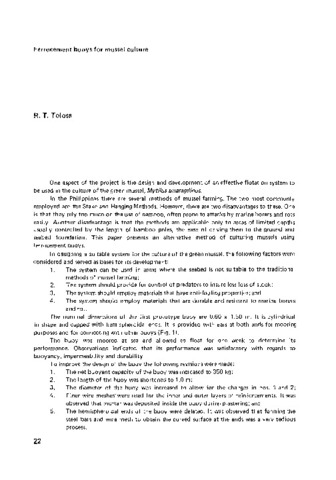
Ferrocement buoys for mussel culture
(Aquaculture Department, Southeast Asian Fisheries Development Center, 1978)A method is described for culturing mussels (Mytilus smaragdinus) using ferro-cement buoys, which may be used in the construction of a raft house or a flotation system for nets and cages. -
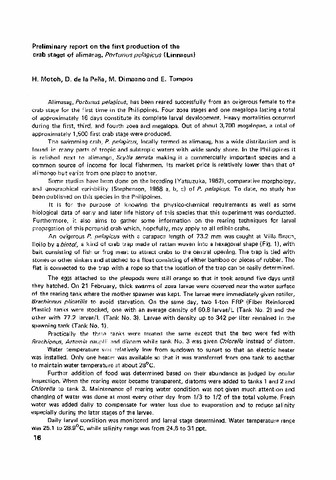
Preliminary report on the first production of the crab stages of alimasag, Portunus pelagicus (Linnaeus)
(Aquaculture Department, Southeast Asian Fisheries Development Center, 1978)An experiment was undertaken studying the early life history of Portunus pelagicus in order to obtain information of relevance to rearing techniques for crabs. -
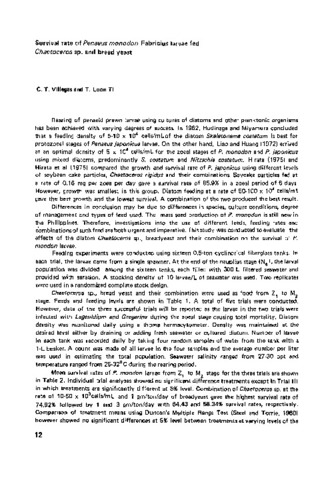
Survival rate of Penaeus monodon Fabricius larvae fed Chaetoceros sp. and bread yeast
(Aquaculture Department, Southeast Asian Fisheries Development Center, 1978)An evaluation was made of the effects of Chaetoceros species, bread yeast and their combination on the survival of Penaeus monodon larvae. In general it was found that feeding with a combination of the 2 resulted in higher larval survival rates. -
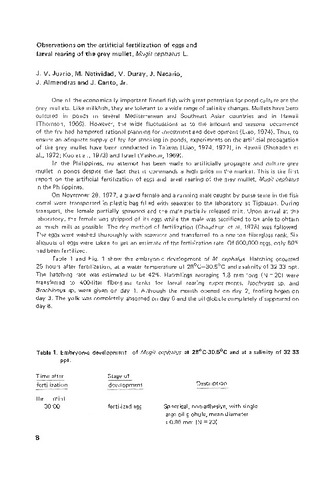
Observations on the artificial fertilization of eggs and larval rearing of the grey mullet, Mugil cephalus L.
(Aquaculture Department, Southeast Asian Fisheries Development Center, 1978)The results are presented of attempts to artificially fertilize Mugil cephalus eggs in the Philippines. Embryonic development is outlined and rearing of the larvae described. Mass mortality occurred during week 3 of rearing. -
Toxicity of malachite green to the larvae of Penaeus monodon Fabricius
(Aquaculture Department, Southeast Asian Fisheries Development Center, 1978)A study was undertaken examining the effect of malachite green on the development and survival of the zoeae, mysis and post-larvae of Penaeus monodon. Sensitivity varied with the different larval stages; the zoeae appeared to be the least tolerant. The prophylactic potentials of malachite green in the control of Lagenidiumand Zoothamnium infesting P. monodon larvae are considered briefly. Toxicity risks may be reduced by application between ecdyses or by the removal of the dye by filtration through activated carbon. -
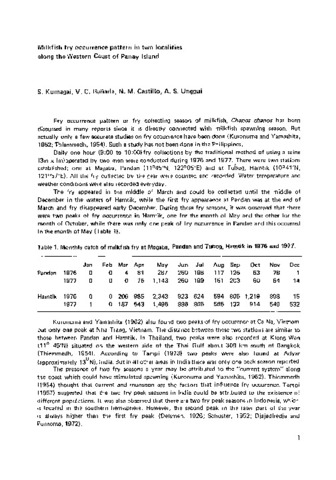
Milkfish fry occurrence pattern in two localities along the Western Coast of Panay Island
(Aquaculture Department, Southeast Asian Fisheries Development Center, 1978)The results are presented of a study of milkfish fry occurrence in the Philippines, namely at Magaba and at Tubog. There were 2 peaks of fry occurrence in the latter, one in May and another in October, whereas only one peak occurred in the former in May. The possible influence on light intensity on the fry seasons is examined. -
Embryonic and larval development of hatchery-reared silver therapon Leiopotherapon plumbeus (Perciformes: Terapontidae)
Aya, Frolan ; ; Garcia, Luis Maria ; (Springer Verlag, 2016)
The embryonic and larval development of hatchery-reared silver therapon Leiopotherapon plumbeus are described to provide essential information on the early life history of this species. Egg size, larval size at hatching, yolk resorption rate, onset of feeding and development of some morphological characters were examined. Fertilized eggs (430–610 µm in diameter) were spherical, yellowish, demersal and slightly adhesive. First cleavage occurred 6 min post-fertilization and embryos hatched 21–24 h post-fertilization under ambient temperature of 27.5 ± 0.1 °C. Newly hatched larvae [1.79 ± 0.04 mm in total length (TL)] with yolk volume of 0.579 ± 0.126 mm3 had no functional or pigmented eyes, mouth or digestive tract. The eyes became fully pigmented and mouth opened [31 and 36.5 hours post-hatching (hph)] shortly before yolk resorption at 39 hph and when larvae had grown to 2.65 ± 0.14 mm in TL. Some morphological characters such as total length, pre-anal length and eye diameter decreased following yolk resorption, which also coincided with the development of foraging capacities shortly before exogenous feeding was initiated. L. plumbeus larvae initiated exogenous feeding at 54 hph, indicating a short (15 h after yolk resorption) transitional feeding period. Larval growth at the early stages of development (54–72 hph) was rapid and steadily increased from 288 to 720 hph, when larvae, 12.05 ± 4.02 mm in TL, closely resembled the external characteristics of their adult conspecifics.
; ; Garcia, Luis Maria ; (Springer Verlag, 2016)
The embryonic and larval development of hatchery-reared silver therapon Leiopotherapon plumbeus are described to provide essential information on the early life history of this species. Egg size, larval size at hatching, yolk resorption rate, onset of feeding and development of some morphological characters were examined. Fertilized eggs (430–610 µm in diameter) were spherical, yellowish, demersal and slightly adhesive. First cleavage occurred 6 min post-fertilization and embryos hatched 21–24 h post-fertilization under ambient temperature of 27.5 ± 0.1 °C. Newly hatched larvae [1.79 ± 0.04 mm in total length (TL)] with yolk volume of 0.579 ± 0.126 mm3 had no functional or pigmented eyes, mouth or digestive tract. The eyes became fully pigmented and mouth opened [31 and 36.5 hours post-hatching (hph)] shortly before yolk resorption at 39 hph and when larvae had grown to 2.65 ± 0.14 mm in TL. Some morphological characters such as total length, pre-anal length and eye diameter decreased following yolk resorption, which also coincided with the development of foraging capacities shortly before exogenous feeding was initiated. L. plumbeus larvae initiated exogenous feeding at 54 hph, indicating a short (15 h after yolk resorption) transitional feeding period. Larval growth at the early stages of development (54–72 hph) was rapid and steadily increased from 288 to 720 hph, when larvae, 12.05 ± 4.02 mm in TL, closely resembled the external characteristics of their adult conspecifics. -
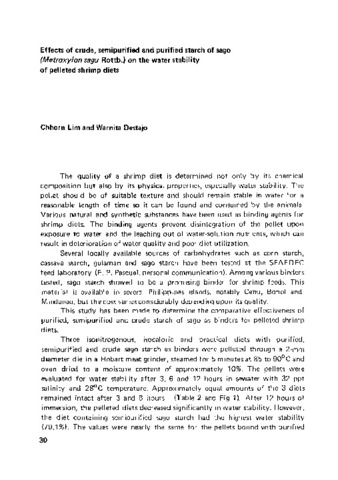
Effects of crude, semipurified and purified starch of sago (Metroxylon sagu Rottb.) on the water stability of pelleted shrimp diets
(Aquaculture Department, Southeast Asian Fisheries Development Center, 1978)A study was conducted to determine the comparative effectiveness of purified, semipurified and crude starch of sago as binders for pelleted shrimp diets. The diet containing semipurified sago starch had the highest water stability (79.1%). The values were nearly the same for the pellets bound with purified and crude sago starch. Reasons for the low binding capacity of purified and crude sago could be that the gel of purified sago is weakened due to purification, and that of the crude sago is due to the spongy material present in the product. Thus, semipurified sago starch is a better source of binder and purified crude sago. From the economic viewpoint, the cost of purified sago is prohibitive for use as binder. Both semipurified and crude sago palm starch are acceptable. Composition of shrimp diets containing various sources of sago palm starch, and binder cost and water stability of shrimp diets containing various sources of sago palm starch tested at 3, 6 and 12 hours, are tabulated. -
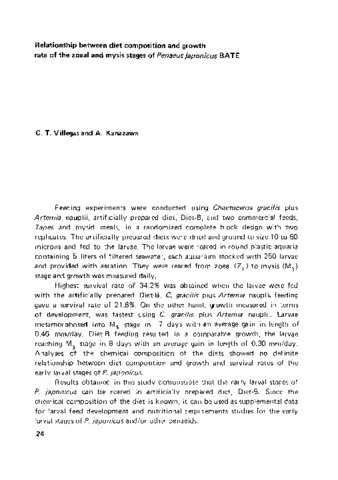
Relationship between diet composition and growth rate of the zoeal and mysis stages of Penaeus japonicus Bate
(Aquaculture Department, Southeast Asian Fisheries Development Center, 1978)Diets containing Chaetoceros gracilis plus Artemia nauplii artificially prepared diet, Diet-B, and two commercial feeds Tapes and mysid meals, were fed to larvae of P. japonicus. Highest survival rate was obtained when larvae were fed with Diet-B. The results show that the early larval stages of P. japonicus can be reared on artificially prepared diets. Since the chemical composition of the diet is known, it can be used as supplemental data for larval feeding development and nutritional requirement studies for the early larval stages of Penaeus japonicus and/or other penaeids. Information is tabulated on feeds and feeding rates used, composition of the artificial diet, fatty acid composition of lipids of the different diets, and of the sterols of the different diets. -
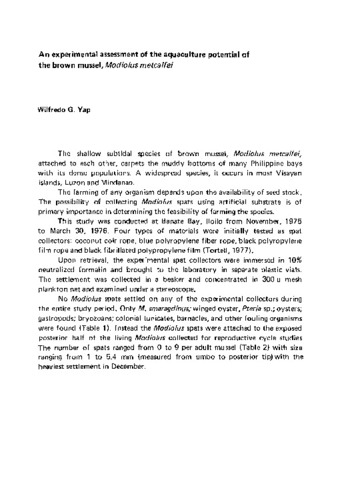
An experimental assessment of the aquaculture potential of the brown mussel, Modiolus metcalfei
(Aquaculture Department, Southeast Asian Fisheries Development Center, 1978)A study was conducted at Banate Bay, Iloilo, from November 1975 to March 1976. Trials were conducted using spat collectors of four types, but no Modiolus metcalfei spat settled on any of the experimental collectors during the entire study period. Instead they attached to the exposed posterior half of the living Modiolus collected for reproductive cycle studies. The aquaculture potential of the brown mussel is considered to be low. Improvement of its production potential should be approached along the line of resource management rather than aquaculture. This management should be aimed at two objectives: (1) maintenance of enough adults on settlement surfaces, and (2) provision of space to allow new recruitments to grow. A possible solution, therefore, is controlled harvesting or thinning after the peak in the settlement season. In this manner, the chances of the mussel bed recovering year after year may be enhanced. -
A preliminary study on the evaluation of casein, shrimp meal, squid meal and spirulina as protein sources for Penaeus monodon (Fabricius) postlarvae
(Aquaculture Department, Southeast Asian Fisheries Development Center, 1978)P. monodon postlarvae were fed with fresh brown mussel (Modiolus metcalfei) meat, and artificial diets containing casein, shrimp (Metapenaeus ensis) meal, squid (Loligo) meal, and Spirulina as protein sources at a rate of 20% of their biomass per day for a period of 10 days. No statistical difference was found among the weight gains of shrimp fed on various experimental diets. However, shrimp fed squid meal diet had highest weight gain followed by shrimp meal, fresh brown mussel meat, casein and Spirulina . Shrimp fed squid meal diet had a significantly better feed conversion and those receiving other experimental diets. Poorest fed conversion was observed in shrimp fed Spirulina. The protein efficiency ratio was statistically highest for the squid meal diet, with the lowest value again for Spirulina diets. Survival rate was significantly highest for shrimp fed the shrimp meal diet. No statistical differences were found among shrimp fed other experimental diets. Appropriate data are tabulated. -
Spawning periodicity of milkfish, Chanos chanos
(Aquaculture Department, Southeast Asian Fisheries Development Center, 1978)Daily samplings were conducted in the waters of Batbatan Island from April 17 to June 11, 1977 in order to collect milkfish (Chanos chanos ) eggs. The numbers of eggs collected is tabulated by lunar period. Milkfish fry are more abundant during the new and full moon periods, and periodicity does exist, during the first and last quarter periods. -
Courtship and mating behavior in Penaeus monodon Fabricius
Primavera, Jurgenne (Aquaculture Department, Southeast Asian Fisheries Development Center, 1978)
An illustrated description is given of the courtship and mating behaviour of P. monodon. Courtship and mating follow three distinct phases: (1) parallel swimming of male and female from the bottom to a height of 20-40 cm over distances of 50 to 80 cm; (2) male turns ventral side up to female; and (3) male turns perpendicular to female, arches body around the female and lifts head and tail. Mating is believed to take place generally at night, following moulting of the female. On the basis of thelycum structure and mating pattern, Penaeus may be divided into two groups: (1) those with a close thelycum in which mating follows moulting, such as P. merguiensis and P. monodon; and (2) those with open thelycum where mating takes place immediately preceding spawning, as in P. stylirostris and P. vannamei. -
A preliminary study on the use of the local variety of ipil-ipil Leucaena leucocephala as a protein source for prawn feed
(Aquaculture Department, Southeast Asian Fisheries Development Center, 1978)A study was carried out to determine the effect of 10 or 20% leaves or seeds in the diet of Penaeus monodon , and the extent to which local ipil-ipil (Leucaena leucocephala ) could replace head shrimp meal. A brief description is given of the experimental methodology, and details of composition of the diet, proximate chemical composition of the diets, mean weight gain and survival of Penaeus monodon larvae fed shrimp head meal and ipil-ipil as protein sources, are presented. Mean weight gains for all groups were poor and not statistically significant. Survival rates for those fed 10% ipil-ipil were significantly higher than those fed 20% diets. Wherever the survival rate was high, mean weight gain was low and vice versa. The presence of the toxic alkaloids mimosine in ipil-ipil could have caused the low survival rate. -
Notes on the construction of 12 cu m ferrocement maturation tank for prawn broodstock
(Aquaculture Department, Southeast Asian Fisheries Development Center, 1978) -
The effect of different binders on the water stability of feeds for prawn
(Aquaculture Department, Southeast Asian Fisheries Development Center, 1978)Corn starch, gelatin, sago palm starch, agar, and bread flour were tested for their binding capacity in pelleted diets for Penaeus monodon . Agar was found to be good binder, but it costs too much, while bread flour was also good but as it's commonly used for human comsumption its use for animal feed should be minimized. The use of 20% bread flour, or a combination of 5% sago palm starch or corn starch with 15% bread flour is recommended, depending on the cost and availability. Basic composition of the formulated diet is tabulated, as is water stability of 2 and 4 mm diameter steamed pellets after 2, 6 and 18 h. -
Growth and survival of Penaeus monodon postlarvae fed shrimp head meal and fish meal as primary animal source of protein
(Aquaculture Department, Southeast Asian Fisheries Development Center, 1978)Although shrimp head meal alone does not provide for good growth and survival, fish meal can provide high survival rate. The addition of shrimp head improves this diet. It is suggested that cholesterol present in shrimp could have caused this difference. Composition of the test diets is tabulated, as are proximate chemical analysis of the diets, and the mean initial weights, final weights, weight gains, survival rate, feed consumed, protein consumed, of Penaeus monodon postlarvae, feed conversion and protein efficiency ratio. -
A preliminary study on the protein requirement of Chanos chanos (Forskal) fry in a controlled environment
(Aquaculture Department, Southeast Asian Fisheries Development Center, 1978)Growth rate of fish appeared to be related to the levels of the protein in the diet up to 40%. Fish fed diets containing 50 and 60% grew slower than those fed 40%, and the optimum level appears to be 40% when fed to fry at a rate of 10% of body weight. Best feed conversion of 1.96 was also obtained from the 40% protein diet. Mean survival rates were low in all treatments, but highest for the 40% protein diet. The competition of 5 isocaloric experimental diets containing various levels of protein are tabulated, as are weight gains, diet conversions and survival rates for milkfish fry fed various dietary levels of protein. Growth curves for milkfish fry are shown, and the relationship between weight gains of milkfish fry and the dietary levels of protein are illustrated.