SEAFDEC/AQD Institutional Repository: Recent submissions
2581-2600 / 4221
-
Agiis: a bivalve cultivated as live shrimp feed
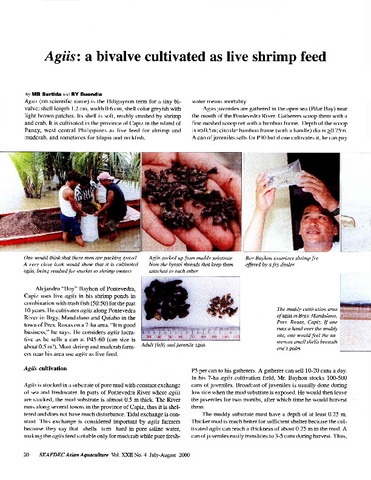
(Aquaculture Department, Southeast Asian Fisheries Development Center, 2000)Live 'agiis' have been proven to be a good feed for shrimp for the past ten years by polyculture fish farmers in the province of Capiz, in the island of Panay, west central Philippines. A brief account is given of culture and feeding operations. Its cultivation period is short and seeds are readily available. It can reduce dependence on trash fish which is now getting to be scarce; it also seems much cheaper. Perhaps this fast-growing tiny bivalve can be scientifically investigated by students of aquaculture as feed for other commercial aquaculture species. Its scientific identification can be a good start. -
Catfish culture in Southeast Asia
(Aquaculture Department, Southeast Asian Fisheries Development Center, 2000)Catfish rank fifth in the world in terms of fresh and brackishwater fish culture. In Asia and the Pacific, the Clariidae family dominates production, representing nearly 80% of the total catfish production. Among the most cultured species are Clarias batrachus, C. macrocephalus, C. gariepinus. The domestic market generally absorbs catfish produce in Asia, although high-producing countries like Thailand and Vietnam engage in export. There are two basic markets for catfish: live fish and processed fish. Particular details are given of catfish production in Thailand, Indonesia and Malaysia. -
Aquaculture provisions of the proposed fishery code
(Aquaculture Department, Southeast Asian Fisheries Development Center, 1997)A list is given of the provisions for aquaculture in the Philippine Fishery Code, passed by Congress on its third and final reading on 5 August 1997, under the following headings: 1) Code of practice for aquaculture; 2) Fishpond lease agreements; 3) Fish pens, fish cages, fish traps, etc.; 4) Non-obstruction to navigation and to defined migration paths of fish; 5) Insurance; and, 6) Registration. -
Establishing a mangrove nursery
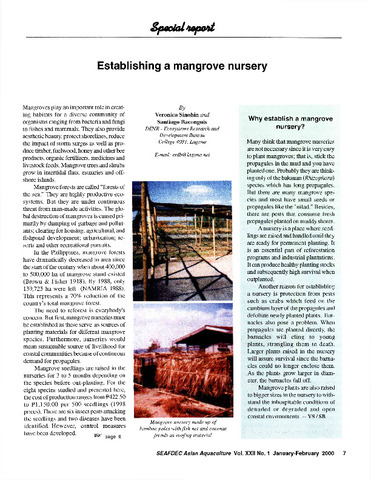
(Aquaculture Department, Southeast Asian Fisheries Development Center, 2000)Mangroves play an important role in creating habitats for a diverse community of organisms ranging from bacteria and fungi to fishes and mammals. They grow in intertidal flats, estuaries and offshore islands. In the Philippines, mangrove forests have dramatically decreased in area since the start of the century, and therefore there is a need to reforest. However, first mangrove nurseries must be established since they serve as sources of planting materials for different mangrove species. Furthermore, nurseries would mean a sustainable source of livelihood for coastal communities because of continuous demand for propagules. A brief account is given of procedures as to the establishment of a mangrove nursery, describing the construction of a nursery, preparation of potting materials, seed collection, seed sowing, and maintenance and protection. Details are provided of the most common true mangrove species in the Philippines. The mangrove nursery is a place for raising and tending seedlings until they are ready for permanent planting. The establishment of mangrove nurseries is in line with government s efforts to rehabilitate the coastal and mangrove ecosystems. -
The aquaculture training needs in the Philippines and Southeast Asia
(Aquaculture Department, Southeast Asian Fisheries Development Center, 1997)AQD has grown into one of the largest and best equipped aquaculture institutions in Asia. The research-based knowledge that AQD has accumulated is aimed at improving aquaculture technologies and providing the necessary background data for academic training of aquaculturists in the region. In order to improve its training programmes, AQD made an assessment of training requirements and available aquaculture manpower in Southeast Asia. Details are given of the survey results, which indicate that brackishwater aquaculture for fish and crustacean has the highest demand until the year 2000. This is followed by freshwater aquaculture, aquaculture management, and fish health management. There is also a need for short-term training on aquaculture research methodology, culture of natural food organisms, fish nutrition, fish and shrimp hatchery operations, aquaculture extension methodology and integrated farming systems. -
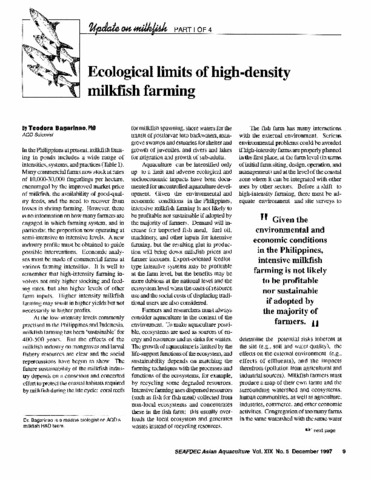
Ecological limits of high-density milkfish farming
Bagarinao, Teodora (Aquaculture Department, Southeast Asian Fisheries Development Center, 1997)
In the Philippines at present, milkfish farming in ponds includes a wide range of intensities, systems and practices. To make aquaculture possible, ecosystems are used as sources of energy and resources and as sinks for wastes. The growth of aquaculture is limited by the life-support functions of the ecosystem, and sustainability depends on matching the farming techniques with the processes and functions of the ecosystems, for example, by recycling some degraded resources. The fish farm has many interactions with the external environment. Serious environmental problems may be avoided if high-intensity farms are properly planned in the first place, at the farm level and at the level of the coastal zone where it can be integrated with other uses by other sectors. It is believed that the key to immediate success in the mass production of milkfish for local consumption and for export of value-added forms may be in semi-intensive farming at target yields of 3 tons per ha per year, double the current national average. Intensive milkfish farming will be limited by environmental, resource and market constraints. Integrated intensive farming systems are the appropriate long-term response to the triple needs of the next century: more food, more income, and more jobs for more people, all from less land, less resources, and less non-renewable energy.
(Aquaculture Department, Southeast Asian Fisheries Development Center, 1997)
In the Philippines at present, milkfish farming in ponds includes a wide range of intensities, systems and practices. To make aquaculture possible, ecosystems are used as sources of energy and resources and as sinks for wastes. The growth of aquaculture is limited by the life-support functions of the ecosystem, and sustainability depends on matching the farming techniques with the processes and functions of the ecosystems, for example, by recycling some degraded resources. The fish farm has many interactions with the external environment. Serious environmental problems may be avoided if high-intensity farms are properly planned in the first place, at the farm level and at the level of the coastal zone where it can be integrated with other uses by other sectors. It is believed that the key to immediate success in the mass production of milkfish for local consumption and for export of value-added forms may be in semi-intensive farming at target yields of 3 tons per ha per year, double the current national average. Intensive milkfish farming will be limited by environmental, resource and market constraints. Integrated intensive farming systems are the appropriate long-term response to the triple needs of the next century: more food, more income, and more jobs for more people, all from less land, less resources, and less non-renewable energy. -
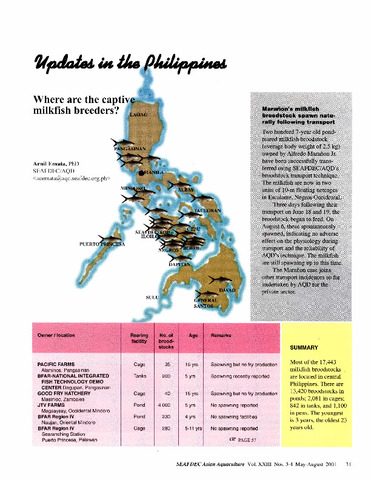
Updates in the Philippines: Where are the captive milkfish breeders?
(Aquaculture Department, Southeast Asian Fisheries Development Center, 2001)A map is provided showing the location of milkfish rearing facilities in the Philippines. Most of the 17,443 milkfish broodstocks are located in central Philippines. A table shows details as to the rearing facility (cage, pen, pond, tank), number of broodstocks, and age. There are 13,420 broodstocks in ponds; 2,081 in cages; 842 in tanks, and 1,100 in pens. The youngest is 3 years, the oldest 23 years old. -
The technology for milkfish hatchery in Indonesia
(Aquaculture Department, Southeast Asian Fisheries Development Center, 2001)The culture of milkfish (Chanos chanos), which is the oldest fish cultured in Indonesia, has spread to almost all the provinces in the country. In order to answer the demand of milkfish fry, without decreasing production and wild fry supply, artificial fry production in big and small-scale hatcheries is being practiced. Details are given of the milkfish hatchery system, listing also the major criteria to be taken into account for site selection. Operation of the hatchery is described, outlining the following activities: broodstock rearing; hormone implantation; broodstock maintenance; egg production and harvest; and, larval rearing. -
AQD recommends semi-intensive milkfish culture
(Aquaculture Department, Southeast Asian Fisheries Development Center, 1998)Details are given of a system for semi-intensive milkfish (Chanos chanos) vulture recommended by the SEAFDEC Aquaculture Department, under the following headings: 1) Pond preparation; 2) Pest (snails) control; 3) Pest (tilapia and other fish) control; 4) Fertilizer application; 5) Stocking density in nursery ponds; 6) Stocking density in grow-out ponds; and, 7) Water management. -
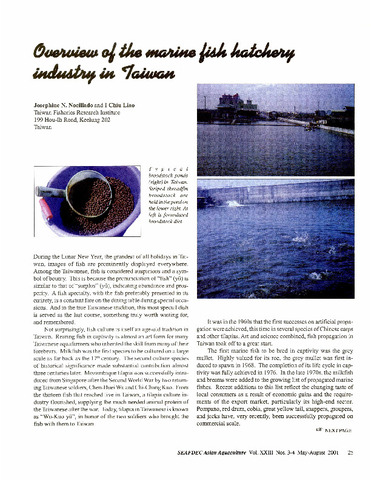
Overview of the marine fish hatchery industry in Taiwan
(Aquaculture Department, Southeast Asian Fisheries Development Center, 2001)Although fish culture itself is an age-old tradition in Taiwan, it was in the 1960s that the first successes on artificial propagation were achieved, with several species of Chinese carps and tilapias. The first marine fish to be bred in captivity was the grey mullet; it was first induced to spawn in 1968. Various other species have since been added to the list of propagated marine fish. The characteristics of the marine fish hatchery industry in Taiwan are outlined, considering both the outdoor pond and indoor tank systems. Future prospects are very good; Taiwan now exports marine fish larvae and fingerlings to many of its Asian neighbours and there are some 60 marine fish species for which commercial larval production is possible. -
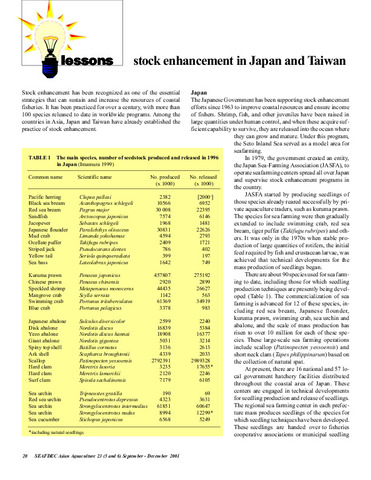
Stock enhancement in Japan and Taiwan
(Aquaculture Department, Southeast Asian Fisheries Development Center, 2001)Stock enhancement has been recognized as one of the essential strategies that can sustain and increase the resources of coastal fisheries. It has been practiced for over a century, with more than 100 species released to date in worldwide programs. Among the countries in Asia, Japan and Taiwan have already established the practice of stock enhancement. Details are given of the main species, number or seedstock produced and released in 1996 in Japan. The species released by the Taiwan Fisheries Research Institute 1976-1995 are also described. -
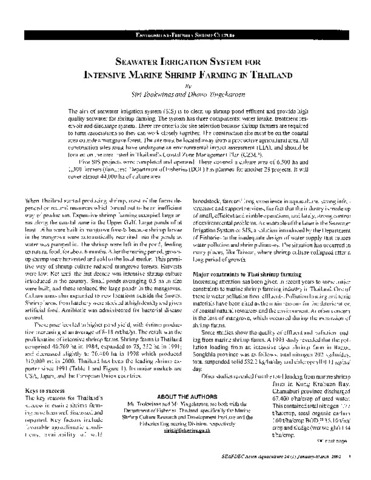
Seawater irrigation system for intensive marine shrimp farming in Thailand
(Aquaculture Department, Southeast Asian Fisheries Development Center, 2002)The aim of the seawater irrigation system (SIS) is to clean up shrimp pond effluent and provide high quality seawater for shrimp farming. The system has 3 components: water intake; treatment reservoir and discharge system. There are criteria for site selection because shrimp farmers are required to form associations so they can work closely together. The construction site must be on the coastal area outside a mangrove forest and located away from a production agricultural area. All construction sites must have undergone an environmental impact assessment, and should be located on the area listed in Thailand's Coastal Zone Management Plan. Five SIS projects, which cover a culture area of 6,500 ha with 1,300 farmers (families), were completed and operated. The Department of Fisheries has planned for another 28 projects, that will cover almost 44,000 ha of culture area. -
Containing the diseases in aquaculture
(Aquaculture Department, Southeast Asian Fisheries Development Center, 2002)A brief discussion is presented on epizootics and their containment in the aquaculture industry, in the form of a question-and-answer interview. Particular reference is made to activities carried out by the OIE (Office International des Epizooties), whose main activities include the provision of guidelines and standards for health protection applicable to international trade in live animals and their products. It has devised an early warning system to apprise its member countries of the occurence of disease outbreaks that would have serious repercussions on public health or the economics of animal products. -
Major viral and bacterial disease problems in shrimp culture
(Society of Aquaculture Engineers of the Philippines, 1995)Major disease problems particularly viral and bacterial in origin have resulted in significant decline in the production of farmed shrimps worldwide. The major diseases of viral and bacterial origins are listed and described. Innovations being applied to prevent and/or minimize their effects are enumerated. The paper suggests a broad outlook of shrimp disease by considering not only the etiological causes but also the epidemiological approach. Attempts to produce disease-free fry are still expensive and cannot be applied widely in commercial farms. The aim is to attain sustainable shrimp farming. -
Sargassum studies in Currimao, Ilocos Norte, Northern Philippines I. Seasonal variations in the biomass of Sargassum carpophyllum J. Agardh, Sargassum ilicifolium (Turner) C. Agardh and Sargassum siliquosum J. Agardh (Phaeophyta, Sargassaceae)
(Walter de Gruyter, 1999)Three species of Sargassum (S. carpophyllum, S. ilicifolium and S. siliquosum were collected each month for a period of one year from the inter- and subtidal zones of Pangil, Currimao, Ilocos Norte, The Philippines. Average monthly biomass was species-specific and significantly influenced by the effect of fertility states of the seaweed, collecting zone, and collecting months. A higher biomass of reproductive plants was accounted for in all species in both zones. Among the three species, S. siliquosum had the highest reproductive and vegetative biomass in both zones, followed by S. carpophyllum and S. ilicifolium. Maximum fertility was observed in October for S. carpophyllum and in November for S. ilicifolium and S. siliquosum. Minimum and maximum reproductive biomass was recorded in May and December, respectively in all species. Biomass of vegetative or non-fertile plants was highest in September in all species except for S. carpophyllum, while minimum biomass was recorded in March for S. carpophyllum and May for S. ilicifolium and S. siliquosum. Reproductive plants had more biomass than vegetative plants. The average monthly wet biomass (g m−2) of other Sargassum species was higher in the subtidal than in the intertidal zone. The biomass of seaweeds associated with Sargassum did not follow a definite pattern. Although water temperature, pH and salinity values were relatively constant, slight variations of temperature were positively correlated (P = 0.05) with subtidal biomass. -
Effect of growth hormone and γ-aminobutyric acid on Brachionus plicatilis (Rotifera) reproduction at low food or high ammonia levels
(Elsevier, 1999)Growth hormone (GH, 0.0025 and 0.025 I.U. ml−1) and γ-aminobutyric acid (GABA, 50 μg ml−1) enhance rotifer population growth in batch cultures. In order to further understand the mechanism of their actions, we conducted experiments culturing isolated females at low food and high free ammonia levels. At an optimum food level of 7×10⁶Nannochloropsis oculata cells ml−1 or at low free ammonia level of 2.4 μg ml−1, the F1 offspring of rotifers treated with GH at 0.0025 I.U. ml−1 had significantly higher population growth rate (r) and net reproduction rate (Ro), and shorter generation time than untreated rotifers. At a lower food level of 7×10⁵ cells ml−1 or at high free ammonia level of 3.1 μg ml−1, rotifers treated with GABA at 50 μg ml−1 had significantly higher r and Ro, and shorter generation time. These results indicate that GABA is effective in enhancing rotifer reproduction when rotifers are cultured under stress whereas GH enhances rotifer reproduction when culture conditions are optimal. Significant effects were also observed in F1 and F2 generations which were not treated with hormones. These data may be useful for treating rotifer mass cultures to mitigate the effects of stress caused by high population densities. -
Significant organotin contamination of sediment and tissues of milkfish in brackish water ponds.
(Springer Verlag, 1999)Organotin pesticides, triphenyltin acetate or hydroxide have long been used as an inexpensive method to control the population of brackish water shails Cerithidea cingulata in the pond culture of milkfish (Chanos chanos Forsskal), and important food fish in the Philippines. The use of organotin pesticeds has been banned for several years now because the chemical renders the soil sterile, is nonbiodegradable and bioaccumulates, and is hazardous to humans. Despite the ban, the clandestine use of the pesticide in milkfish ponds continues to threaten the environment and humans. -
Density dependent growth of the tropical abalone Haliotis asinina in cage culture
(Elsevier, 1999)The effects of different stocking densities on the growth, feed conversion ratio and survival of two size groups of the tropical abalone Haliotis asinina were determined. Three culture trials were conducted in net cages installed in a sheltered cove, Guimaras Province, Philippines. Trials 1 and 2 were conducted using 15–20 mm abalone juveniles for 150 days, while trial 3 was conducted using 35–40 mm abalone for 180 days. The animals were fed sufficient amounts of the red alga, Gracilariopsis bailinae (=G. heteroclada), throughout the experiment. There was an inverse relationship between growth (length and weight) and stocking density. Feed conversion ratio was not influenced by density, but was observed to be higher for larger animals. Survival was not significantly affected by density. Net cages are appropriate for culture of H. asinina. This study showed that H. asinina can reach commercial size of about 60 mm in one year. It also showed that growth of H. asinina can be sustained on a single-species diet. An economic analysis will be important in choosing the best stocking density for commercial production. -
Sensitivity of grouper Epinephelus coioides eggs to handling stress at different stages of embryonic development
(Society of Israeli Aquaculture and Marine Biotechnology, 1998)The sensitivity of grouper Epinephelus coioides eggs to handling stress at different stages of embryonic development was investigated. Naturally-spawned grouper eggs in floating net cages were collected and handled at the early cleavage, blastula, gastrula, neurula, and eyed stages. Egg viability, hatching rate and percentage of normal larvae were significantly higher (p<0.05) in eggs collected and stocked at the eyed stage than in all other stages. An increasing sensitivity to handling stress was observed in eggs from early cleavage to gastrula, as manifested by the decreasing percentage of viable eggs, hatched, and normal larvae. Sensitivity to handling stress decreased when development reached the neurula and eyed stages. Hatched larvae from eggs handled during the blastula and gastrula stages had high mortalities during the first 3-24 hours after stocking. The results of this study show that grouper E. coioides eggs are most sensitive to handling stress during the early cleavage to gastrula phases. The results imply that harvesting or collection of grouper eggs is best done after neurulation, when the embryo has already formed optic vesicles (eyed stage), to increase egg viability and the hatching rate. It will also minimize mortalities and the occurence of abnormal larvae. -
Butylated hydroxytoluene: its effect on the quality of shrimp diet stored at various temperatures and on growth and survival of Penaeus monodon juveniles
(Elsevier, 1999)Shrimp diets with and without the antioxidant, butylated hydroxytoluene (BHT) were stored at 10°, 20°, 28°–30°, and 40°C for 10 weeks. To monitor lipolysis and lipid oxidation, free fatty acid (FFA) content, peroxide values (PVs), and malonaldehyde (MAL) levels were measured from the extracted lipids of the stored diets. Fatty acid levels of the diets increased between the initial and final samplings and the increase was higher (8.4%) in diets without BHT stored at 40°C after 10 weeks. Peroxide values of the extracted lipids were low and fluctuated monthly between 2.2 and 7.4 mmol/kg fat. MAL levels increased in diets with and without BHT except those stored at 10°C for 4 weeks. Diets with BHT stored at 10°C had the lowest (8.7 mg MAL/kg fat) MAL levels and diets without BHT stored at 40°C for 10 weeks had the highest (16.9 mg MAL/kg fat). Shrimp fed diets with BHT gained 5.7–6.4× their initial weight after 10 weeks of rearing. Their growth was significantly better than those fed diets without BHT (4–6×) during the 60-day culture period. Survival was significantly higher in those fed diets with BHT (87–88%) than those without BHT (75–85%). No hepatopancreatic lesions were seen in shrimp samples fed diets with and without BHT and stored at various temperatures. The incorporation of BHT in shrimp feed is necessary if the feed is to be stored at 40°C for 10 weeks.