SEAFDEC/AQD Institutional Repository: Recent submissions
Now showing items 2561-2580 of 4221
-
Developments in mollusc farming in Southeast Asia
(Aquaculture Department, Southeast Asian Fisheries Development Center, 2001)Southeast Asia has a relatively long tradition in mollusc culture. The mollusc species of commercial significance in this region are the blood cockles (Anadara granosa), the green mussels (Perna viridis), the oysters (Crassostrea spp.) and the horse mussels (Modiolus sp.). Mollusc production has been observed to fluctuate dramatically in recent years due mainly to the inconsistent seed supply from the wild, which varies geographically and annually. These variations are often associated with pollution and also the uncontrolled harvesting of adults irrespective of their sizes, which reduces chances of spawning among adults. Production of the above-mentioned species in Southeast Asia in 1997 amounted to 73 820, 62 073, 36 779 and 5 300 mt., respectively. The culture of these bivalves is still dependent on traditional methods of obtaining seeds from the wild and transplanting them to culture sites for grow-out. Culture techniques for these bivalves are basically the same all over Southeast Asia, except for minor variations in the use of structures and materials to suit the local conditions. Whilst efforts are geared towards developing new technologies to promote mollusc culture in the region, it is important to facilitate and stimulate environmentally acceptable developments and sustainable management practices. Although hatchery propagation techniques have been developed for these cultured and other non-cultured species, the technologies have yet to be taken up commercially. Some of the common problems confronted by the region, which varies greatly by species and location, are inconsistent seed supply, lack of suitable areas for expanding culture activities, poor post harvest handling techniques, demand levels being below production capacity, environmental pollution, vagaries of nature, low price and lack of access to export markets. -
Developments in seaweed farming in Southeast Asia
(Aquaculture Department, Southeast Asian Fisheries Development Center, 2001)During the last thirty years, seaweed farming has progressed in the region comprising the Association of Southeast Asian Nations (ASEAN). Farm production reached a high of 146,500 mt of dried seaweeds in 1997 from an initial harvest of 500 mt in 1973. In 1997, the ASEAN region produced about 90% of the world s production of carrageenophyte seaweed, providing raw materials for the US$35O million world carrageenan market. Two species of carrageenophytes, Kappaphycus alvarezii (=Eucheuma cottonii) and Eucheuma denticulatum (=Eucheuma spinosum), constitute the base of the seaweed industry in the region. K. alvarezii is predominantly farmed in the Philippines and Malaysia while E. denticulatum is dominant in Indonesia. Vegetative propagation is still applied in all farmed species of carrageenophytes, while the monoline method remains the most popular method of farming. Non-traditional farming areas have been established in central and northern Philippines and in Sabah, Malaysia. The culture technology has been developed for Gracilaria sp.; however, no up-to-date reports on production are available. Seaweed farming has become one of the most important sources of livelihood for at least 100,000 coastal families in Southeast Asia, contributing apparently to the reduction of blast and cyanide fishing and to the relative improvement of peace and order in seaweed farming areas. -
Shrimp (Penaeus monodon Fabricius) production in brackishwater ponds applied varying fertilizer combinations
(Aquaculture Department, Southeast Asian Fisheries Development Center, 1992)Details are given of the production of Penaeus monodon in the Philippines reared in brackishwater earthen ponds applied with different fertilizer combinations, namely diammonium phosphate, urea and chicken manure. Results show that the shrimp showed higher yields in fertilized ponds, but increasing the concentration of fertilizers did not give a marked increase in yield - the excess fertilizer was wasted. -
An idealized rural coastal zone management integrating land and water use
(Aquaculture Department, Southeast Asian Fisheries Development Center, 1998)Various countries have formulated special integrated coastal zone management (ICZM) strategies which seek to both manage development and conserve natural resources and integrate and coordinate the relevant people sectors and their functions and roles within the bounds of this rich realm. Concerns that may be addressed by ICZM include: 1) Natural resources degradation; 2) Pollution; 3) Land use conflicts; and, 4) Destruction of life and property by natural hazards. Some prevalent sources of environmental impacts (livelihoods) are listed, together with some recommendations to the concerns which they may raise in relation to coastal zone management: agriculture; aquaculture; fisheries; forestry; human settlements; tourism; and, transport industry. -
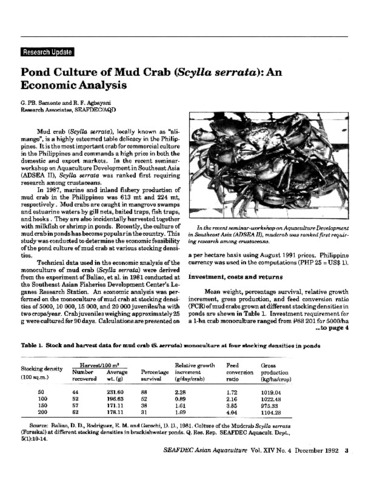
Pond culture of mud crab (Scylla serrata): An economic analysis
(Aquaculture Department, Southeast Asian Fisheries Development Center, 1992)The findings are presented of a study conducted to determine the economic feasibility of the pond culture of mud crab (Scylla serrata) at various stocking densities. Investments, costs, and returns are given for a 1 ha crab monoculture at 4 stocking densities - 5000, 10,000, 15,000 and 20,000. Results show that mud crab monoculture in brackishwater ponds is economically feasible at stocking densities of 5000/ha and 10,000/ha. -
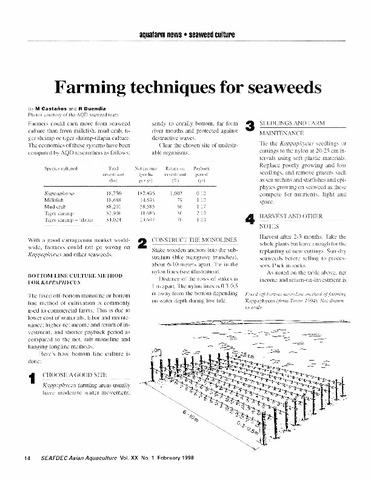
Farming techniques for seaweeds
(Aquaculture Department, Southeast Asian Fisheries Development Center, 1998)Details are given of farming methods developed by the SEAFDEC Aquaculture Department for 3 different seaweeds: 1) Bottom line culture method for Kappaphycus; 2) Pond culture of Gracilaria; and, 3) Gracilariopsis bailinae, the new seaweed on the block. -
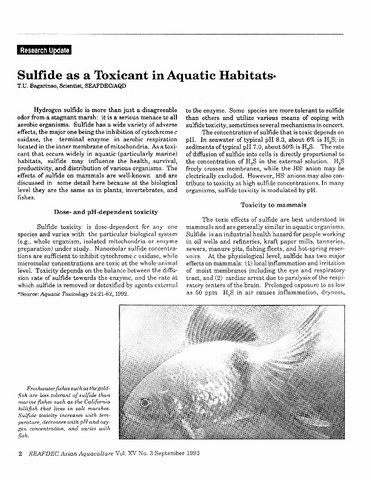
Sulfide as a toxicant in aquatic habitats
Bagarinao, Teodora (Aquaculture Department, Southeast Asian Fisheries Development Center, 1993)
The toxic effects of sulphide are best understood in mammals and are generally similar in aquatic organisms. At the physiological level sulphide has 2 major effects on mammals: 1) local inflammation and irritation of moist membranes including the eye and respiratory tract; and, 2) cardiac arrest due to paralysis of the respiratory centres of the brain. The toxicity of sulphide to plants, macroinvertebrates, freshwater fish and marine fish is discussed in detail. It is concluded that the role of sulphide in mass kills of fish, shrimp and other animals in brackishwater earthen ponds, lakes and sea cages should be determined.
(Aquaculture Department, Southeast Asian Fisheries Development Center, 1993)
The toxic effects of sulphide are best understood in mammals and are generally similar in aquatic organisms. At the physiological level sulphide has 2 major effects on mammals: 1) local inflammation and irritation of moist membranes including the eye and respiratory tract; and, 2) cardiac arrest due to paralysis of the respiratory centres of the brain. The toxicity of sulphide to plants, macroinvertebrates, freshwater fish and marine fish is discussed in detail. It is concluded that the role of sulphide in mass kills of fish, shrimp and other animals in brackishwater earthen ponds, lakes and sea cages should be determined. -
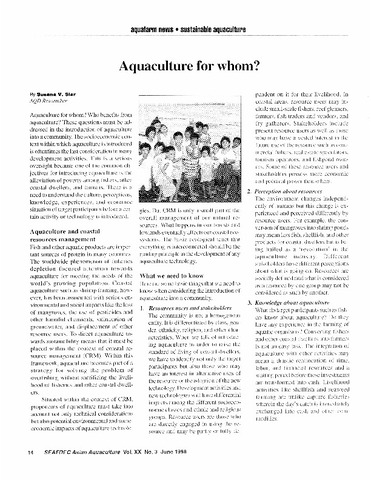
Aquaculture for whom?
(Aquaculture Department, Southeast Asian Fisheries Development Center, 1998)Aquaculture and coastal resources management is discussed, indicating the various factors which need to be taken into consideration when introducing aquaculture into a community: 1) Resources users and stakeholders; 2) Perception about resources; 3) Knowledge about aquaculture; 4) Property rights regimes; 5) Gender matters; 6) Consumer preferences; 7) Availability of support services. -
The natural life history of milkfish
Bagarinao, Teodora (Aquaculture Department, Southeast Asian Fisheries Development Center, 1994)
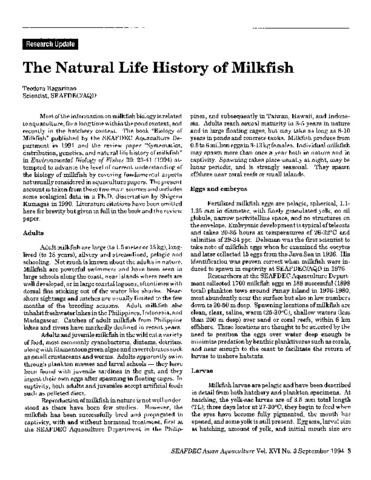
Following brief descriptions of the various phases in the natural life history of the milkfish (Chanos chanos), namely adults, eggs and embryos, larvae, fry and metamorphosis, juveniles and sub-adults, a summary is provided of the life history, providing also a schematic diagram. -
The Philippine seaweed industry
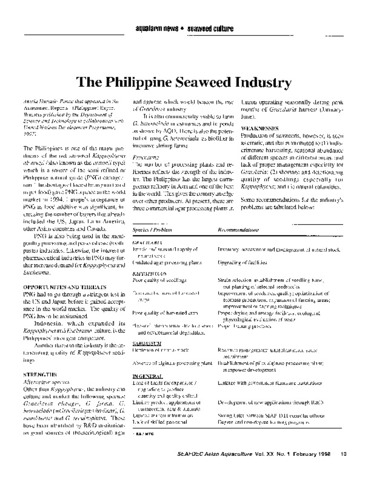
(Aquaculture Department, Southeast Asian Fisheries Development Center, 1998)A brief outline is given of the Philippine seaweed industry, which involves mainly the red seaweed Kappaphycus alvarezii, produced as a source of the semi-refined or Philippine natural grade (PNG) carrageenan. Other species cultured and marketed include: Gracilaria changii, G.firma, G.heteroclada, G.manilaensis and G.tenuistipitata. The Philippines has the largest carrageenan refinery in Asia. However, production of seaweeds is rather eratic, which is attributed to the following factors: 1) indiscriminate harvesting, seasonal abundance of different species in different areas and lack of proper management; 2) shortage and deteriorating quality of seedlings, especially for Kappaphycus; and 3) natural calamaties. -
Technology for the community: SEAFDEC-designed artificial reefs
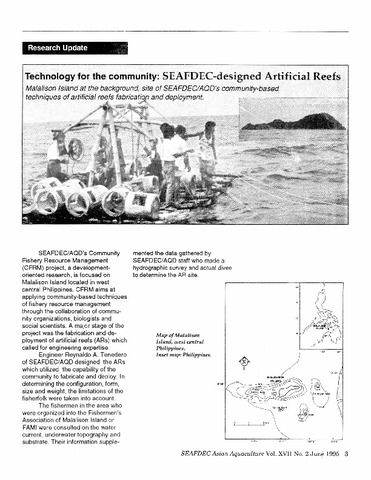
(Aquaculture Department, Southeast Asian Fisheries Development Center, 1995)An account is given of the fabrication and deployment of artificial reefs used in the SEAFDEC/AQD's Community Fishery Resource Management project, which focused on Malalison Island located in west Central Philippines. The project aimed to apply community-based techniques of fishery resource management through the collaboration of community organizations, biologists and social scientists. The 3 types of reefs (building blocks, concrete pipe culvert, and modified concrete pipe culvert) were deployed at Gui-ob reef covering an area of less than 1 ha. -
Sustainability in aquaculture
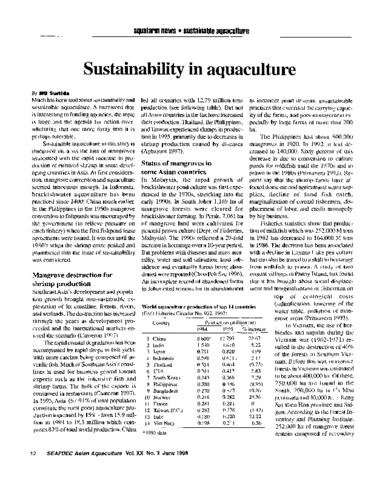
(Aquaculture Department, Southeast Asian Fisheries Development Center, 1998)Sustainable aquaculture in Asia is discussed, considering in particular the loss of mangroves associated with the rapid increase in production of cultured shrimp. Southeast Asia's development and population growth brought non-sustainable exploitation of its coastline; the destruction has increased through the years as development proceeded and the international markets entered the scenario. An outline is given of the current status of mangroves in some Asian countries. Some worldwide remedies for sustainable aquaculture are described. -
Knowing Asian aquaculture and fisheries
(Aquaculture Department, Southeast Asian Fisheries Development Center, 1998-06)An outline is given of aquaculture practices in Malaysia, Philippines and Thailand, which included freshwater, brackishwater and marine systems. -
Mangrove destruction for shrimp rearing in Minh Hai, Viet Nam: its damage to natural resources and the environment
(Aquaculture Department, Southeast Asian Fisheries Development Center, 1996) -
Knowing Asian aquaculture and fisheries
(Aquaculture Department, Southeast Asian Fisheries Development Center, 1998-02)An outline is given of aquaculture and fisheries in Asia, providing information of use to students whose work can influence laws, rules, policy and regulations on aquaculture and fisheries, with the view in mind to sustainable aquaculture. In this issue, the following countries are examined: China, Indonesia, and Bangladesh. -
Economic value of the milkfish industry
Bagarinao, Teodora (Aquaculture Department, Southeast Asian Fisheries Development Center, 1998)
A brief description is given of the milkfish (Chanos chanos) farming industry in the Philippines. Over the past 20 years, the relative importance of milkfish has declined with the expansion of tilapia, tiger shrimp and seaweed farming. In 1975, some 141,461 mt of milkfish made up 10% of the total fish production, whereas in 1995, the total milkfish harvest of 150,858 mt made up only 5.5% of the total fish production. Milkfish are harvested and marketed mostly fresh or chilled, whole or deboned, but some are canned or smoked. The domestic markets, mainly in Metro Manila, absorb most of the production. Milkfish is also absorbed in different product forms: dried, canned, smoked, or marinated. An export market for quick-frozen deboned milkfish fillets has begun to develop and fish processing companies are responding fast. The milkfish farming industry has important linkages with the various sectors that supply the inputs, and those that transport, store, market or process the harvest. For intensive milkfish farming to be both profitable and sustainable, more value-added products must be developed and marketed. -
The Malaysian experience
(Aquaculture Department, Southeast Asian Fisheries Development Center, 1997)Integrated farming has long been practiced in Malaysia, not only to provide protein requirements needed by the family, but also as a source of income. With fish being promoted on a larger scale, the Malaysian government is providing farmers with financial assistance and hands-on training on fish culture and rice production. Systems of fodder-fish integrated farming and fish-livestock farming in mine ponds are outlined. -
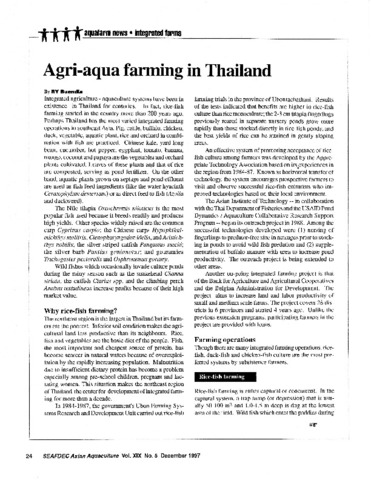
Agri-aqua farming in Thailand
(Aquaculture Department, Southeast Asian Fisheries Development Center, 1997)Integrated agriculture-aquaculture systems have been in existence in Thailand for centuries. This country has the most varied integrated farming operations in southeast Asia; pig, cattle, buffalo, chicken, duck, vegetable, aquatic plant, rice and orchard in combination with fish are practices. The systems most preferred by subsistence farmers are rice-fish, duck-fish and chicken-fish culture. A brief outline is given of these 3 systems. -
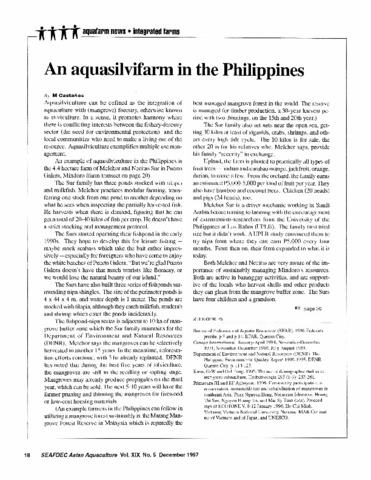
An aquasilvifarm in the Philippines
(Aquaculture Department, Southeast Asian Fisheries Development Center, 1997)Aquasilviculture can be defined as the integration of aquaculture with mangroves. Details are given of an example of aquasilviculture in the Philippines at Puerto Galera, Mindoro. The farm has 3 series of perimeter ponds stocked with tilapia, although milkfish, mudcrab and shrimp may be caught when entering the ponds incidentally. -
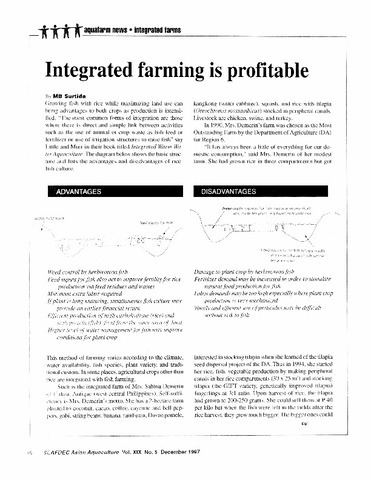
Integrated farming is profitable
(Aquaculture Department, Southeast Asian Fisheries Development Center, 1997)Growing fish with rice while maximizing land use can bring advantages to both crops as production is intensified. Details are given of the basic structure of rice field aquaculture, listing the major advantages and disadvantages of this system. Particular reference is made to the integrated farms at Culasi, Antique (Western Philippines) and at Barangay Igcocolo, Guimbal, Iloilo where agricultural crops other than rice are integrated with fish farming (tilapia -- Oreochromis mossambicus) and livestock rearing. An account is also given of the system at the AQD site at New Busuang, Kalibo, Aklan which evaluates the economic feasibility and profitability of farming mudcrab in tidal flats with existing mangroves.