SEAFDEC/AQD Institutional Repository: Recent submissions
3841-3860 / 4221
-
The effect of stocking density, temperature and light on the early larval survival of the abalone Haliotis asinina Linné
(Phuket Marine Biological Center, 2001)Newly hatched trocophore larvae of the abalone haliotis asinina linne were stocked at densities of 1000, 3000 and 5000 larvae/1 at low (20-25oC) and high (ambien, 28-30oC) water temperature levels in light (transparent) and dark (black cloth-coered) lass container. Larvae were reared in UV light-irradiated sea water until pre-settement stage. Aeration was not provided during the 20-h incubation periond. A 3x2x2 factorial design with three replicates per treatment was folloed. A three-way analysis of variance (ANOVA) showed a significant interaction among the factors tested. Analysis at each density level showed that at stocking density of 1000 larvae/1, no significant difference between temperatures and between light or dark condition was observed. However, at densities of 3000 and5000, significantly higher survival was obtained at low, than high temperature (P<0.05), but no difference between the light and darck conditions. Analysis at each temperature showed that, at high temperature,better survival was obtained at stocking density of 1000, than higher densities (P<0.001), and at light than at darck condition (P<0.05). However, at low temperature, no significant difference between light abd darck conditions was detected. ANOVA at light or darck condition showed that at any of these conditons, larvae survival was always higher at 1000 stocking density that t other density (P 0.05). Survival was not significntly different between stockng density of 3000 and 5000 larvae/1 at any of those light conditions. Theredore, during incubation of newly hatched trocophore larvae of H. Asinina to pre-settlement stage, the optimum stocking density at high temperature (28-30oC) was 1000/1, in a light-penetrable rearing container. When reared at higherstocking densities of 3000 or 5000, a higher survival was obtained when temperature was lower to 20-25oC in either rearing conditions tested. -
Mangroves of Southeast Asia
(Aquaculture Department, Southeast Asian Fisheries Development Center, 2000)This paper provides an introduction to Southeast Asian mangroves covering taxonomy, distribution and ecological factors; discusses mangrove goods and services and their valuation; and recommends guidelines for mangrove conservation and management, including mangrove-friendly aquaculture. -
Marine fishes and coastal resource management: mangrove-friendly development strategies
Garcia, Luis Maria ; ; (Aquaculture Department, Southeast Asian Fisheries Development Center, 2000)
Recent statistics of fishery production in the Philippines reveal outputs that are either declining (municipal fishery) or levelling off (commercial fishery and aquaculture). These trends are, in part, a reflection of the serious effects of unregulated economic activities in the coastal zone. The degradation of coastal ecosystems means a loss of livelihood among many communities of impoverished fishers as catches from municipal waters have declined over the years. Considering that mangroves, seagrasses, and coral reefs are vulnerable to anthropogenic perturbations, several development strategies are presented to meet the twin issues of ecosystem conservation and food security for coastal fishing communities. Mariculture, searanching, habitat alteration and restoration are a few of these strategies. Our recent experience in village-based reef resource management in Mararison Island, central Philippines may likewise be a viable option in the management of shoreward ecosystems (mangroves and seagrasses). In particular, the establishment of a marine reserve in the island may find some relevant applications in mangrove management and development.
; ; (Aquaculture Department, Southeast Asian Fisheries Development Center, 2000)
Recent statistics of fishery production in the Philippines reveal outputs that are either declining (municipal fishery) or levelling off (commercial fishery and aquaculture). These trends are, in part, a reflection of the serious effects of unregulated economic activities in the coastal zone. The degradation of coastal ecosystems means a loss of livelihood among many communities of impoverished fishers as catches from municipal waters have declined over the years. Considering that mangroves, seagrasses, and coral reefs are vulnerable to anthropogenic perturbations, several development strategies are presented to meet the twin issues of ecosystem conservation and food security for coastal fishing communities. Mariculture, searanching, habitat alteration and restoration are a few of these strategies. Our recent experience in village-based reef resource management in Mararison Island, central Philippines may likewise be a viable option in the management of shoreward ecosystems (mangroves and seagrasses). In particular, the establishment of a marine reserve in the island may find some relevant applications in mangrove management and development. -
Property rights and collective action in the management of mangrove ecosystems: Implications of the adoption of mangrove friendly-aquaculture
(Aquaculture Department, Southeast Asian Fisheries Development Center, 2000)The SEAFDEC/AQD experience in Malalison Island on the Community Fishery Resources Management Project is well used in the Aklan project on community-based mangrove-friendly aquaculture. The territorial use rights in fisheries that was implemented in Malalison has become a model in investigating property rights regime in state-owned mangrove areas in Ibajay, Aklan. The concept of property rights as a management strategy in arresting the further destruction of mangroves and rehabilitating destroyed mangrove forest requires the collective effort of different users and stakeholders. There is a need to balance environmental conservation and food security in the management of mangrove resources. -
Mangrove-associated mollusc research at SEAFDEC/AQD
(Aquaculture Department, Southeast Asian Fisheries Development Center, 2000)Mollusc research at the Aquaculture Department of the Southeast Asian Fisheries Development Center started in 1975 and focused on two commercially important mangrove-associated bivalves, the slipper-shaped oyster (Crassostrea iredalei) and the green mussel (Perna viridis). Studies conducted were on spatfall forecasting to increase collection of seeds from the wild; improvement of farming techniques; seed production in the hatchery; bivalve sanitation; and transplantation. These studies have led to the development of a suitable spat collector for oyster and mussel; promotion of the raft culture method for oysters and mussels to prevent siltation of growing areas, including a low-cost raft design for this purpose; refinement of transplantation techniques to increase production and to grow osyters and mussel in suitable areas without natural populations; and desgin of a prototype low-cost depuration unit. A socio-economic study of oyster and mussel farming practices in Western Visayas provided information on current farming practices and profitability. A study done on the use of green mussel as biofilter in a semi-intensive shrimp pond showed that shrimp stocked with mussels grew faster than those without. A study on the biology and fishery of the "imbao" Anodontia edentula, another mangrove-associated bivalve, is ongoing. Spawning has been achieved in the laboratory and larval stages monitored were first polar body, 2-cell stage, morula, ciliated gastrula, trocophore, veliger, and pediveliger. -
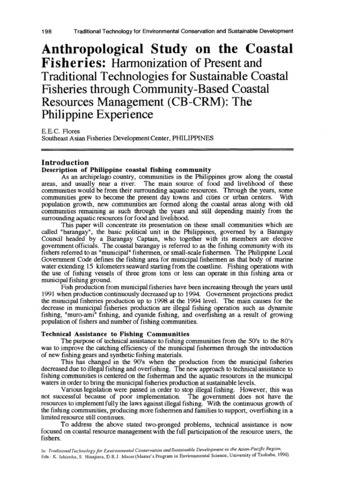
Anthropological study on the coastal fisheries: harmonization of present and traditional technologies for sustainable coastal fisheries through community-based coastal resources management (CB-CRM): the Philippine experience.
(Master’s Program in Environmental Sciences, University of Tsukuba, 1996)As an archipelago country, communities in the Philippines grow along the coastal areas, and usually near a river. The main source of food and livelihood of these communities would be from their surrounding aquatic resources. Through the years, some communities grew to become the present day towns and cities or urban centers. With population growth, new communities are formed along the coastal areas along with old communities remaining as such through the years and still depending mainly from the surrounding aquatic resources for food and livelihood. This paper will concentrate its presentation on these small communities which are called "barangay", the basic political unit in the Philippines, governed by a Barangay Council headed by a Barangay Captain, who together with its members are elective government officials. The coastal barangay is referred to as the fishing community with its fishers referred to as "municipal" fishermen, or small-scale fishermen. The Philippine Local Government Code defines the fishing area for municipal fishermen as that body of marine water extending 15 kilometers seaward starting from the coastline. Fishing operations with the use of fishing vessels of three gross tons or less can operate in this fishing area or municipal fishing ground. Fish production from municipal fisheries have been increasing through the years until 1991 when production continuously decreased up to 1994. Government projections predict the municipal fisheries production up to 1998 at the 1994 level. The main causes for the decrease in municipal fisheries production are illegal fishing operation such as dynamite fishing, "muro-ami" fishing, and cyanide fishing, and overfishing as a result of growing population of fishers and number of fishing communities. -
Mud crab (Scylla serrata) culture in tidal flats with existing mangroves
(Aquaculture Department, Southeast Asian Fisheries Development Center, 2000)The performance of the mud crab Scylla serrata (Forsskal) in 200 m2 pens installed in tidal flats with existing mangroves was determined in a factorial experiment with stocking density (0.5 or 1.5/m2) and feed (salted fish by-catch or a mixed diet of 75% salted brown mussel flesh and 25% salted fish by-catch) as main factors. Duration of the experiment was 160 days. Results showed no interaction between feed and stocking density so data were pooled for each feed and stocking density treatment. There was no significant differences in growth, feed conversion ratio (FCR), survival, and production among two types of feed. Regardless of feed, the FCR was significantly more efficient and survival significantly higher at 0.5 than at 1.5/m2 stocking density. Growth, however, was not significantly different. Cost-return analysis on a per crop/200 m2 basis showed that the use of either of the two stocking density levels with either of the two types of feed was economically viable with a return on capital investment of 65-87%. Partial budgeting analysis, however, revealed that net earnings were increased by P1,128.00 if crabs were stocked at 1.5/m2 and P881.00 if fed a mixed diet of 75% salted brown mussel flesh and 25% salted fish by-catch compared with crabs stocked at 0.5/m2 and fed salted fish by-catch alone. -
Incidence and causes of mass fish kill in a shallow tropical eutrophic lake (Laguna de Bay, Philippines)
; ; ; ; Romana-Eguia, Maria Rowena; ; (Shiga Prefectural Government, 2001)
Mass fish kills in Laguna de Bay, the largest lake in the Philippines, has been reported as early as in the 1930’s. With the introduction of and development of aquaculture in this lake, considerable attention and concern was focused on the problem. Records of mass fish kill in the lake mainly from unpublished sources and reports from fisherfolk were reviewed and the causes categorized. The data covered the period 1972 to 1998. Among the commercially important fish species affected were milkfish (Chanos chanos), Nile tilapia (Oreochromis niloticus), bighead carp (Aristichthys nobilis), snakehead (Channa striata), catfish (Clarias macrocephalus and C. batrachus, Arius manilensis), silver perch (Terapon plumbeus) and goby (Glossogobius giurus). The first three species are widely used in aquaculture and the rest are important in open water fishery. Sixty percent of mass fish kill incidents were due to low dissolved oxygen with more than half of these cases associated with blue-green phytoplankton blooms. Fish kills due to pollution from agriculture and industries, fish pathogens and other causes are also discussed. The incidence of mass fish kill reached its peak between 1977 to 1986. Records show that the most number of fish kills (80%) occurred between the months of May to September. The lakeshore towns in the central arm of the lake had the highest incidence of fish kill reported with 46% and followed by the west arm of the lake with 38% of all fish kills recorded. -
Socio-economic impacts of shrimp culture
Primavera, Jurgenne (International Foundation for Science (IFS), 1998)
Farmed shrimp contributed 27% of total world shrimp production in 1995 with a volume of 712,000 tonnes ('metric tonnes,' t). Undoubtedly, the shrimp culture industry earns valuable foreign exchange for developing countries and generates jobs across the industry from fry gatherers to growers and processors. However, grave socio-economic consequences — including conversion, expropriation, and privatization of mangroves and other lands; salinization of water and soil; decline in food security; marginalization of coastal communities; unemployment and urban migration; and social conflicts — have followed in the wake of shrimp farm development in the Philippines and other tropical countries. The paper focuses on mangrove ecosystems: the valuation and cost-benefit analysis of their goods and services and the mangrove-offshore fisheries connection. Research gaps in these areas and the need to internalize the ecological and socio-economic costs ('externalities j of shrimp farming are highlighted. Other recommendations include mangrove conservation and rehabilitation, enforcement of existing legislation, and introduction of environment-friendly aquaculture within the broader framework of community-based, integrated coastal area management, eg the traditional, extensive polyculture ponds in Indonesia. -
Philippines
(Asian Productivity Organization, 1996) -
Engineering and deployment of artificial reefs for a community-based fishery resource management project at Mararison Island, Antique, Philippines
(Japan International Marine Science and Technology Federation, 1995)This paper describes the self-initative of the island's inhabitants in the fabrication and deployment of concrete artificial reefs (ARs) using indigenouse materials as well as appropriate technology at Mararison Island, Antique, Philippines. Deployment of ARs is one of the developmental components of SEAFDEC/AQD assisted community-based fishery resource managment project. To determine transport and deployment problems, two prototype prefabricated modules, building blocks and pipe culverts, were deployed in May 1994. The building blocks module consisted of 10 150x200x2000 mm concrete culvert units arranged in pyramidal configuration of 5,4,3,2, and 1 layers. AR modules designed to provide more surface area and crevices were fabricate in segments at a maximum of 1.47 KN/unit to ease transport and deployment.After attaining its concrete strength, the units were manually hauled from fabrication site to a bamboo raft and towed by a motorized bance to the deployment site. The raft have a rectangular opening at the middle where the units were manually lowered, one at a time, useing rope and pully. Local community divers using surface-supplied are compressors assemled the modules in block and in pyramidal configuration. A relatively flat boottom, 18 m water deep, and the presence of exploited coral reefs in the area were among the factors considered in setting up the ARs. -
Series: European Mariculture Society Special Publication; No. 4
Cultivation of live feed for the rearing of sugpo (Penaeus monodon) larvae
(European Mariculture Society, 1979)The sugpo, Penaeus monodon, is a very important prawn species in Southeast Asia. It is extremely euryhaline and fast growing. Interest in the farming of this prawn species is very high. Unfortunately, the supply of natural fry is not sufficient. It is, therefore, necessary to develop the technology of breeding them in captivity and producing sufficient seed material. The Southeast Asian Fisheries Development Center, Aquaculture Department in Tigbauan, Iloilo, Philippines, operates a hatchery to produce fry for experimental rearing in brackish water ponds and for various laboratory studies. -
Small-scale fisheries and yield of coral reefs in Malalison Island, west central Philippines: Implications for a community-based coastal fishery resource management
Amar, Edgar; ; (Institute of Fisheries Economics, National Taiwan Ocean University; International Institute of Fisheries Economics and Trade, 1995)
Fish landings in Malalison Island on west central Philippines were monitored from February 1991 to January 1992 to determine the fishing gears employed, the predominant species caught, the catch per unit effort (CPUE), and the yield from the coral reefs. A total of 494 fishing operations were recorded; fishing was monitored only during spring tide periods. CPUE (kg man-hr-1) by gear was 1.10 for spear guns, 1.43 for spear guns with compressor, 0.43 for set gill nets, 2.37 for 'drive-in' gill nets, 1.15 for drift gill nets, 0.67 for hook and lines. The CPUEs of Malalison gears are comparable to those of other coral reef fisheries. Dominant species caught were fusiliers and surgeonfish for gill net, surgeonfish for spear gun, and snappers and groupers for hook and line. The fish yield from coral reefs was estimated to be 5.8 t km-2 yr-1 and this is similar to overexploited reefs in the Philippines. The yield is also among the lowest reported in the Philippines and elsewhere. On the basis of live coral cover, yield, and fishing effort, the Malalison reefs can be categorized as an intensively fished fishery showing serious habitat degradation. Community-based management and resource enhancement should be initiated to protect the fishery and keep its utilization sustainable. -
The rabbitfishes
(Elsevier, 1995) -
The plight of older women in a fishing village: The women fish traders of Bugtong Bato, Aklan, central Philippines
(ICLARM, 2001)The changing nature of the fisheries in Bugtong Bato, a small fishing community in Central Philippines has also changed the role of women, particularly of older women, in the community. Until the 1980s, fishing used mainly traditional gears and methods and was highly seasonal. The livelihood activities of men were highly diversified, and fishermen undertook seasonal outmigration to the sugarcane plantations in Negros. Younger women and women of child-bearing age attended to domestic chores, helped their husbands prepare for the day's fishing activities, sought employment as domestic helpers in the capital town or Manila, or engaged in seasonal jobs such as rice harvesting or sinamay fiber knotting. Older women mainly attended to domestic chores. With the introduction of new fishing gears and methods, seasonal outmigration has virtually stopped. The men who participated in group fishing financed by local financiers earn better incomes from these new fishing techniques. However, as fishing now requires longer periods at sea, older fishermen are unable to join their younger counterparts, and rely only on traditional fishing methods for their livelihood. Due to physical limitations and poor health, older fishermen are unable to earn enough to support their families, and their wives seek supplementary means of livelihood. The introduction of new fishing gears and methods has increased considerably the volume of fish landed and spurred the development of a new economic activity in this community - that of fish trading. Most fish traders are older women whose husbands are unable to fish or whose income from fishing cannot meet their daily needs. As such, older women in this community have assumed the role of primary providers for their families. -
Voluntary feed intake and energy partitioning in tilapia, (Oreochromis niloticus) fed diets with different protein/energy levels
(Wageningen Pers, 2001)In order to investigate the effect of different protein/energy levels of diets (two commercial and one laboratory) on voluntary feed intake and energy partitioning in tilapia (O. niloticus), 15 fishes with an initial body mass of 33 g were reared individually in respirometric chambers for 42 days and offered 3 diets ad libitum. The protein contents of the diets were 36.1, 33.8 and 36.8% (dry matter base); the energy content 18.9, 18.4 and 19.2 kJ GE/g and 11.7, 10.5 and 15.4 kJ ME/g. The initial body composition and energy content was estimated from a control group. Feed consumption was recorded for each individual fish. Body mass development was monitored weekly. At the end of the experiment, the fishes were sacrificed and their chemical composition (protein as N.6.25, lipid, ash) and gross energy content were determined. To establish energy budgets, ingestion (I) was calculated from feed intake, retention (P) from accretion in the carcass, heat production (R) from oxygen consumption (indirect calorimetry) and apparently non-utilized energy (faecal and non-faecal losses, U) by difference from energy ingestion. In the beginning, food consumption amounted to ~5% body mass equivalent (BME) per day for all groups and gradually decreased to 2.5, 2.8 and 1.6% BME by the end of the experiment. While the food consumption was significantly different between the treatments, there were no significant differences in the body mass development. Average final body mass was 98.6, 93.8 and 103.7 g. Energy retention was 29.7, 29.2 and 44.4% of GE ingested; heat dissipation 32.1, 27.9 and 36.0%; faecal and non-faecal losses 38.2, 43.2 and 19.6%. For all energy budget parameters, values for the laboratory diet were significantly different from those of commercial feeds 1 and 2. Calculation of metabolizable energy from ingested feed revealed no significant differences in the energy uptake, suggesting that the voluntary feed uptake was controlled by the demand for metabolizable energy. The fishes were able to completely compensate for the lower ME content of the commercial feeds by increasing voluntary feed intake. -
Aquaculture
; ; ; ; ; Primavera, Jurgenne (Elsevier, 2001)
Aquaculture, the aquatic counterpart of agriculture, has grown rapidly in recent decades to become one of the most important means of obtaining food from the sea. Impacts of aquaculture on biodiversity arise from the consumption of resources, such as land (or space), water, seed, and feed, their transformation into products valued by society, and the subsequent release into the environment of wastes from uneaten food, fecal and urinary products, and chemtherapeutants as well as microorganisms, parasites, and feral animals. Negative effects may be direct, through release of eutrophicating substances, toxic chemicals, the transfer of diseases and parasites to wild stock, and the introduction of exotic and genetic material into the environment, or indirect through loss of habitat and niche space and changes in food webs. Today, large quantities of fish are caught to produce fish meal–the main ingredient in feed–which may result in overfishing and affect marine food chains, including marine mammals and top carnivores. In some types of aquaculture, fish and shrimp larvae are caught in the wild to be used as seed. This may also result in bycatches of large amounts of other larvae, representing losses to capture fisheries and biodiversity. Large areas of critical habitats such as wetlands and mangroves have been lost due to aquaculture siting and pollution, resulting in lowered biodiversity and recruitment to capture fisheries. The magnitude of biodiversity loss generally increases with scale, intensity of resource use, and net production of wastes, but it is very much dependent on which species is cultured and the method of cultivation. In some cases aquaculture may increase local biodiversity, e.g., when ponds are constructed in dry areas and with integrated aquaculture. -
Impacts of brackishwater pond culture on the mangrove ecosystem
Primavera, Jurgenne (Southeast Asian Fisheries Development Center, Aquaculture Department, 2000)
This paper aims to describe Southeast Asian mangroves, the impacts of brackishwater pond culture on these ecosystems, and lessons from the region for the development of aquaculture in Malaysia. -
Recent developments in freshwater and marine cage aquaculture in the Philippines
(Asian Fisheries Society; World Aquaculture Society - Southeast Asian Chapter, 2000)Fish production from freshwater cages and pens, and marine cages and pens constitute 19% of the total foodfish produced from aquaculture in the Philippines. In 1998, production from freshwater cages and pens contributed about P 2.5 billion or about 10% of the total revenues from aquaculture. Freshwater cage and pen culture is practiced in most of the major lakes and reservoirs in the country. The most important species cultured in freshwater cages are tilapia and bighead carp (Aristichthys nobilis) while milkfish (Chanos chanos) is farmed in freshwater pens at Laguna de Bay. Small water impoundments intended for the irrigation of upland farms are also being used to culture tilapia and other freshwater fish in cages. The unregulated expansion of cages and pens, use of high stocking densities, and excessive feeding has resulted in the deterioration of the water quality in many areas. This has prompted the more informed local government authorities to adopt measures limiting further expansion of cage and pen culture activities beyond the carrying capacity of freshwater bodies to prevent periodic occurrences of mass fish kills. While cage mariculture of groupers has been practiced in the Philippines since the 1980 s, it was only in the early 1990 s that much of the growth and expansion of the industry occurred with the popularization of milkfish mariculture. In the last five years, no less than 1,000 cages with an aggregate capacity in excess of 10,000 metric tons a year have been invested in milkfish sea farming. The species now acounts for about 90% of the production from marine cages. In recent years, a drop in milkfish prices has motivated the industry to focus its attention on other fishes, primarily grouper (Epinephelus spp.), snapper (Lutjanus spp.), sea bass (Lates calcarifer) and siganid (Siganus spp.). Currently, imported species such as red tilapia, yellow-wax pompano (Trachinotus blochii) and red drum (Sciaenops ocellatus) are also being tested by the private sector. A high production cost due to low feed conversion efficiency and high seed cost is presently the greatest concern of marine cage farmers. In some areas, unregulated expansion has already led to problems in water quality. -
Restocking of windowpane shell, Placuna placenta in a depleted bed off Tigbauan, Iloilo, the Philippines
(Phuket Marine Biological Center, 2000)The Tigbauan coast, Iloilo, the Philippines, has been depleted of the natural population of the windowpane shell, Placuna placenta Linnaeus, 1758, since the early 1980's. To support the declining P. placenta industry of the Philippines, restocking of depleted natural beds has to be done. This work aimed at assessing the suitability of the area for restocking of this valuable bivalve species. Immature P. placenta broodstock (71.6 ± 6.2 mm) and juveniles (40 ± 10mm) were stocked in a 40 m2 muddy bottom area off Tigbauan. Growth , survival, and reproduction of the animals were monitored monthly for 3 months. All juveniles were found dead after a month covered with sand and silt. However, broodstock remained alive. Broodstock samples, taken after a month, spawned after exposure to UV-light irradiated sea water. Survival rate, shell length and body weight increment of the broodstock after 91 days were 51%, 15.0 mm and 12.6 g, respectively. P. placenta veligers were found in the plankton one month after spawning and until the end of the three-month rearing period. Net productivity of the area ranged from 0.03-0.32 ml O2/l. Phytoplankton species and macrobenthic organisms, such as Ophelina acuminata Oersted, 1843, Halophila johnstoniae Busk, 1852 and sipunculans, associated with P. placenta in the natural habitat were also collected in the area. Restocking of the depleted bed is still feasible by using adult animals to naturally repopulate the area.