SEAFDEC/AQD Institutional Repository: Recent submissions
4021-4040 / 4221
-
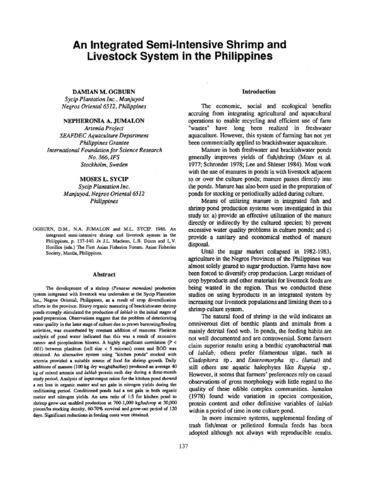
An integrated semi-intensive shrimp and livestock system in the Philippines
(Asian Fisheries Society, 1986)The development of a shrimp (Penaeus monodon) production system integrated with livestock was undertaken at the Sycip Plantation Inc., Negros Oriental, Philippines, as a result of crop diversification efforts in the province. Heavy organic manuring of brackishwater shrimp ponds strongly stimulated the production of lablab in the initial stages of pond preparation. Observations suggest that the problem of deteriorating water quality in the later stage of culture due to prawn burrowing/feeding activities, was exacerbated by constant addition of manures. Plankton analysis of pond water indicated that this was a result of excessive nanno- and picoplankton blooms. A highly significant correlation (P < .001) between plankton (cell size < 5 microns) count and BOD was obtained. An alternative system using "kitchen ponds" stocked with artemia provided a suitable source of food for shrimp growth. Daily additions of manure (100 kg dry weight/ha/day) produced an average 40 kg of mixed artemia and lablab protein each day during a three-month study period. Analysis of input:output ratios for the kitchen pond showed a net loss in organic matter and net gain in nitrogen yields during the conditioning period. Conditioned ponds had a net gain in both organic matter and nitrogen yields. An area ratio of 1:5 for kitchen pond to shrimp grow-out enabled production at 700-1,000 kg/ha/crop at 30,000 pieces/ha stocking density, 60-70% survival and grow-out period of 120 days. Significant reductions in feeding costs were obtained. -
Effects of storage on the microbial quality of slipper oysters, Crassostrea iredalei
(Asian Fisheries Society, 1986)The effects of storage on the microbial quality of slipper oysters, Crassostrea iredalei, were examined. Oysters were stored at room temperature (24°C), under a blanket of ice (3-4 C), chilled (4-C) and frozen (-25°C) until they spoiled. The shelf life of oysters stored at room temperature was only two days. Oysters held under a blanket of ice had a shelf life of 14 days and chilled oysters, 22 days. Frozen oysters remained in good condition over the 64 day storage period. The initial total aerobic bacterial count of oysters was 105cfu/g. Counts for frozen oysters decreased by 1 log (104) while counts for oysters stored at other temperatures increased by 2-4 log (107-109). Bacterial typing of 50 randomly-picked colonies made every four days showed Pseudomonas to be the predominant spoilage organism. Total and fecal coliform counts did not increase even for oysters held at room temperature. Typical Staphylococcus aureaus colonies were isolated but were shown to be non-pathogenic by the coagulase test. Analyses for the presence of other organisms of public health concern revealed that Salmonella, Shigella, Vibrio cholerae, V. parahaemolyticus, Lactose + Vibrios (V. vulnificus) and fecal streptococci were present in very low or undetectable levels. Thus, hazards or risks associated with these organisms may be considered minimal. -
Disease investigation of transported Chanos chanos stocked in Laguna Lake, Philippines
(Asian Fisheries Society, 1986)Milkfish,Chanos chanos fingerlings transported by boat (petuya) for seven to eight hours were observed for stress-inducing factors during transport, daily for 10 days after stocking in pens in Laguna Lake, Philippines. Handling, hauling, and crowding of fish contributed to stressful conditions. Likewise, the transport procedure of the clising the water entry hole at the bottom of the boat to block water exchange was associated with decreased dissolved oxygen and increase tubidity, with respective values of 2.4 mg/l and 79 Formalin Turbidity Units when water change was possible. In addition , marked and abrupy fluctuations in salinity from 15 to 30 ppt then 0 ppt within 1 to 3 hr were observed during transport. Although moralities during transport were minimal, subseqeunt deaths after stocking in pens mounted to not less than 2.4%. Reddish snout, scale loss and hemorrhagic areas along the lateral body surface wwere observed. Bacterial counts of water increased significantly during trasnport when water exchange was stopped. Kidney and skin/muscle specimens yielded significantly higher bacterial counts on days 2, 3, 5 and 8 poststocking predominated by Aeromonas hydrophila biovar hydrophila and two species of gram-negative bacilli phenotypically resembling Pseudomonas sp. -
Antibiotic uptake of the giant freshwater prawn Macrobrachium rosenbergii by the osmotic infiltration technique
(Asian Fisheries Society, 1986)Erythromycin and oxytetracycline uptake by the giant freshwater prawn, Macrobrachium rosenbergii , was evaluated by the two-step osmotic infiltration technique. Test prawns were immersed in 7.5% NaCl conditioning (hyperosmotic) solution for 30 min. then transferred to a freshwater (hypo-osmotic) solution containing 10 mu g/ml of antibiotic. Antibiotic uptake was determined in test and control prawns at 5, 10, 20 and 40 min. Maximum concentration of erythromycin was observed in test prawns 10 min. after exposure, whereas the same concentration was not achieved in control prawns until 40 min. Oxytetracycline uptake was similar in treated and control prawns in that maximum tissue levels were observed after 40 min. in both cases. The uptake of erythromycin was significantly greater in prawns treated for 10 min. than in prawns treated for 5, 20 and 40 min. Osmotic infiltration did not significantly enhance oxytetracycline uptake at all time intervals tested. -
Morphological development of the swimming and feeding apparatus in larval rabbitfish, Siganus guttatus.
(1986)The development of body parts for swimming and feeding in Siganus guttatus larvae was studied in samples reared in the laboratory at temperatures of 27.3-30 degree C. From the observations, the larval stage of S. guttatus may be divided into three phases: (1) inactive swimming and feeding by swallowing (to about 4-5 mm TL); (2) the transitional phase (to about 7-8 mm TL); and active swimming and feeding (8 mm TL and beyond). A change in feeding habits may be expected in S. guttatus larvae at sizes 7-8 mm TL as shown by this study. -
Induced spawning and larval rearing of grouper (Epinephelus salmoides Maxwell)
(Asian Fisheries Society, 1986)Broodfish of grouper (Epinephelus salmoides ) were induced to spawn by hormonal induction. The hormones used for this experiment were HCG + pituitary gland (PG) and LRH-a. The results showed that at dosages of 500 IU HCG + 3 mg of PG per kg of fish for first injection and 1,000 IU HCG + 3 mg of PG per kg of fish at the final injection at an interval of 24 hours, the treated fish spawned naturally in a spawning tank 12 hours after the final injection. At lower dosages of 500 IU HCG + 3 mg PG at 12-hour intervals or 500 IU HCG + 3 mg PG at 24-hour intervals or using 10 mg LRH-a at 12-hour intervals, the eggs can be artificially fertilized only by stripping. The larval rearing experiment was conducted in a 250-l fiberglass tank at the stocking density of 2,500 larvae per tank. Feeds used in this experiment were: (a) Isochrysis + sea urchin eggs; (b) Isochrysis + Brachionus ; and (c) Tetraselmis + Brachionus . The results showed that newly hatched larvae fed with Isochrysis mixed with sea urchin eggs and then Brachionus from day 10 had the best survival rate (9% at day 30). -
Acetes as prime food for Penaeus monodon larvae
(Asian Fisheries Society, 1986)This paper presents research attempts to develop a suitable artificial diet for shrimp larvae with locally-available materials. Larval rearing experiments using finely ground Acetes tissues conducted under various climatic conditions and hatchery systems were completed. In the dry season, larvae in outdoor tanks fed dry Acetes had the highest survival rate (68%) compared to larvae fed Chaetoceros (48%) or fresh Acetes (39%). In contrast, larvae from an indoor hatchery reared with Chaetoceros had higher survival rate (52%) than those fed with Acetes (35%) and fresh Acetes (24%). During rainy months, the survival of larvae reared with Skeletonema , dry and fresh Acetes in outdoor tanks was 72%, 52% and 38% and in indoor tanks 62%, 40% and 23%, respectively. -
The pathogenicity of bacteria associated with transport-stressed Chanos chanos fingerlings
(Asian Fisheries Society, 1986)Two isolates of Aeromonas hydrophila biovar hydrophila and two isolates of Pseudomonas-like bacteria cultured from milkfish, Chanos chanos, fingerlings stocked in Laguna Lake(Philippines) pens after transport were tested for virulence against healthy milkfish fingerlings. Various combination of bacterial and different routes of inoculation (intraperitoneal injection, bath treatment of scaled fish and bath treatment of unscaled fish) were tested. Results show that bacterial entry in the pathogenesis of the test bacteria to challenged fish is more effective in fishes with scales removed than in uninjured fish or though intraperitoneal injection. The minimum lethal dose of A. hydrophila to scaled fish appeared less than 105 cells/ml of water medium. For Pseudomons-like isolates, the minimum lethal dose was at the level 105 cells/ml of water medium. Fish mortalities significantly increased on day 2 in all bacteria but A. hydrophila was significantly more virulent than the Pseudomonas-like inocula. When A. hydrophilawas injected intraperitoneally into undamaged fish, the maximum dose of 107cells per 2-g fish was needed to cause significant moralities. In general, virulence of the isolates was directly proportional to dose as well as to the length of exposure. A cute signs of bacterial infected scaled milkfish. Lethargic fish displayed spastic and unbalanced swimming movement before death. The virulence of the bacteria as evaluated in this study should lead to further investigation on the role of extracellular factors in bacterial pathogenesis to milkfish fingerling. -
Effects of coconut milk and brown sugar on crude toxins from mussels exposed to Pyrodinium bahamense var. compressa
(Asian Fisheries Society, 1986)During a red tide episode caused by Pyrodinium bahamense var. compressa in Western Samar, Philippines in 1983, those who were taken ill after ingesting the green mussel, Perna viridis , resorted to drinking coconut milk (gata , Pilipino) with brown sugar or unpurified sugar lumps (tagapulot , Pilipino) as a temporary palliative, pending medical attention. Many victims felt relief after the drink. Crude toxins (CT) were extracted from P. viridis exposed to Pyrodinium using 0.1 N HCl and reacted with either or both 5% coconut milk (CM) and 5% brown sugar (BS) for an hour. The CT, CM, BS, CT + CM, CT + BS, and CT + CM + BS were assayed in duplicates for saxitoxin using the standard mouse toxicity test. CT with initial toxicity of 2,114 MU/100 g meat was substantially detoxified after a one-hour reaction. In CT + CM, the toxicity was 664 MU/100 g; in combined CT + CM + BS the toxicity was 1,005 MU/100 g. In medium- (436-563 MU/100 g) and low-toxicity extracts (160-231 MU/100 g) no deaths in mice were recorded within one hour of injection. -
Bacterial depuration of grossly-contaminated oysters, Crassostrea iredalei.
(1986)Oysters (Crassostrea iredalei ) from a commercial growing area in Capiz, Iloilo, Philippines, were purchased from the Iloilo City Central Market and used in a depuration trial within 24 hours of collection. Total coliform (TC) and fecal coliform (FC) levels were determined using the five-tube, most probable number (MPN) technique. Samplings were carried out in three areas in the tank: (a) near the water trickle are, (b) at the middle and (c) near the water outflow area. FC proved to be a better and more consistent indicator of depuration efficiency than TC which gave erratic levels in the first 24 hours. The oysters with initial FC MPN of 2.2 x 10 super(5)/100 g meat depurated to acceptable levels (< 230 MPN/100 g meat) after 48 hours except those in the middle of the tank (490 MPN/100 g). This suggests the presence of an "indifferent" or "dead" spot. Nevertheless, the same oysters depurated successfully within 72 hours. Ranges of chemical and physical parameters in the depuration water were: temperature, 27.0-29.5 degree C; salinity, 30.5-32.0 ppt; and dissolved oxygen, 4.0-6.2 mg/l. -
Socio-economics of oyster and mussel farming in Western Visayas, Philippines
(Asian Fisheries Society, 1994)Among the economically important bivalves, the slipper oyster (Crassostrea iredalei) and green mussel (Perna viridis) are predominantly being farmed in the Philippines. Oyster and mussel farms in the Western Visayas region have increased because of the need for supplementary sources of income brought about by the dwindling catch of small-scale fishermen. Socio-demographic and costs and returns data were gathered from 175 oyster and mussel farmers using a combination of rapid rural appraisal techniques and a pre-tested questionnaire. Oyster and mussel farms, less than 1000 m2, were located among fish capture devices in rivers and bays. The oyster and mussel farmers belong to the marginalized sector of society with about 30% of total household income derived from oyster and mussel farming. Problems encountered by oyster and mussel farmers included poaching, mortality due to siltation or sedimentation and pond effluents, no spat, lack of financing, and lack of buyers. This study recommends that oyster and mussel farmers form cooperatives to effectively market their produce and avail of financing, and research on the non-occurrence of spat. -
Feeding habits of larval rabbitfish, Siganus guttatus in the laboratory
; ; ; Bagarinao, Teodora ; ; (Asian Fisheries Society, 1986)
The feeding habits of Siganus guttatus larvae were determined in laboratory rearing studies at 23.8-30.3 degree C by examination of digestive tract contents of larvae given rotifers and/or brine shrimp. Larvae were initially fed on rotifers at a total length (TL) of 2.6 mm (day 2 from hatching), and on brine shrimp at 4.4 mm TL (day 12). A change in feeding habits, seen as the flexion point in the relationship between larval TL and maximum amount of prey, occurred at about 7.0-9.5 mm TL with rotifers as prey, and at 7.2 mm TL with brine shrimp. Higher preference for brine shrimp over rotifers was seen in larvae 8-9 mm TL and larger. These changes in habit coincided with the full osteological development of the feeding apparatus in larvae at 7-8 mm TL. S. guttatus larvae exhibited a diurnal feeding pattern at day 9 (mean 3.7 mm TL), day 15 (5.8 mm TL) and day 21 (7.9 mm TL).
; ; (Asian Fisheries Society, 1986)
The feeding habits of Siganus guttatus larvae were determined in laboratory rearing studies at 23.8-30.3 degree C by examination of digestive tract contents of larvae given rotifers and/or brine shrimp. Larvae were initially fed on rotifers at a total length (TL) of 2.6 mm (day 2 from hatching), and on brine shrimp at 4.4 mm TL (day 12). A change in feeding habits, seen as the flexion point in the relationship between larval TL and maximum amount of prey, occurred at about 7.0-9.5 mm TL with rotifers as prey, and at 7.2 mm TL with brine shrimp. Higher preference for brine shrimp over rotifers was seen in larvae 8-9 mm TL and larger. These changes in habit coincided with the full osteological development of the feeding apparatus in larvae at 7-8 mm TL. S. guttatus larvae exhibited a diurnal feeding pattern at day 9 (mean 3.7 mm TL), day 15 (5.8 mm TL) and day 21 (7.9 mm TL). -
Growth and survival of Nile tilapia fingerlings in net cages without supplemental feed in Laguna Lake, Philippines
(Asian Fisheries Society, 1986)Oreochromis niloticus fingerlings were stocked at densities of 50, 100, 150 and 200 fish/m super(2) in fixed net cages in Laguna Lake, Philippines. These were reared without supplemental feed on 1 April-30 July 1980, 5 August-3 December 1980, and 19 December 1980-19 April 1981. Water temperature, dissolved oxygen, chloride level and pH for the three periods were measured outside the net cages. Growth rates were highest at 50 and 100 fish/m super(2) reared between April and July when phytoplankton biomass was high with a peak production observed in June (65.5 g/m super(2)), and zooplankton biomass ranged from 9.3 to 32.68 g/m super(2). Under these conditions, fish initially weighing 1.6-1.7 g grew to a marketable size of 106-124 g in four months. Those stocked at 150 and 200 fish/m super(2) had lower weights but still weighed over 80 g. None of those in the other two rearing periods exceeded 50 g after four months. Survival and fish yield during April-July were also higher than for those reared during the other periods. -
Osmoregulation in Penaeus monodon: Effects of molting and external salinity
(Asian Fisheries Society, 1986)The effect of molting on osmotic, chloride, calcium and total protein concentrations in the hemolymph of the shrimp Penaeus monodon was investigated. Regardless of medium salinity, tissue water as well as osmotic and chloride concentrations in the hemolymph became stable within one day after molting. In general, total protein concentrations remained stable throughout the molting cycle. Large fluctuations in hemolymph calcium were observed 0-6 hours after molt. In low salinities, hemolymph calcium peaked at 3 hours postmolt to values 30% higher than those during molt. These values subsequently decreased rapidly one after molting, when hemolymph concentrations achieved intermolt values. At 44 ppt, calcium concentrations were highest during molt, then gradually declined by about 15% to intermolt values. -
Impact of fishpond management on the mangrove ecosystem in the Philippines
; Bagarinao, Teodora (Natural Resources Management Center and National Mangrove Committee, Ministry of Natural Resources, 1986)
Fishpond development in the Philippines is discussed, examining resulting impacts on the mangrove ecosystems. Socio-economical implications and management measures are also considered. -
The larval and juvenile fish community in Pandan Bay, Panay Island, Philippines
Bagarinao, Teodora; (Ichthyological Society of Japan, 1986)
Long-term (1975-1977) collections of larval and juvelnile fish were made from 1) onshore, a sandy beach flanked by a coral terrace and a river mouth, and 2) 500m offshore in 30 m deep water in Pandan Bay. About 70 species in 47 families were recorded onshore and 120 specis in 74 families were recorded offshore over the two-year period. About 60 species were common to both stations. Metamorphic stage Mugilidae dominated the onshore catch (75% of 587 samples), followed by Ambassis ssp. (55%) and Chanos chanos (48%). Predominant in the offshore station were larval Stolephorus spp. and Sardinella spp., occurring in 79% and 62% of 345 samples, respectively. Apogonidae, Leiognathidae, Gobiidae, Dussumieria sp., Caesio spp., Upeneus spp. larval, and the neotenic fish, Schindleria praematura, each occured in 20-40% of the offshore samples. Siganus spp., Lutjanus spp., Sphyraena spp. occured in considerable numbers onshore. Offshore, the first two species occured in higher, and the latter two in lower relative abundance. Mugilidae and Chanos chanos were also relatively less abundant offshore. Larvae of many inshore and pelagic fishery species like Carangidae, Scombridae and Bothidae occured at the offshore station together with larvae of coral reefs species like Pomacentrus spp. and the mesopelagic species like Benthosema spp. and Lestidiops sp. -
A review of maturation and reproduction in closed thelycum penaeids
Primavera, Jurgenne (Aquaculture Department, Southeast Asian Fisheries Development Center, 1985)
Commercially important penaeids of the closed thelycum group belong to five subgenera of the genus Penaeus — Penaeus, Fenneropenaeus, Marsupenaeus and Melicertus that are almost exclusively Indo-West Pacific and Farfantepenaeus that is predominantly Western Atlantic. Since the ablation of Penaeus duorarum more than a decade ago, the first for any penaeid, around 23 species have been matured in captivity, 17 of them belonging to the closed thelycum subgenera (P. aztecus, P. brasiliensis, P. californiensis, P. duorarum, P. esculentus, P. indicus, P. japonicus, P. kerathurus, P. latisulcatus, P. merguiensis, P. monodon, P. notialis, P. orientalis, P. paulensis, P. penicillatus, P. plebejus, and P. semisulcatus). The complete spectrum of controlled reproduction in penaeids covers maturation, spawning, hatching of eggs into viable larvae, and the production of postlarvae to constitute the next batch of broodstock. The full closing of the cycle has been achieved in at least six closed thelycum species whereas gaps, e.g. inability of mature females to spawn or nonhatching of eggs, remain for the others. Spawners or mature females used in commercial hatcheries and research laboratories are either wild-caught or matured in captivity with human control ranging from nil to a regular closing of the cycle. Wild spawners may be spawned directly after capture and transport or subjected to environmental manipulation, e.g. thermal control to induce or inhibit spawning. Females matured in captivity may come from wild broodstock (adults and subadults caught from estuaries or "sourced" by trawlers from offshore waters) or captive (pond- or tank-reared) broodstock. Introduced or exotic penaeid species must depend on a pond- or tank-reared broodstock whereas indigenous prawns and shrimps may be constituted from wild or captive broodstock. There are three basic approaches employed singly or in combination to induce ovarian maturation in penaeids — endocrine, dietary or nutritional and environmental. Endocrine manipulation has so far been synonymous with unilateral eyestalk ablation, a technique with far-reaching impact on penaeid aquaculture. Closed thelycum penaeids may be classified into those that require ablation in order to mature and those that do not. To a third group belong species that have been experimentally induced to mature with and without ablation. Diets for maturation include fresh and frozen animal sources (mussel, clam, oyster, squid, marine worms, shrimps, fish) and formulated pellets given in any combination. The choice of marine worms and mollusks is based on their high levels of arachidonic, eicosapentaenoic and docosahexaenoic acid, the dominant fatty acids found in mature ovaries and testes. Environmental parameters studied in relation to maturation include light (intensity, quality and photoperiod), temperature, salinity and pH. Although a regular closing of the cycle has been achieved for some, the state-of-the-art for most penaeids is the successful production of larvae and postlarvae from either wild spawners or wild immature/spent females matured/rematured in captivity. The improvement of reproductive performance including larval quality from captive broodstock remains a major area for future research and includes the determination of minimum age and size for maturation. The complete description of the nutritional and environmental requirements for maturation should lead to the development of alternatives to ablation such as photoperiod manipulation or the use of reproductive hormones. The present focus on characterizing the physicochemical and dietary requirements for maturation should be extended to other phases of reproduction: mating, spawning, fertilization and hatching. Studies on biology (molting, mating, fertilization including the cortical reaction) and biochemistry (maturation stages) provide baseline information for designing maturation tanks and formulating broodstock pellets. Investigations of wild stocks complement laboratory studies in elucidating the interrelationships among molting, mating, maturation and spawning. Manual spermatophore transfer is being developed to solve the problem of nonmating in closed (and open) thelycum species. This technique will also be useful in future hybridization work, together with in vitro fertilization. -
Combinations of dietary fat sources in dry diets for Chanos chanos fingerlings
(Asian Fisheries Society, 1986)A study was conducted to determine the effects of 1:1 ratio of several dietary fat sources added in semipurified diets at 10% level on milkfish fingerlings. Results showed that the cod liver oil + coconut oil diet promoted significantly the highest growth rate. However, beef tallow + coconut oil and pork lard + coconut oil also gave good growth, feed conversion and survival. The hepatosomatic index of milkfish did not differ significantly among treatments. Proximate analysis of whole milkfish body showed that as body fat increased, body protein, ash and moisture levels decreased. Weight gains were positively correlated with body fat. Also, the various groups of fatty acids in diets and in milkfish have positive correlations. Diets containing high levels of saturated fatty acids resulted in low levels of milkfish polyunsaturated fatty acids. -
Acceptability of five species of freshwater algae to tilapia (Oreochromis niloticus) fry
(International Development Research Centre, 1985)Unialgal cultures of Oscillatoria quadripunctulata, Chroococcus dispersus, Navicula notha, Euglena elongata, and Chlorella ellipsoidea were fed to tilapia fry for 30 days. Mean weights and survival rates of the fry were highest when given Navicula (105.6 mg, 86%) and Chroococcus (89.1 mg, 90%). Oscillatoria, a filamentous cyanophyte, showed limited acceptability to tilapia fry, possibly because of its larger size in comparison with Chroococcus. Fry fed Chlorella and Euglena did not survive at all. C14-labeled algae of the above species were fed to tilapia fry of varying ages. Assimilation rates per fry after 24 hours of feeding with a suitable algal species increased with the age of the fry. Moreover, the same trend as in the growth and survival experiments was observed, i.e., the highest assimilation rates were obtained in 40-day old tilapia fry given Navicula and Chroococcus as natural feeds. On the other hand, negligible amounts of the other three algal species tested were assimilated by tilapia fry. The above results were explained in terms of the enzyme secretion of tilapias. There seemed to be no transition stage in the feeding habit of both fry and adult tilapia. The acceptability of plant matter in the diet of even the early larval stages was demonstrated. -
Egg size and larval size among teleosts: implications to survival potential
Bagarinao, Teodora; (Asian Fisheries Society, 1986)
A survey of the early life history characteristics of 135 teleost fishes from freshwater, marine, tropical, temperate and boreal habitats show the influence of egg size and larval size on survival potential. Marine species have smaller eggs and larvae than freshwater species at similar temperatures. Coldwater species tend to have larger eggs and larvae than warm water species. Egg diameters are positively correlated with larval lengths (Lh) and weights at hatching. The times from fertilization to onset of feeding (tf), to yolk and oil resorption (ty) and to irreversible starvation (ts), increase linearly with Lh and decrease exponentially with temperature. Both tf and ts are positive linear functions of ty. Thus, larger larvae with much yolk that lasts for a relatively longer period feed later and if not fed, will starve later than small larvae with little yolk. Larger larvae will thus have the advantage under conditions of limited or variable food supply. Moreover, large larvae tend to have large mouths and are thus capable of ingesting large high-calorie prey. They also tend to have higher swimming speeds and greater potential to encounter food and avoid predators. There is no definite relation between growth rates and Lh, but tropical species with small eggs and larvae tend to have high growth rates. Survival potential has implications in the recruitment to natural stocks and in seed production in hatcheries.