SEAFDEC/AQD Institutional Repository: Recent submissions
4061-4080 / 4221
-
Culture of invertebrates as food organisms for village-level fish hatcheries
(South China Sea Fisheries Development and Coordinating Programme, 1982)A review is presented of some practical methods that may be applied by fish farmers in producing food organisms for fish and prawn hatcheries. Organisms involved in the discussion include Moina, chironomid larvae, mosquito (Culex) larvae and earthworm (Lunbricus). -
Preliminary trials of combined Artemia rearing and salt production in earthen salt ponds in the Philippines
Primavera, Jurgenne ; ; (Universa Press, 1980)
This paper describes trials at combining Artemia rearing with salt production during the dry season, in newly-constructed earthen salt ponds (reservoir, evaporation, concentration, and crystallization ponds, total area of 5,000 m2 at the Leganes, Iloilo Station of the SEAFDEC Aquaculture Department. Salt production by the solar method amounted to 250 sacks of slat over 30 days or an average of 8 sacks/day (1 sack = 50 kg). Two successful Artemia inoculations were undertaken in May and June 1979 respectively : in both cases the adult stage was reached after 1 week. The May population died off when the salinity was suddenly increased by salt addition. The June population gradually disappeared at the onset of the rainy season.
; ; (Universa Press, 1980)
This paper describes trials at combining Artemia rearing with salt production during the dry season, in newly-constructed earthen salt ponds (reservoir, evaporation, concentration, and crystallization ponds, total area of 5,000 m2 at the Leganes, Iloilo Station of the SEAFDEC Aquaculture Department. Salt production by the solar method amounted to 250 sacks of slat over 30 days or an average of 8 sacks/day (1 sack = 50 kg). Two successful Artemia inoculations were undertaken in May and June 1979 respectively : in both cases the adult stage was reached after 1 week. The May population died off when the salinity was suddenly increased by salt addition. The June population gradually disappeared at the onset of the rainy season. -
Biology, use and culture of Artemia
(South China Sea Fisheries Development and Coordinating Programme, 1982) -
A suctorean parasite of Penaeus monodon larvae
(Sea Grant College Program, Texas A&M University, 1979)A pathogenic suctorean, identified as Ephelota gemmipara was observed in P. monodon larvae spawned and reared in tanks. Commonly found to inhabit hydroid colonies, E. gemmipara has a stalked body with two types of tentacles, the sucking and piercing types, and was observed to reproduce by multiple exogenous budding. -
Effects of furanace on the development of larval stages of Penaeus monodon Fabricius
(Sea Grant College Program, Texas A&M University, 1979)Successful molts and morphological defects in P. monodon zoeae (Z1, Z2, Z3) resulting from a 24-h exposure to 1.0 and 2.0 mg/L furanace in baths of 1.0 and 2.0 mg/L were quantified. Molting was delayed in Z1, but not in Z2 and Z3 at 1.0 mg/L; considerably delayed in all sub-stages at 2.0 mg/L. Morphological defects in the telson, carapace, uropods and pereiopods were observed in high frequency in Z3 after the exposure. These abnormalities did not result in 1.0 mg/L. In Z2, a 6-h exposure is deemed optimum for bath in 1.0 mg/L as gauged from higher survival of larvae after 96 h. -
Supplemental feeding of Tilapia mossambica
(Heenemann Verlagsgesellschaft, 1979)T. mossambica were grown to marketable size in floating cages in Laguna de Bay at a stocking density of 75/m2. Those given supplemental feed 1 (rice bran:ipil-ipil:fish meal, 60:20:20) showed significantly faster growth than those fed with supplemental feed 2 (chopped snails:rice bran, 30:70). Controls, without supplemental feeding, showed slower growth rates as compared to the supplement-fed lots. A more efficient feed conversion ratio was obtained for feed 1 (4:1) as compared to feed 2 (6:1). Laboratory experiments in aquaria showed the feasibility of improving the growth of tilapia with ipil-ipil (Leucaena leucocephala) leaf meal alone. Varying levels of ipil-ipil, given at 3, 6, and 9% of the body weight, increased the body weight to 0.75 g, 1.68 g, and 2.94 g, respectively. Moreover, the crude protein content of tilapia increased proportionately with increasing levels of ipil-ipil leaf meal. The significance of the above results in the light of establishing a tilapia lake farming industry and its effect on the improved nutrition of the people were discussed. -
Successful inoculation of Artemia and production of cysts in man-made salterns in the Philippines
(Universa Press, 1980)The objective of the inoculation described in this paper was to test the feasibility of culturing Artemia in man-made earthen salterns and of producing adults and cysts for use in aquaculture projects in the Philippines. San Francisco Bay (California, USA) Artemia were inoculated in two concrete tanks and in four earthen ponds which are part of a small local salt factory. It was found that Artemia can be grown (with continuous production of nauplii and cysts) year-round in covered concrete tanks and in open concrete tanks and earthen ponds during the dry season (February to June). Lethal effects of too high water temperatures (>35°C) to the cultures were anticipated by the use of green coconut fronds placed on the water surface alongside the walls of the tanks and the earthen dikes. Rice bran enriched with vitamins and traces of minerals appeared to be a good food for Artemia cultured in aerated concrete tanks; in the earthen salt ponds the brine shrimp grew well on the natural food present. Over a 3 month production period, 26 kg dry weight cysts and 150 kg live weight adults have been harvested from a total surface of 1.7 ha of salt ponds and brine tanks. -
A preliminary report on the fauna of decapod crustacea in the mangrove and estuarine areas of Batan Bay, Panay Island, Philippines
(Los Baños, Laguna, Philippines: Philippine Council for Agricultural and Resources Research, 1977)In the Philippines, the total mangrove site for aquaculture development and others is about 576,000 hectares which constitute only 1.9 percent of the country's land resources. There are at present about 176,000 hectares of fishponds, representing 30.5 percent of the total mangrove resources in the country. Located in the northern part of Panay Island, 11°40' latitude and 122°30' longitude, Batan Bay has approximately 2,500 hectares with the average water depth of less than 5 meters during low tide. This bay consists of Port Batan, Banga Baylet and numerous tidal creeks. More than 80 percent of the coastal line in the bay is surrounded by mangrove areas and the rest is rocky or coconut forest. Shrimp fishing is considered an important fishery in Batan Bay. The main objectives of this survey are: 1) To know the species, particularly edible ones, of decapod crustaceae found in the mangrove and estuarine areas; 2) To know their ecology and life history; and 3) To provide the biological data available for protection or preservation of the mangrove area. -
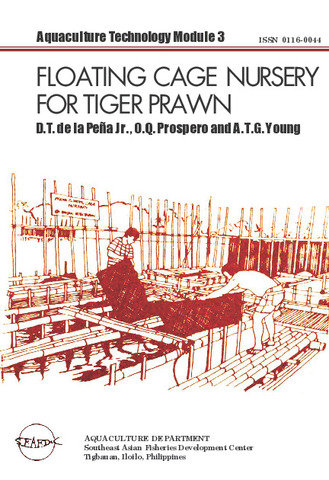
Series: Aquaculture technology module / SEAFDEC Aquaculture Department; No. 3
Floating cage nursery for tiger prawn
(Aquaculture Department, Southeast Asian Fisheries Development Center, 1985) -
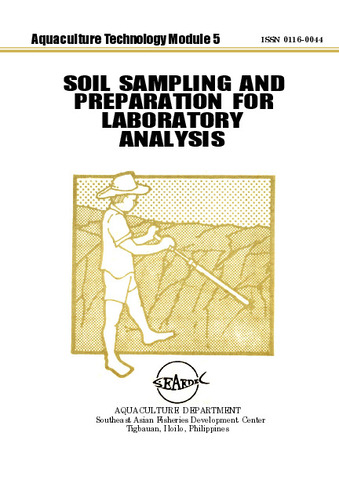
Series: Aquaculture technology module / SEAFDEC Aquaculture Department; No. 5
Soil sampling and preparation for laboratory analysis
(Aquaculture Department, Southeast Asian Fisheries Development Center, 1986) -
Extensive and semi-intensive culture of sugpo (Penaeus monodon) in the Philippines
(Aquaculture Department, Southeast Asian Fisheries Development Center, 1984) -
Status of prawn (Penaeus monodon) feed development in the Philippines
(Aquaculture Department, Southeast Asian Fisheries Development Center, 1984)Approximately a decade ago the culture of sugpo or tiger prawn (Penaeus monodon) was in its infancy. Prawns were stock alone together with milkfish and fed mainly on natural food present in ponds. High market prices, increase consumer demand, and availability of seeds through artificial propagationin the last six years have brought about a shift towards more intesive culture of prawns. With the advent of the monoculture and more intensive farming of sugpo has come a greater demand for an external source of food because natural food organism in the ponds would no longer suffice to meet the dietary requirements of the prawns. The intensive culture of prawns requires knoledge of their nutrient requirements in order to provide adecquate food for growth and survival. Knowledge of their feeding habits is important particilarly in feed developmemt. Prawn culturists and nutritionists are faced not only with problems of nutritional requirements but also practical consideration such as physical feature of the diet, methods and frequency of feeding, feeding behavior and feeding preferences at varios stage of the life cycle,effects of the food on water quality, amount of feed and types of facilities appropriate for culture. -
Government policies on aquaculture
(Aquaculture Department, Southeast Asian Fisheries Development Center, 1984) -
The processing and exporting of prawns in the Philippines
(Aquaculture Department, Southeast Asian Fisheries Development Center, 1984) -
Seed production and the prawn industry in the Philippines
Primavera, Jurgenne (Aquaculture Department, Southeast Asian Fisheries Development Center, 1984)
In any aquaculture system, the major components are seed and feed. The same is true for Penaeus monodon known locally as sugpo, lukon, pansat or by its trade/export name "black tiger". This paper is an attempt to give a state-of-the-art of prawn hatchery technology and wild fry collection in the country, focus on technical and non-technical problems, and offer solutions and policy recommendations. -
Series: Aquaculture technology series / SEAFDEC Aquaculture Department; No. 2
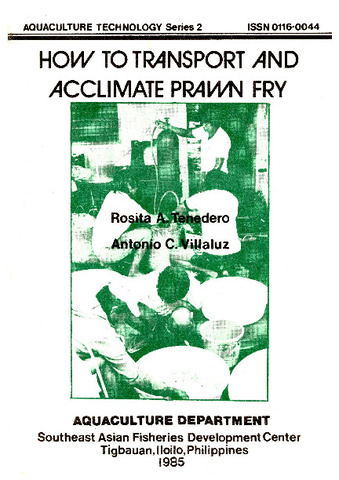
How to transport and acclimate prawn fry
(Aquaculture Department, Southeast Asian Fisheries Development Center, 1985)The manual describes the procedures and techniques to follow for short and long duration transport of prawn fry. Regulations for acceptance and handling of wet shipment and the acclimation of the fry are also covered. -
Series: Aquaculture technology series / SEAFDEC Aquaculture Department; No. 1
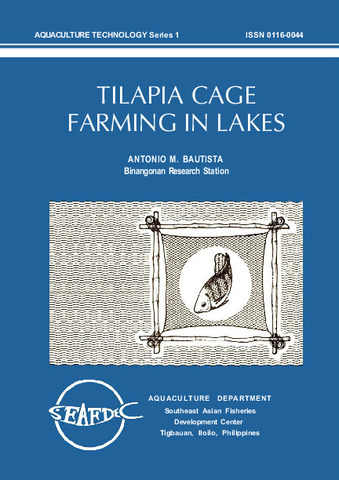
Tilapia cage farming in lakes
(Aquaculture Department, Southeast Asian Fisheries Development Center, 1984)Guidelines are given for the cage culture of tilapia in lakes in the Philippines. The following major topics are covered: site selection; cage design and layout; operation and management tips. -
Seaweed projects funded by DA-BFAR
(Aquaculture Department, Southeast Asian Fisheries Development Center, 2002) -
ITDI R&D activities on seaweeds
(Aquaculture Department, Southeast Asian Fisheries Development Center, 2002) -
Seaweed research at SEAFDEC/AQD
(Aquaculture Department, Southeast Asian Fisheries Development Center, 2002)