SEAFDEC/AQD Institutional Repository: Recent submissions
621-640 / 4221
-
Annual report 1984
(Aquaculture Department, Southeast Asian Fisheries Development Center, 1985)The 1984 annual report of the Aquaculture Department of SEAFDEC is presented under the following main headings: 1) research; 2) training and extension; 3) administration. -
Interaction effect of light intensity and photoperiod on egg hatchability, survival and growth of polychaete Marphysa iloiloensis from larva to juvenile
Mandario, Mary Anne ; ; (Elsevier, 2021)
Polychaetes are of high commercial interest as potential feed in aquaculture industry. Despite this, knowledge of polychaete culture is limited. The goal of this study is to develop a protocol that maximizes survival and growth of polychaetes from embryonic to juvenile stages. To determine the effect of light intensity and photoperiod on Marphysa iloiloensis, two experiments were conducted; 1 - hatchability (embryo-larva; 24 h duration) and 2 - survival and growth (larva-juvenile; 29 d duration). Both experiments followed a 3 × 3 factorial design using three light intensities (3.4, 64.4, and 157 μmol m−2 s−1) and three photoperiods (1 L: 23D, 3 L: 21D, and 6 L: 18D) with four replicates each. The best light regime was compared to the control (0 μmol m−2 s−1). Hatching success was significantly lower in treatments exposed to 157 μmol m−2 s−1 regardless of photoperiod (P < 0.05). Survival at juvenile stage was significantly dependent on the interaction between light intensity and photoperiod (P < 0.01). Survival was higher in both 0 μmol m−2 s−1 and 3.4 μmol m−2 s−1 (all photoperiods). Survival decreased significantly in 64.4 μmol m−2 s−1 and 157 μmol m−2 s−1 under both 3 L: 21D and 6 L: 18D photoperiods. Prolonged exposure to higher light intensity compromised the survival of the polychaete from larval to juvenile stage while growth was not affected. These findings suggest that either continuous darkness or a light intensity of 3.4 μmol m−2 s−1 is the best culture condition from embryonic to juvenile stage of mud polychaete M. iloiloensis to optimize production.
; ; (Elsevier, 2021)
Polychaetes are of high commercial interest as potential feed in aquaculture industry. Despite this, knowledge of polychaete culture is limited. The goal of this study is to develop a protocol that maximizes survival and growth of polychaetes from embryonic to juvenile stages. To determine the effect of light intensity and photoperiod on Marphysa iloiloensis, two experiments were conducted; 1 - hatchability (embryo-larva; 24 h duration) and 2 - survival and growth (larva-juvenile; 29 d duration). Both experiments followed a 3 × 3 factorial design using three light intensities (3.4, 64.4, and 157 μmol m−2 s−1) and three photoperiods (1 L: 23D, 3 L: 21D, and 6 L: 18D) with four replicates each. The best light regime was compared to the control (0 μmol m−2 s−1). Hatching success was significantly lower in treatments exposed to 157 μmol m−2 s−1 regardless of photoperiod (P < 0.05). Survival at juvenile stage was significantly dependent on the interaction between light intensity and photoperiod (P < 0.01). Survival was higher in both 0 μmol m−2 s−1 and 3.4 μmol m−2 s−1 (all photoperiods). Survival decreased significantly in 64.4 μmol m−2 s−1 and 157 μmol m−2 s−1 under both 3 L: 21D and 6 L: 18D photoperiods. Prolonged exposure to higher light intensity compromised the survival of the polychaete from larval to juvenile stage while growth was not affected. These findings suggest that either continuous darkness or a light intensity of 3.4 μmol m−2 s−1 is the best culture condition from embryonic to juvenile stage of mud polychaete M. iloiloensis to optimize production. -
Annual report 1983
(Aquaculture Department, Southeast Asian Fisheries Development Center, 1984)The annual report for 1983 is presented. Summaries are provided for all of the Department's ongoing research projects on fish, crustaceans, mollusks, and seaweeds. The training and extension programs are described and a list of the Department's publications is included. -
フィリピン・バタン湾におけるウシエビ放流の試み
; ; Primavera, Yasmin; (International Center for Research and Education in Agriculture, 2019-06-06)
Processes and results of stock enhancement of tiger shrimp performed in Batan Bay in Philippines was reported as a trans-disciplinary research for enhancement of area-capability (AC). Causes of decline in catch amount of tiger shrimp were overfishing and degradation of its nursery grounds such as mangrove forest. Five fishers had participated in the intermediate culture throughout the project period. Technical issues for stock enhancement were solved and expectable recapture rate of released shrimp was more than 20%. Economic feasibility of the stock enhancement was also confirmed. Forty-five percent of the people in the area are realizing the increase of catch amount of tiger shrimp. Effectiveness of stock enhancement is obtaining understanding from common people including public administrations. After the project, the stock enhancement was paused and stakeholders want to proceed with the stock enhancement. Aklan State University is planning to support stock enhancement project as its extension activities and expect participations of researchers from foreign countries. Such activities will provide research opportunities for evaluation and theorization of AC. -
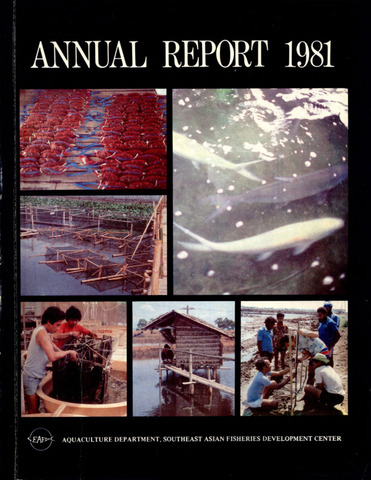
Annual report 1981
(Aquaculture Department, Southeast Asian Fisheries Development Center, 1982)The report contains details of administration, aquaculture development, and aquaculture investigation, mainly dealing with tilapia, milkfish (Chanos chanos), and shrimp (Penaeus) culture for SEAFDEC's 3 research stations. -
Aspects of nutrition and reproduction in Siganus guttatus with emphasis on applications to aquaculture
(Aquaculture Department, Southeast Asian Fisheries Development Center, 1984)The rabbitfish Siganus guttatus, one of the common species in Philippine waters is being studied at the Aquaculture Department of the Southeast Asian Fisheries Development Center (SEAFDEC) in Iloilo, Philippines for eventual mass seed production. Several problems were encountered in the rearing of this species in the hatchery. One of those suspected was egg quality. This study was conducted to investigate the problem. At the start of the study, the orientation was to improve the feeding management of the broodstock, and to monitor variables strictly dependent on the parents: maturation, spawning frequency, fertilization rates, egg diameter, hatching rates, normality of larvae. Subsequently, the quality of the larvae was investigated using variables such as size at hatching, speed of yolk resorption and early growth. The later part of the study included feeding of broodstocks with formulated experimental diets and rearing the larvae produced. On the whole, this investigation included several aspects of the biology of S. guttatus and provides information on nutrition, growth and reproduction, with emphasis on their applications to aquaculture. -
Technologies in Mangrove-Friendly Aquaculture. Final Report of and Papers Presented to the On-Site Training on Mangrove-Friendly Aquaculture, Hai Phong City, Socialist Republic of Vietnam, 19-30 April 1999
(Aquaculture Department, Southeast Asian Fisheries Development Center, 2000)This document contains the final report of and papers presented as lecture materials, to the On-Site Training on Mangrove-Friendly Aquaculture held in Hai Phong City, Socialist Republic of Vietnam from 19 to 30 April 1999. This document replaces the Advance Copy of the Report issued in May 1999. Fourteen experts on mangroves and aquaculture served as lecturers and resource persons. Technologies in Mangrove-Friendly Aquaculture, in general were introduced, taking into consideration the results of the Workshop on Mangrove-Friendly Aquaculture, 11-15 January 1999, Iloilo City, Philippines. The On-Site Training was participated in by 25 participants; 20 from Vietnam and 5 from Cambodia. The conduct of the On-Site draining was an offshoot of the Project SD/AQ99-CM01 with the SEAFDEC Secretariat which also allocated the necessary funds from the Japanese Trust Fund. The Canada-ASEAN Centre based in Singapore provided funds for the participation of the trainees from the Kingdom of Cambodia. -
Mangrove-aquaculture technology: Philippine experience
(Aquaculture Department, Southeast Asian Fisheries Development Center, 2000)This paper presents the history of one of the earliest mangrove-aquaculture projects in the Philippines which started in 1986. The site is part of the Bureau of Fisheries and Aquatic Resources (BFAR) Fish Farm for milkfish production in Son-oc, Poblacion, Ubay, Bohol, central Philippines. Mangrove seedlings were planted in an area at a ratio of 80%-20%. mangrove to fish culture area. The project proved that mangroves and fish could live and grow in a harmonious relationship. The project area now serves as a free entry for wild fishes so that fish production of no less than one-half ton yearly has been recorded in an area of over 2.0 ha. Fishes caught are usually grouper, snapper, tarpons, barracuda, siganids, tilapia, mullets, caravalle, slipmouth, whiting, scats, goby, sea bass, shrimps and blue crabs. The mangrove-aquaculture project in Ubay, Bohol which has been successful, could be easily adapted by the fisherfolk living in coastal areas where mangroves can be grown. The forest products and fishery resources obtained from such activity could contribute to the sustenance of coastal communities. -
Culture technologies for some economically important seaweeds
(Aquaculture Department, Southeast Asian Fisheries Development Center, 2000) -
Aquaculture of shellfish in Vietnam
(Aquaculture Department, Southeast Asian Fisheries Development Center, 2000) -
Wise use of important mollusc species in mangrove areas: Malaysia
(Aquaculture Department, Southeast Asian Fisheries Development Center, 2000)For centuries, several edible mollusc species are being collected for food by coastal communities from these mangrove ecosystems. The most common molluscs collected are cockles, various species of oysters, clams and cerithids. This paper attempts to discuss the most practical culture technologies that have been developed for some of the more important mollusc species that are cultured in Malaysia. In order of priority, these are Anadara granosa (blood cockle), Crassostrea iredalei (brackishwater slipper oyster), Crassostrea belcheri (mangrove oyster), and Cerithidia obtusa (horn shells). -
The role of mangrove ecosystems and coastal aquaculture in the life of people in coastal mangrove areas
(Aquaculture Department, Southeast Asian Fisheries Development Center, 2000)In discussing the benefits from forests, usually only the direct products such as timber or other forestry products are counted. Little attention is made on indirect benefits such as climate regulation, erosion prevention, flood restriction, etc., which are of great importance because mangrove forests grow at tidal and riverside areas where winds and waves are usually strong. In this paper, the direct products and indirect benefits from mangrove forests are discussed. -
Mangrove-friendly marine shrimp aquaculture technology: Thailand experience
(Aquaculture Department, Southeast Asian Fisheries Development Center, 2000) -
Community-based mangrove-friendly aquaculture: Philippine experience
(Aquaculture Department, Southeast Asian Fisheries Development Center, 2000)This paper discussed two mangrove-friendly aquaculture technologies that will not only protect the coastal and mangrove ecosystem but could also increase the income of the coastal communities not only from the forest products but also from fish, shellfish, and crab production. Moreover, the technologies will not only serve as livelihood but also help in promoting the conservation of biodiversity. -
The Philippine legal framework on silvofisheries
(Aquaculture Department, Southeast Asian Fisheries Development Center, 2000) -
Legal framework for mangrove-friendly aquaculture: Vietnam experience
(Aquaculture Department, Southeast Asian Fisheries Development Center, 2000) -
Wise-use technologies in mangrove-friendly aquaculture: Vietnam experience
(Aquaculture Department, Southeast Asian Fisheries Development Center, 2000)This report refers to the status of aquaculture technologies in coastal areas in general. Some mangrove-friendly aquaculture systems in Vietnam are also discussed including several measures to develop aquaculture in mangroves suitably and sustainably. -
A wise use technology of mangrove-friendly aquaculture in Indonesia: Silvofishery
(Aquaculture Department, Southeast Asian Fisheries Development Center, 2000) -
Regional technical guidelines on early warning system for aquatic animal health emergencies
(Aquaculture Department, Southeast Asian Fisheries Development Center, 2020)This Regional Technical Guidelines for Early Warning System on Aquatic Animal Health Emergencies was developed to enumerate the actions to be undertaken by the AMS in case of the occurrence of known, unknown, existing, emerging or re-emerging disease(s). The guidelines identified the key players in aquatic emergency preparedness and response system including their roles and responsibilities. Actions to be undertaken during any disease emergencies were also described. -
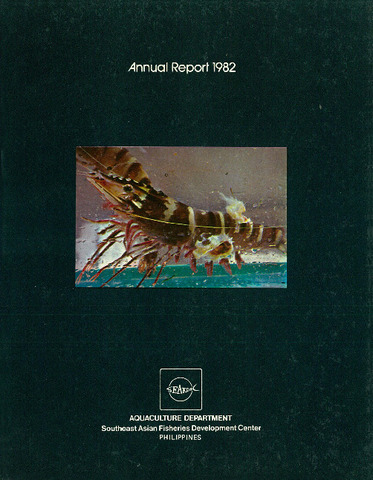
Annual report 1982
(Aquaculture Department, Southeast Asian Fisheries Development Center, 1983)Following a brief overview of 1982 activities of the aquaculture Department of the Southeast Asian Fisheries Development Center, an account is given for the accomplishment and progress of Tigbauan, Leganes, and Binangonan research stations.