SEAFDEC/AQD Institutional Repository: Recent submissions
Now showing items 1181-1200 of 4221
-
Shelter colour preference of the postlarvae of the giant freshwater prawn Macrobrachium rosenbergii
; Bagarinao, Teodora ; ; ; (Springer Verlag, 2017)
The addition of artificial shelters of various materials has been used in Macrobrachium rosenbergii tanks and ponds as a means of increasing productivity. The present study investigated the shelter colour preference of M. rosenbergii postlarvae (age 15–18 days after metamorphosis) in the laboratory. Shelter occupancy tests were performed on four groups of 200 postlarvae in four 57-l aquaria, into which were placed shelters made of rigid coloured netting sewn into four-layered cubes open on two sides. The shelters were presented in six colour pairs: black vs dark green, black vs light green, black vs blue, dark green vs light green, dark green vs blue, and light green vs blue. Colour preference was tested six times for each colour pair. The data obtained were analyzed using Thurstone’s law of comparative judgment. The mean z-score was significantly highest (i.e., highest preference) for the black shelter. Vision was involved in the detection of and approach to the shelter. When released in aquaria, intact-eyed individual postlarvae directly approached the shelter straight away, whereas blind postlarvae (paint over the eyes) swam around randomly and occupied the shelter only after accidental contact much later. Postlarvae in open water out of the shelter exhibited frequent aggressive contact, while those in the shelter were quiescent. The use of black shelters in rearing tanks is thus recommended for reducing stress and aggression among M. rosenbergii postlarvae in the hatchery.
; ; ; (Springer Verlag, 2017)
The addition of artificial shelters of various materials has been used in Macrobrachium rosenbergii tanks and ponds as a means of increasing productivity. The present study investigated the shelter colour preference of M. rosenbergii postlarvae (age 15–18 days after metamorphosis) in the laboratory. Shelter occupancy tests were performed on four groups of 200 postlarvae in four 57-l aquaria, into which were placed shelters made of rigid coloured netting sewn into four-layered cubes open on two sides. The shelters were presented in six colour pairs: black vs dark green, black vs light green, black vs blue, dark green vs light green, dark green vs blue, and light green vs blue. Colour preference was tested six times for each colour pair. The data obtained were analyzed using Thurstone’s law of comparative judgment. The mean z-score was significantly highest (i.e., highest preference) for the black shelter. Vision was involved in the detection of and approach to the shelter. When released in aquaria, intact-eyed individual postlarvae directly approached the shelter straight away, whereas blind postlarvae (paint over the eyes) swam around randomly and occupied the shelter only after accidental contact much later. Postlarvae in open water out of the shelter exhibited frequent aggressive contact, while those in the shelter were quiescent. The use of black shelters in rearing tanks is thus recommended for reducing stress and aggression among M. rosenbergii postlarvae in the hatchery. -
Salt tolerant Nile tilapia production: Prospects in aquaculture
; Romana-Eguia, Maria Rowena R. (Rajiv Gandhi Centre for Aquaculture (MPEDA), 2016)
In the Philippines, salt tolerant Nile tilapia strains have been developed and promoted for culture to increase tilapia production in brackishwater pond systems previously dedicated for milkfish and/or penaeid shrimp culture. This was mainly done to address the decline in the production of such major commodities in ponds and/or cages brought about by diseases and mass fish kills caused by intensified culture methods. The present paper focuses on the different salt tolerant Nile tilapia stocks that have been developed and disseminated in the Philippines, the culture practices involved, as well as the prospects for profitable production of Nile tilapia in saline conditions. -
Mortality of pond-cultured Litopenaeus vannamei associated with acute hepatopancreatic necrosis disease (AHPND) and white spot syndrome virus (WSSV) infection in the Philippines
; ; Amar, Edgar C.; ; ; Faisan, Joseph P., Jr. ; ; ; ; ; (Japanese Society of Fish Pathology, 2017)
Mortalities of up to 60% were observed in pond-cultured Litopenaeus vannamei in Bohol, Philippines. Histopathological examination revealed typical acute hepatopancreatic necrosis disease (AHPND) pathology. PCR test generated 1,269 bp and 230 bp amplicons confirmative for the toxin-producing AHPND strain of Vibrio parahaemolyticus among shrimp sampled from eight ponds. The same samples were subjected to PCR analyses for the presence of other viruses, namely WSSV, IHHNV, IMNV, and TSV. The samples were negative for the viruses except WSSV, which was detected after one-step PCR in six out of eight ponds. These results suggested that shrimp were infected dually with AHPND V. parahaemolyticus and WSSV. -
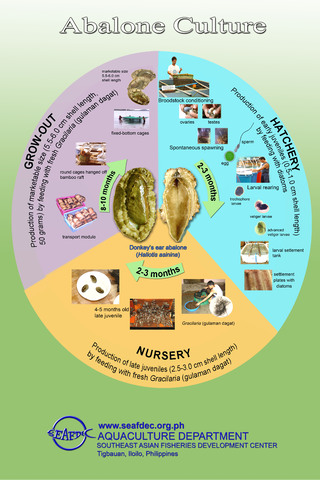
Abalone culture
(Aquaculture Department, Southeast Asian Fisheries Development Center, 2007)Conceptualized by SM Buen-Ursua (Abalone Project). -
Digital curation projects: A study of selected academic and research repositories in the Philippines
; Alayon, Stephen (Nanyang Technological University, 2016)
The paper examines digitization and preservation initiatives in selected academic and research libraries in the Philippines. It identifies the drivers for the projects, practices followed, and issues encountered. Most of the projects were initiated by the librarians in cooperation with information and communication technology personnel. The selection of the materials for digitization was based on demand, the condition of the print format, and importance of the materials for future use. Conversion into microfilm from digital format, use of Internet mirror sites, and off-site repositories of data on hard disks were some of the preservation methods practiced by libraries. Challenges faced by digital curation activities include the need to develop digital curation skills of information professionals and researchers, and to develop the information infrastructure of the institutions and the country. -
Substrate preference for burying and feeding of sandfish Holothuria scabra juveniles
(Elsevier, 2017)Substrate preference for both burying and feeding of sandfish Holothuria scabra juveniles (3–6 g wet body weight) and their associated daily behavior, growth and survival were investigated in laboratory and field experiments using different coastal substrate types (silty mud, sandy mud, and coarse sand) to determine the ideal habitat for potential grow-out culture, sea ranching or stock enhancement of this important sea cucumber species. During the peak hours of burying (03:00–09:00 h) and feeding (15:00–03:00 h), a significantly greater number of sandfish juveniles preferred to bury in (28.3%) and feed on (21.5%) sandy mud, typical of intertidal coastal sand flats. Silty mud was the least preferred substrate for feeding (13.5%) and burying (13.8%). Burying and feeding preferences of sandfish juveniles were not significantly influenced by the presence of seagrass (Thalassia hemprichii) on coarse sand. Growth of sandfish juveniles in the first two weeks of rearing in tanks was significantly greater on coarse sand (growth rate: 0.59 g d−1 or 7.0% d−1), followed by sandy mud (0.34 g d−1 or 4.72% d−1) while OM content of these sediments remain almost unchanged. On silty mud, sandfish juveniles constantly shrunk (−0.02 g d−1 or −0.63% d−1) for 8 weeks while sediment OM content increased. In the field, silty mud substrate of a mangrove pond caused total mortality of sandfish within two weeks, while sandy mud substrate of a sand flat provided significantly higher growth than the control (no sediment), but not significantly different than coarse sand of a seagrass bed. Sandy mud to coarse sand substrates of intertidal sand flats were most preferred by sandfish juveniles while silty mud associated with muddy mangroves and culture ponds seems to be unsuitable that sandfish would opt to avoid. Our results will contribute to the selection of suitable sites for sandfish sea ranching and stock enhancement in coastal areas. -
Growth response of cultured larvae of silver therapon Leiopotherapon plumbeus (Kner, 1864) in outdoor tanks in relation to fertilizer type and fish density
Aya, Frolan; Garcia, Luis Maria (Wiley, 2016)
This study evaluated the effects of fertilizer type and fish density on early growth and survival of silver therapon Leiopotherapon plumbeus (Kner, 1864) larvae reared in outdoor tanks. In the first experiment, larvae (1.92 ± 0.09 mm total length) were stocked into nine, 4 m3 tanks at an initial density of 0.5 larvae L-1 and reared for 42 days at an ambient temperature of 28.8–30.7°C. Three treatments with three replicates each were compared: organic (chicken manure, OF) or inorganic fertilizers (ammonium phosphate, IF) applied once every 2 weeks, and the unfertilized (NF) tanks serving as the control group. Water quality, zooplankton densities, survival or growth of L. plumbeus larvae did not vary significantly in either fertilized or unfertilized tanks. Fertilization resulted in elevated nutrient concentrations, which did affect survival (2.10%–6.07%) of the fish larvae. In the second experiment, larvae were stocked at densities of 0.4 or 0.6 larvae L-1 in tanks fertilized at 4–5 days interval with OF and IF for 30 days. Growth performance of L. plumbeus larvae was affected by fish density, with significantly larger (20.04 ± 2.65 mm in total length) and higher specific growth rate (SGR; 6.97 ± 0.48% day-1) at 0.4 larvae L-1 than at 0.6 L-1. Fry production did not vary significantly between fish density treatment groups given the same fertilizer types, but survival rates were improved at 0.4 L-1. Together, production of L. plumbeus larvae in outdoor tanks can be optimized at a lower stocking density, regardless of the type of fertilizer used. -
Temporal changes in innate immunity parameters, epinecidin gene expression, and mortality in orange-spotted grouper, Epinephelus coioides experimentally infected with a fish pathogen, Vibrio harveyi JML1
Amar, Edgar C.; Faisan, Joseph P., Jr. ; ; Pakingking, Rolando V., Jr. (Elsevier, 2017)
Changes in innate immunity parameters and epinecidin mRNA transcript levels were examined to characterize the non-specific immune response of E. coioides to pathogenic V. harveyi JML1 isolated from affected cage-cultured fish. After fish had been injected with bacteria at a dose causing 30% mortality, blood and tissue samples were collected at 0, 6, 12, 24, 48, 72, 96, 120, and 240 h post-infection (hpi) for assessment of indices such as the oxidative burst (OB) and phagocytic index (PI) of head kidney cells, and lysozyme activity (LYS) and total immunoglobulin (Total Ig) levels of the plasma. The epinecidin mRNA transcript levels (EGE) from skin, gills, liver, kidney, and spleen tissues were also determined by gelbased RT-PCR. Lastly, daily mortality (DM), liver total bacterial load (TBC), and presumptive Vibrio count (TVC) were monitored up to 240 hpi. The results revealed that bacteria proliferated rapidly in fish tissue, reaching peak densities at 24 hpi for both TBC and TVC but was on a downward trend thereafter. The pattern in fish mortality closely correlated with TBC and TVC. Total Ig, OB, and PI in E. coioides were suppressed in the early part of infection when V. harveyi load was high but recovered and later increased as bacterial density declined. LYS and EGE were consistently high and their activities were not hampered by bacterial infection. The study demonstrated that V. harveyi JML1 interacts with E. coioides by transiently inhibiting some immune parameters resulting in mortalities. However, consistently high LYS, upregulated EGE, and resurgent PI, OB and Total Ig conferred resistance and subsequent recovery in the fish. The study provides new insights on the interaction between E. coioides and V. harveyi JML1 that can aid in formulating health management strategies for groupers. Further studies on prophylactic interventions to enhance the innate immune response in grouper during infection with V. harveyi JML1 are suggested. -
Poly-beta-hydroxybutyrate-enriched Artemia sp. for giant tiger prawn Penaeus monodon larviculture
Ludevese-Pascual, Gladys; Laranja, Joseph Leopoldo ; Amar, Edgar C. ; ; ; (John Wiley and Sons, 2017)
The beneficial effects of PHB as supplement for giant tiger prawn Penaeus monodon postlarvae using a short-term enrichment strategy via Artemia were examined. The effects of co-supplementing with a lipid emulsion were also evaluated to determine whether it yielded an additional benefit. Results on the average weight and larval development were not significantly different among postlarvae fed the different dietary treatments, indicating that PHB supplementation could not be used to stimulate growth in P. monodon postlarvae while such positive results have been reported in other aquaculture species. Nonetheless, significantly higher survival was obtained in postlarvae fed PHB-enriched Artemia irrespective of lipid enrichment. In addition, PHB increased the survival of the postlarvae after exposure to a lethal dose of ammonia. Lipid supplementation nullified this effect. The cumulative mortality of postlarvae subjected to a sublethal concentration of ammonia for 24 h and subsequent exposure to pathogenic Vibrio campbelli showed that PHB but not lipids could effectively enhance the resistance of the postlarvae. Co-supplementing lipids even significantly decreased this outcome. Our study indicates that PHB supplementation increases the quality of larval P. monodon and their chance of surviving under adverse environmental conditions. The short-term co-supplementation with lipid emulsion did not add to these effects. -
Proceedings of the International Seminar-Workshop on Mud Crab Aquaculture and Fisheries Management, 10-12 April 2013, Tamil Nadu, India
(Rajiv Gandhi Centre for Aquaculture (MPEDA), 2015) -
Development of practical diet for the grow-out culture of Scylla serrata in ponds
; ; Quinitio, Emilia T. (Rajiv Gandhi Centre for Aquaculture (MPEDA), 2015)
A series of feeding experiments were conducted in the laboratory and in ponds of SEAFDEC/AQD using hatchery-produced Scylla serrata juveniles to develop an effective pelleted grow-out diet. The practical feed ingredients included local and imported fishmeal, shrimp meal, copra meal, soybean meal, corn grits and squid liver powder. The other feed ingredients were rice bran, wheat pollard, bread flour and micronutrient mixes. The results in the laboratory trials were used to improve the feed composition for the culture of crab juveniles in grow-out ponds. Three runs (Run 1 - 108 days, Run 2 - 129 days and Run 3 - 114 days) were conducted in 270m2 ponds. Crab juveniles at stocking densities of 0.08 - 0.10m-2 were fed two dietary treatments containing 44% and 38% crude protein at similar dietary energy level estimated at 17 MJ/kg diet. There were no significant differences in the survival, growth and feed conversion ratio in each of the three runs. In Run 1, the survival rate of crabs fed with 44% protein was higher (56-77%) than crabs fed with 38% protein (35-50%), but these were not significantly different. In Run 2, < 5 g crabs could grow up to a mean body weight of 435 g with survival rates of 31- 45% after 129 days on a ration consisting of 80% pelleted formulated feed and 20% low value fish. Similarly in Run 3, a mean of 443 g was attained in less than 4 months with survival rates of 30-73%. The final average weight and specific growth rate of crabs fed these two diets were not significantly different which showed that in ponds, the 38% crude protein diet was able to sustain growth as with the 44% diet provided the dietary energy is similar. The feed conversion ratio for both test diets and low value fish showed a great variation (low value fish 1 to 4; test diets 1.81 to 5.6). This study showed that low value fish as the traditional feed for mud crab in the grow-out culture can be decreased to only 20% of the ration by incorporating 80% of formulated pelleted feed. -
Culture of Scylla serrata (Forskal) in cement ponds
(Rajiv Gandhi Centre for Aquaculture (MPEDA), 2015)Male and female Scylla serrata juvenile crabs were stocked separately in cement ponds (14 x 8 x 0.8 m; 90 m3) and reared for 90 days. The study was conducted at the Fisheries Research Station, JAU. Okha, Gujarat. The crabs were fed trash fish and Trochus spp. The survival rates of male and female crabs were higher in Run 1 at 66.11% and 45.55%, respectively, than in Run 2 at 13.9% and 6.1%, respectively. The mean body weights of males (1,704 g) and females (994.5g) in Run 1 were higher compared to those in Run 2 (381.2 g for males and 104.5 g for females). However, there were no significant differences (P>0.05) in the average daily weight gain of 0.19 g day-1 for males and 0.13 g day-1 for females in Run 1 and 0.16 g day-1 for males and 0.13 g day-1 for females in Run 2. The water parameter levels were within the optimum ranges for mud crab culture. The results indicate that it is not commercially viable to grow juveniles to market size in cement ponds based on the conditions in this study. -
Soft-shell crab production using hatchery-produced mangrove crab Scylla serrata juveniles
(Rajiv Gandhi Centre for Aquaculture (MPEDA), 2015)Soft-shell crab production is being practiced in many Asian countries but the major source of seedstock is from the wild, which could no longer sustain the increasing demand. Commercial scale soft-shell crab production can become sustainable only if there is a continuous supply of seedstock not dependent on wild stock. Rajiv Gandhi Centre for Aquaculture (RGCA) under the Marine Products Export Development Authority (MPEDA) has established a pilot-scale mud crab hatchery at Thoduvai, Nagapattinam District, Tamilnadu in 2004 with the technical assistance from SEAFDEC/AQD. At present, RGCA has the biggest mud crab hatchery in India and a demonstration farm at Karaikal, U.T. of Puducherry, where nursery rearing, grow-out and soft-shell crab production are conducted using hatchery- produced mangrove crabs or mud crabs, Scylla serrata. This paper presents the results of the soft-shell crab production using hatcheryproduced S. serrata juveniles maintained in perforated low density polyethylene (LDPE) boxes. The duration of the molt interval, time of molt (day or night) and the increase in body weight and carapace width of each size group (40-60, 61-80, 81-100, 101-120, 121-140, 141-160, 161-180 g) after molting were determined. Results showed that the percentage increase in body weight and carapace width increased as the crabs grew bigger. Likewise, the molt interval was longer in bigger-sized groups of crabs. Sixty to seventy percent of the population molted during night time and the next molt occurred within 25 days in 80-160 g size groups. Soft-shell crabs in boxes within the water surface and juvenile crabs (2.5 cm CW initial size) for culture until market size in the pond can be a viable technology technology for mud crab growers. -
Mud crab nursery rearing practices
; Quinitio, Emilia T.; (Rajiv Gandhi Centre for Aquaculture (MPEDA), 2015)
The need for seeds for expansion of the mud crab industry led to the development of the hatchery technology. The nursery technology was developed as this served as a link between the hatchery, which produces megalopae or early crab instars, and the grow-out phase which requires bigger crab juveniles for a higher yield. The nursery has two phases, the first ending with production of crablets with 1- 1.5 cm carapace width (CW) and the second phase with crablets of 2.5-3.0 cm ICW. The more commonly recommended system employs stocking of megalopae or crab instars in net cages installed in ponds. Locally available unprocessed food and commercially available shrimp formulated diet are used for feeding. However, recent studies have successfully used formulated nursery diet for mud crab. One of the main problems in the nursery is cannibalism, and several strategies have been investigated and tried to address the problem. -
Effect of tank color on the survival of mud crab Scylla serrata larvae
(Rajiv Gandhi Centre for Aquaculture (MPEDA), 2015)The survival rate of mud crab or mangrove crab Scylla serrata larvae was evaluated using black and yellow-painted tanks. About 400,000 zoea 1 were stocked in 6 tons of treated seawater. The larvae were initially fed with rotifers and subsequently with newly hatched Artemia until the megalopa stage. The larval rearing water was enriched with a combination of Spirulina powder and frozen micro-algal products that include Nannochloropsis sp., Tetraselmis sp. and Thallasiosira weissfolgii. After 15 to 17 days of rearing, the larvae successfully molted to megalopa stage. A total of 377,062 megalopae were harvested. Although the survival rate of megalopae was higher in yellow tanks (23.63± 0.03%), it was not significantly different when compared to those in black tanks (15.66±0.02%) (P=0.05). -
Mass seed production of mud crab Scylla serrata at Rajiv Gandhi Centre for Aquaculture
(Rajiv Gandhi Centre for Aquaculture (MPEDA), 2015)Mass seed production of mud crab Scylla serrata adopting the best management practices has been done in the hatchery of Rajiv Gandhi Centre for Aquaculture, Thoduvai in Tamil Nadu. Mature female mud crabs from farms and landing centres were procured, screened for White Spot Syndrome Virus and conditioned in the hatchery. The crabs were subjected to unilateral eyestalk ablation whenever necessary and maintained in tanks with sand substrate and aeration. The crabs were fed fresh squid, oyster meat and low value fish. Hatching occurred 9 days after spawning. The newly hatched zoeae were stocked in 5-ton tanks at 80 ind/li. The larvae were fed rotifers and Artemia nauplii. Green water culture system with the use of probiotics was adopted. Enrichment of Artemia was carried out. A hatchery run ranged from 25-30 days. The highest survival rate achieved was 17.5%. This could propel the commercialization of mud crab seed production in India. -
Reproductive biology of mud crab Scylla tranquebarica found in Ratnagiri coast, Maharashtra, India
(Rajiv Gandhi Centre for Aquaculture (MPEDA), 2015)The study was carried out to determine the reproductive biology of the mud crab Scylla tranquebarica to provide baseline information that are useful in the seed production activities. Size at first maturation was observed in male crabs with 11 cm carapace width (CW) and in female crabs with 10 cm CW. The highest GSI values in male crabs (6.17) and females (5.12) were observed in October. The maximum number of eggs produced by females was up to 5 million. The egg diameter ranged from 0.69 to 0.76 mm at the heartbeat stage. Embryonic development was classified into five major stages: blastula, gastrula, nauplius pigmentation and heartbeat. The color of newly spawned eggs was orange. As the embryo developed, the color changed from orange to brown and finally to black prior to hatching. The incubation period was 11-13 days and the hatching success was 80%. The temperature and salinity during the incubation period ranged from 27 to 30°C and 30 to 35 ppt, respectively. -
Molecular genetic approaches to resolve taxonomical ambiguity of mud crab species (Genus Scylla) in Indian waters
(Rajiv Gandhi Centre for Aquaculture (MPEDA), 2015)Mud crab or mangrove crab (Genus Scylla de Haan) is one of the most extensively cultured and economically important brachyuran crabs from the family Portunidae in Indo-Pacific countries, including India. Mud crabs exhibit variations in colour, size, spination, polygonal pattern and habitat. These contribute to the confusion in their identification. Accurate identification of the species is essential in the breeding programmes of domesticated stocks and is a crucial factor in the success of stock enhancement programmes. The taxonomic uncertainty of the genus Scylla in India is still an issue and several papers are being published using misleading identification. This is the first attempt to resolve the taxonomical ambiguity of mud crabs commonly found in Indian waters using multiple molecular genetic approaches. ITS-1, RAPD, PCRRFLP and mt-DNA sequencing along with traditional morphometric methods were used. Furthermore, a PCR method was developed by which mud crab species in India could be identified rapidly and accurately. The results of gene sequencing along with other molecular markers clearly indicated that the ‘green’ morph of Indian mud crab is S. serrata, while the ‘brown’ one is S. olivacea which was validated using the revised classification of mud crabs by Keenan et al. (1998). The S. serrata commonly mentioned in published literatures from India is S. olivacea and the S. tranquebarica, as believed by many Indian researchers, should be classified as S. serrata. Therefore, caution should be taken while interpreting or implementing the biological, molecular and aquaculture data published in those literatures. -
Scylla species found in Cochin backwaters, Kerala, South India
(Rajiv Gandhi Centre for Aquaculture (MPEDA), 2015)The present study described the Scylla species collected from Cochin backwaters for two years from June 2010 to May 2012. Identification and description of Scylla species were carried out based on the morphological characters focusing on the first and second male gonopods, and third maxillipeds. The first male pleopods of the three species were found to be similar in shape, but variations were observed in the setation pattern. S. serrata and S. tranquebarica showed two patches of setae on the inner margin on its posterior end, which was thin and inconspicuous in the former, while thick and conspicuous in the latter. S. olivacea was found to possess only a single tuft of thick setae on the inner margin of the first male pleopod. The second male pleopods were similar in S. serrata and S. tranquebarica, while found to be varied in S. olivacea. The second male pleopods were found to possess setation on the inner margin on its posterior region in S. olivacea, which was totally absent in S. serrata and S. tranquebarica. There were no significant variations in the third maxillipeds among the three Scylla spp. The third maxillipeds of three Scylla spp. were characterized by broad and flattened merus and ischium, lined with thick hairs on the inner margin. The present study shows the occurrence of three species, Scylla serrata, S. tranquebarica and S. olivacea, in Cochin backwaters. However identification of species needs to be confirmed using molecular techniques. -
Status of mud crab industry in Thailand
(Rajiv Gandhi Centre for Aquaculture (MPEDA), 2015)Mud crab is an economically important crustacean commodity in Thailand due to its high nutritional and market value. All the four species of mud crab, Scylla paramamosain, S. olivacea, S. serrata and S. tranquebarica are found in Thailand. The production areas are along the coasts of Gulf of Thailand where S. paramamosain or white mud crab is abundant, and Andaman Sea where S. olivacea or black mud crab is dominant. Data from the Thai Department of Fisheries estimated that the total mud crab production in 2010 was 2,130 mt valued at Baht 322.7 million (US$10.84 million). In the last decade, the production from coastal aquaculture was 6,921 mt valued at Bath 491.4 million (US$16.51 million). The probable cause of the decrease in production is the over exploitation of the wild population. Mud crab culture systems commonly practiced are grow-out (culture from juveniles to market size crabs in ponds), fattening of lean crabs and production of soft-shell crabs. In the past, seedstocks for grow-out culture were collected from the wild. Recently, both wild and hatchery-reared seedstocks are being utilized for farming. Mud crabs for fattening and production of soft-shell rely mainly on wild resources. All culture practices are considered extensive or semiintensive except for soft-shell crab farming which is intensive. The current research and development activities include broodstock and seed production techniques, and formulated feed production. Further technical and financial support are required to improve the survival and production of mud crab. Likewise, support for the transfer of technology to farmers is needed. The lack of seed supply is a major issue facing the mud crab industry in Thailand. A few mud crab hatcheries, which belong to the government, have been established. It is becoming difficult to collect ovigerous females from the wild. Hence, most females are obtained from ponds. Collection of ovigerous females in the wild is prohibited from October to December. Restocking of mud crabs in the natural habitat has become a routine activity to increase the resources.