SEAFDEC/AQD Institutional Repository: Recent submissions
Now showing items 1421-1440 of 4221
-
Ecology and farming of milkfish
Bagarinao, Teodora (Aquaculture Department, Southeast Asian Fisheries Development Center, 1999)
This book is a reader-friendly illustrated account of the life history of milkfish (Chanos chanos) in nature and in aquaculture. It describes the different farming systems and status of the milkfish industry, and recommends means to ensure sustainability.
(Aquaculture Department, Southeast Asian Fisheries Development Center, 1999)
This book is a reader-friendly illustrated account of the life history of milkfish (Chanos chanos) in nature and in aquaculture. It describes the different farming systems and status of the milkfish industry, and recommends means to ensure sustainability. -
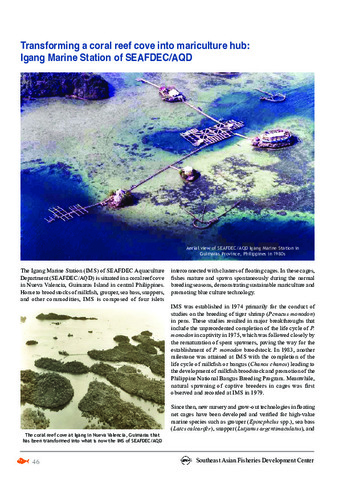
Transforming a coral reef cove into mariculture hub: Igang marine station of SEAFDEC/AQD
(Secretariat, Southeast Asian Fisheries Development Center, 2015) -
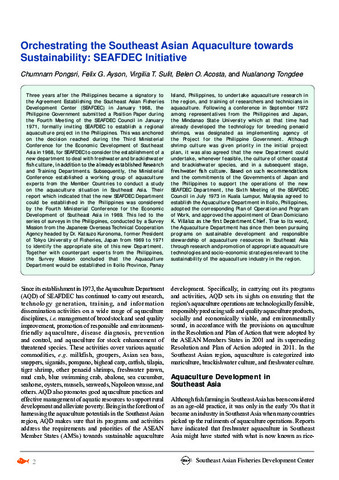
Orchestrating the southeast Asian aquaculture towards sustainability: SEAFDEC initiative
(Secretariat, Southeast Asian Fisheries Development Center, 2015)Three years after the Philippines became a signatory to the Agreement Establishing the Southeast Asian Fisheries Development Center (SEAFDEC) in January 1968, the Philippine Government submitted a Position Paper during the Fourth Meeting of the SEAFDEC Council in January 1971, formally inviting SEAFDEC to establish a regional aquaculture project in the Philippines. This was anchored on the decision reached during the Third Ministerial Conference for the Economic Development of Southeast Asia in 1968, for SEAFDEC to consider the establishment of a new department to deal with freshwater and brackishwater fish culture, in addition to the already established Research and Training Departments. Subsequently, the Ministerial Conference established a working group of aquaculture experts from the Member Countries to conduct a study on the aquaculture situation in Southeast Asia. Their report which indicated that the new SEAFDEC Department could be established in the Philippines was considered by the Fourth Ministerial Conference for the Economic Development of Southeast Asia in 1969. This led to the series of surveys in the Philippines, conducted by a Survey Mission from the Japanese Overseas Technical Cooperation Agency headed by Dr. Katsuzo Kuronoma, former President of Tokyo University of Fisheries, Japan from 1969 to 1971 to identify the appropriate site of this new Department. Together with counterpart experts from the Philippines, the Survey Mission concluded that the Aquaculture Department would be established in Iloilo Province, Panay Island, Philippines, to undertake aquaculture research in the region, and training of researchers and technicians in aquaculture. Following a conference in September 1972 among representatives from the Philippines and Japan, the Mindanao State University which at that time had already developed the technology for breeding penaeid shrimps, was designated as implementing agency of the Project for the Philippine Government. Although shrimp culture was given priority in the initial project plan, it was also agreed that the new Department could undertake, whenever feasible, the culture of other coastal and brackishwater species, and in a subsequent stage, freshwater fish culture. Based on such recommendations and the commitments of the Governments of Japan and the Philippines to support the operations of the new SEAFDEC Department, the Sixth Meeting of the SEAFDEC Council in July 1973 in Kuala Lumpur, Malaysia agreed to establish the Aquaculture Department in Iloilo, Philippines, adopted the corresponding Plan of Operation and Program of Work, and approved the appointment of Dean Domiciano K. Villaluz as the first Department Chief. True to its word, the Aquaculture Department has since then been pursuing programs on sustainable development and responsible stewardship of aquaculture resources in Southeast Asia through research and promotion of appropriate aquaculture technologies and socio-economic strategies relevant to the sustainability of the aquaculture industry in the region. -
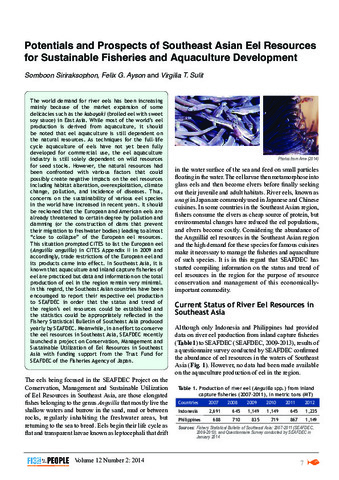
Potentials and prospects of Southeast Asian eel resources for sustainable fisheries and aquaculture development
(Secretariat, Southeast Asian Fisheries Development Center, 2014)The world demand for river eels has been increasing mainly because of the market expansion of some delicacies such as the kabayaki (broiled eel with sweet soy sauce) in East Asia. While most of the world’s eel production is derived from aquaculture, it should be noted that eel aquaculture is still dependent on the natural resources. As techniques for the full-life cycle aquaculture of eels have not yet been fully developed for commercial use, the eel aquaculture industry is still solely dependent on wild resources for seed stocks. However, the natural resources had been confronted with various factors that could possibly create negative impacts on the eel resources including habitat alteration, overexploitation, climate change, pollution, and incidence of diseases. Thus, concerns on the sustainability of various eel species in the world have increased in recent years. It should be reckoned that the European and American eels are already threatened to certain degree by pollution and damming (or the construction of dams that prevent their migration to freshwater bodies) leading to almost “close to collapse” of the European eel resources. This situation prompted CITES to list the European eel (Anguilla anguilla) in CITES Appendix II in 2009 and accordingly, trade restrictions of the European eel and its products came into effect. In Southeast Asia, it is known that aquaculture and inland capture fisheries of eel are practiced but data and information on the total production of eel in the region remain very minimal. In this regard, the Southeast Asian countries have been encouraged to report their respective eel production to SEAFDEC in order that the status and trend of the region’s eel resources could be established and the statistics could be appropriately reflected in the Fishery Statistical Bulletin of Southeast Asia produced yearly by SEAFDEC. Meanwhile, in an effort to conserve the eel resources in Southeast Asia, SEAFDEC recently launched a project on Conservation, Management and Sustainable Utilization of Eel Resources in Southeast Asia with funding support from the Trust Fund for SEAFDEC of the Fisheries Agency of Japan. -
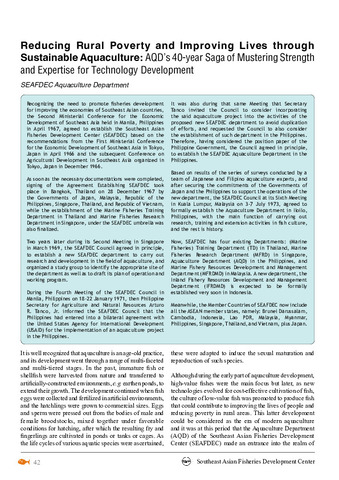
Reducing rural poverty and improving lives through sustainable aquaculture: AQD's 40-year saga of mustering strength and expertise for technology development
(Secretariat, Southeast Asian Fisheries Development Center, 2013)Recognizing the need to promote fisheries development for improving the economies of Southeast Asian countries, the Second Ministerial Conference for the Economic Development of Southeast Asia held in Manila, Philippines in April 1967, agreed to establish the Southeast Asian Fisheries Development Center (SEAFDEC) based on the recommendations from the First Ministerial Conference for the Economic Development of Southeast Asia in Tokyo, Japan in April 1966 and the subsequent Conference on Agricultural Development in Southeast Asia organized in Tokyo, Japan in December 1966. As soon as the necessary documentations were completed, signing of the Agreement Establishing SEAFDEC took place in Bangkok, Thailand on 28 December 1967 by the Governments of Japan, Malaysia, Republic of the Philippines, Singapore, Thailand, and Republic of Vietnam, while the establishment of the Marine Fisheries Training Department in Thailand and Marine Fisheries Research Department in Singapore, under the SEAFDEC umbrella was also finalized. Two years later during its Second Meeting in Singapore in March 1969, the SEAFDEC Council agreed in principle, to establish a new SEAFDEC department to carry out research and development in the field of aquaculture, and organized a study group to identify the appropriate site of the department as well as to draft its plan of operation and working program. During the Fourth Meeting of the SEAFDEC Council in Manila, Philippines on 18-22 January 1971, then Philippine Secretary for Agriculture and Natural Resources Arturo R. Tanco, Jr. informed the SEAFDEC Council that the Philippines had entered into a bilateral agreement with the United States Agency for International Development (USAID) for the implementation of an aquaculture project in the Philippines. It was also during that same Meeting that Secretary Tanco invited the Council to consider incorporating the said aquaculture project into the activities of the proposed new SEAFDEC department to avoid duplication of efforts, and requested the Council to also consider the establishment of such department in the Philippines. Therefore, having considered the position paper of the Philippine Government, the Council agreed in principle, to establish the SEAFDEC Aquaculture Department in the Philippines. Based on results of the series of surveys conducted by a team of Japanese and Filipino aquaculture experts, and after securing the commitments of the Governments of Japan and the Philippines to support the operations of the new department, the SEAFDEC Council at its Sixth Meeting in Kuala Lumpur, Malaysia on 3-7 July 1973, agreed to formally establish the Aquaculture Department in Iloilo, Philippines, with the main function of carrying out research, training and extension activities in fish culture, and the rest is history. Now, SEAFDEC has four existing Departments: (Marine Fisheries) Training Department (TD) in Thailand, Marine Fisheries Research Department (MFRD) in Singapore, Aquaculture Department (AQD) in the Philippines, and Marine Fishery Resources Development and Management Department (MFRDMD) in Malaysia. A new department, the Inland Fishery Resources Development and Management Department (IFRDMD) is expected to be formally established very soon in Indonesia. Meanwhile, the Member Countries of SEAFDEC now include all the ASEAN member states, namely: Brunei Darussalam, Cambodia, Indonesia, Lao PDR, Malaysia, Myanmar, Philippines, Singapore, Thailand, and Vietnam, plus Japan. -
Meeting social and economic challenges in Southeast Asian aquaculture: Targeting rural aquaculture development for poverty alleviation
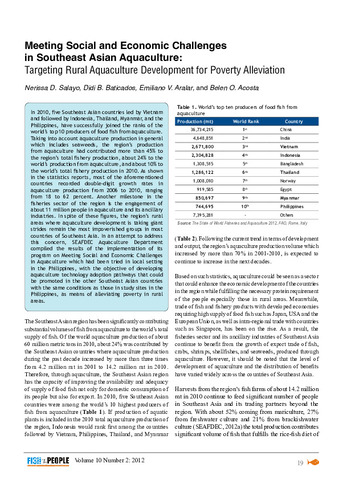
(Secretariat, Southeast Asian Fisheries Development Center, 2012)In 2010, five Southeast Asian countries led by Vietnam and followed by Indonesia, Thailand, Myanmar, and the Philippines, have successfully joined the ranks of the world’s top 10 producers of food fish from aquaculture. Taking into account aquaculture production in general which includes seaweeds, the region’s production from aquaculture had contributed more than 45% to the region’s total fishery production, about 24% to the world’s production from aquaculture, and about 10% to the world’s total fishery production in 2010. As shown in the statistics reports, most of the aforementioned countries recorded double-digit growth rates in aquaculture production from 2006 to 2010, ranging from 18 to 62 percent. Another milestone in the fisheries sector of the region is the engagement of about 11 million people in aquaculture and its ancillary industries. In spite of these figures, the region’s rural areas where aquaculture development is taking giant strides remain the most impoverished groups in most countries of Southeast Asia. In an attempt to address this concern, SEAFDEC Aquaculture Department compiled the results of the implementation of its program on Meeting Social and Economic Challenges in Aquaculture which had been tried in local setting in the Philippines, with the objective of developing aquaculture technology adoption pathways that could be promoted in the other Southeast Asian countries with the same conditions as those in study sites in the Philippines, as means of alleviating poverty in rural areas. -
Promoting sustainable aquaculture development to increase fish supply and improve livelihoods of rural people in Southeast Asia
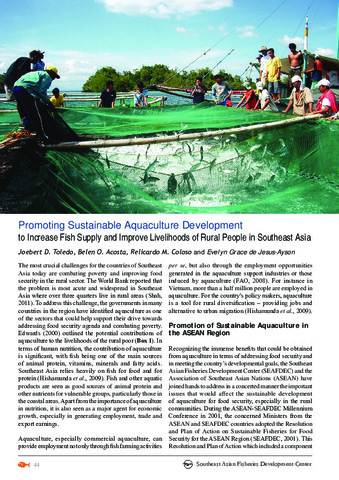
(Secretariat, Southeast Asian Fisheries Development Center, 2011) -
SEAFDEC Regional Fish Disease Program: Safeguarding the quality of aquaculture products and environmental integrity of the southeast Asian region
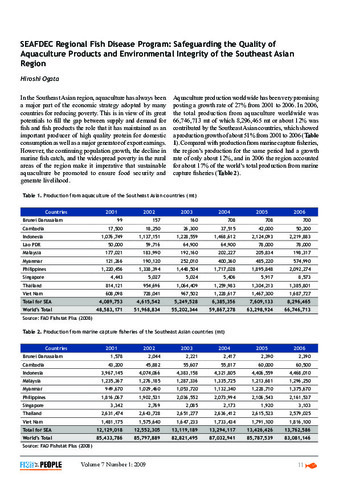
(Secretariat, Southeast Asian Fisheries Development Center, 2009) -
The filter net [tangab] fishery in Iloilo Strait, Philippines: Food and livelihood for coastal communities in the midst of waste of non-target fishery resources
Bagarinao, Teodora (Secretariat, Southeast Asian Fisheries Development Center, 2008)
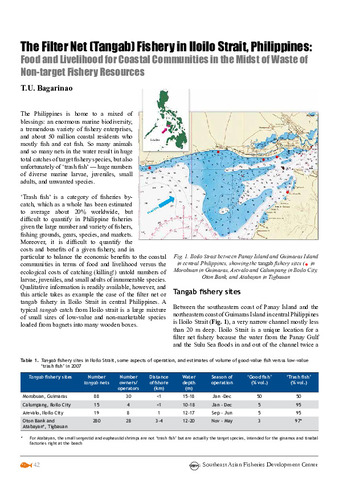
The Philippines is home to a mixed of blessings: an enormous marine biodiversity, a tremendous variety of fishery enterprises, and about 50 million coastal residents who mostly fish and eat fish. So many animals and so many nets in the water result in huge total catches of target fishery species, but also unfortunately of ‘trash fish’ — huge numbers of diverse marine larvae, juveniles, small adults, and unwanted species. 'Trash fish' is a category of fisheries bycatch, which as a whole has been estimated to average about 20% worldwide, but difficult to quantify in Philippine fisheries given the large number and variety of fishers, fishing grounds, gears, species, and markets. Moreover, it is difficult to quantify the costs and benefits of a given fishery, and in particular to balance the economic benefits to the coastal communities in terms of food and livelihood versus the ecological costs of catching (killing!) untold numbers of larvae, juveniles, and small adults of innumerable species. Qualitative information is readily available, however, and this article takes as example the case of the filter net or tangab fishery in Iloilo Strait in central Philippines. A typical tangab catch from Iloilo strait is a large mixture of small sizes of low-value and non-marketable species loaded from bagnets into many wooden boxes. -
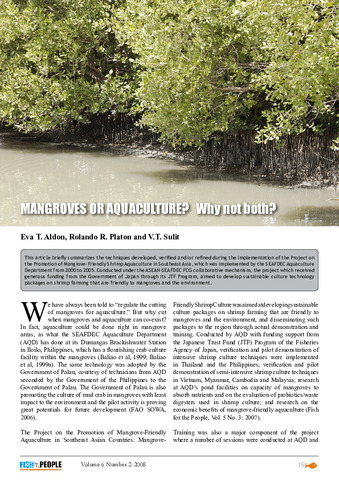
Mangroves or aquaculture? Why not both?
(Secretariat, Southeast Asian Fisheries Development Center, 2008)This article briefly summarizes the techniques developed, verified and/or refined during the implementation of the Project on the Promotion of Mangrove-Friendly Shrimp Aquaculture in Southeast Asia, which was implemented by the SEAFDEC Aquaculture Department from 2000 to 2005. Conducted under the ASEAN-SEAFDEC FCG collaborative mechanism, the project which received generous funding from the Government of Japan through its JTF Program, aimed to develop sustainable culture technology packages on shrimp farming that are friendly to mangroves and the environment. -
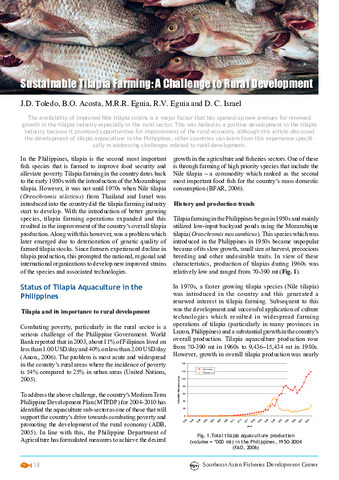
Sustainable tilapia farming: a challenge to rural development
; ; Eguia, Maria Rowena R.; ; (Secretariat, Southeast Asian Fisheries Development Center, 2008)
The availability of improved Nile tilapia strains is a major factor that has opened up new avenues for renewed growth in the tilapia industry especially in the rural sector. This was hailed as a positive development in the tilapia industry because it promised opportunities for improvement of the rural economy. Although this article discussed the development of tilapia aquaculture in the Philippines, other countries can learn from this experience specifically in addressing challenges related to rural development. -
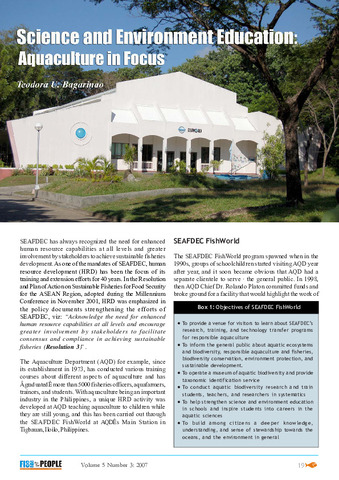
Science and environment education: Aquaculture in focus
Bagarinao, Teodora (Secretariat, Southeast Asian Fisheries Development Center, 2007)
-
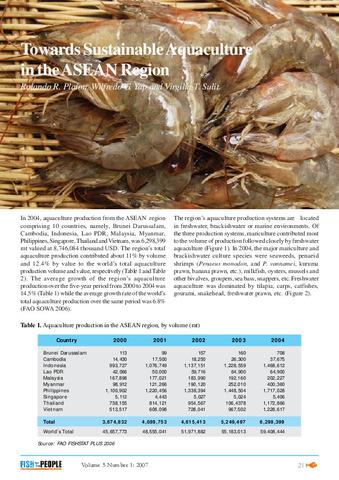
Towards sustainable aquaculture in the ASEAN region
(Secretariat, Southeast Asian Fisheries Development Center, 2007) -
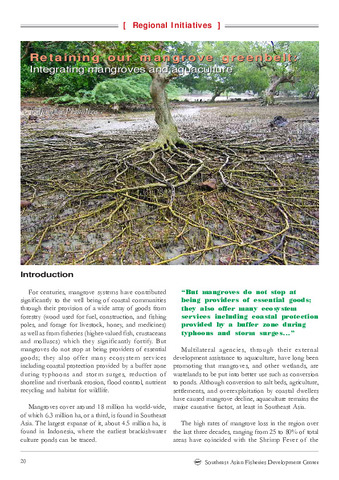
Retaining our mangrove greenbelt: Integrating mangroves and aquaculture
Primavera, Jurgenne (Secretariat, Southeast Asian Fisheries Development Center, 2004)
Although multilateral agencies in Southeast Asia have long been promoting that mangroves, and other wetlands, are wastelands to be put into better use, such as conversion to ponds. However, there is a need for Mangrove Friendly Aquaculture (MFA) technology in the intertidal forest, or swamp, which does not require the clearing of trees. MFA may be defined on 2 levels: 1) silvofisheries or aquasilviculture, where the low density culture of crabs, shrimps and fish is integrated with mangroves; and, 2) mangrove filters where mangrove forests are used to absorb the excess nutrients in the effluents from high-density culture ponds. A review is made of MFA practices belonging to the first category. Discussion is on a country basis, moving from traditional systems in Indonesia, to the introduced technologies in Indonesia, Vietnam, the Philippines and Malaysia. It is hoped that this review will be of use to scientists, aquaculturists, policy makers and governmental/NGOs interested in making aquaculture more ecologically sound and socially responsible. -
SEAFDEC Asian Aquaculture Volume 24(2) April - May 2002
(Aquaculture Department, Southeast Asian Fisheries Development Center, 2002) -
SEAFDEC Asian Aquaculture Volume 24(1) January - March 2002
(Aquaculture Department, Southeast Asian Fisheries Development Center, 2002) -
Impacts of aquaculture on fish biodiversity in the freshwater lake Laguna de Bay, Philippines
(Wiley, 2016)Laguna de Bay is the largest inland water body in the Philippines, being used predominantly for aquaculture and open water fisheries. Aquaculture in the lake began decades ago, with many changes in the lake ecosystem having occurred since that time. Most dominant species for fish culture are introduced species. Other invasive species were also introduced to the lake as escapees from land-based aquaculture facilities. This study was conducted to monitor fish diversity in two adjacent, but distinctly different, sites in the lake, namely an open fishery area (OFS), with no adjacent aquaculture structures, and an aquaculture site (AQS), with cages for the culture of various commodities. Fish traps were installed at both sites, with the traps being sampled at least every 2 weeks from April 2013 to February 2015. The results of pairwise t-tests indicated significantly higher Shannon–Wiener diversity index (H′), evenness (J′), Simpson's similarity index (D) and species richness (s) in OFS than in AQS. In terms of total catch per day, significantly greater fish biomass were obtained from AQS than from OFS. Introduced aquaculture species had a mean dominance of 83% and 47% in AQS and OFS, respectively. However, invasive species introduced from the ornamental fish trade exhibited a mean relative dominance of 10.3% in AQS and 13.5% in OFS. The relative dominance of native species was also significantly higher in OFS (41%) than in AQS (6.5%). The results of this study demonstrated the adverse impacts of aquaculture in regard to the species diversity of fish in localized areas in Laguna de Bay. The dependency of aquaculture on introduced fish species adversely impacted the natural fish population in the lake. Focusing on the culture of commercially important local species for aquaculture, rather than introduced species, will improve fish production of inland waters without accompanying adverse impacts on biodiversity. -
Requirements of juvenile sea bass, Lates calcarifer Bloch, for lysine and arginine
(International Foundation for Science, 1993)The dietary requirements of juvenile sea bass for the essential amino acids, lysine and arginine, were studied. Fish (Initial average weight in Lysine (Study 1) and Arginine (Study 2) experiments were 13.1 g and 2.5 g, respectively) were given amino acid test diets that contained fish meal, zein, squid meal, and crystalline amino acids (about 46% dietary protein) for 12 weeks. Each set of nitrogenous and isocaloric test diets contained graded levels of lysine or arginine. Fish were fed twice a day at 0800 and 1600 h: in Study 1, feeding rate was 4-2.5% of body weight per day throughout the experiment, while in Study 2, fish were fed at a rate of 10% body wt per day during the first four weeks and at 4% body wt per day from 5 to 12 weeks thereafter. The fish were reared in 500 li (Study 1) or 250 li (Study 2) fiberglass tanks provided with flowthrough seawater at 28°C and salinity of 30 ppt. At the end of the feeding experiment, growth, survival, and feed efficiency were determined. Survival was high in fish given adequate lysine or arginine. Mean weight gains were significantly different in fish fed varying levels of lysine or arginine but no significant different in fish fed varying levels of lysine or arginine but no significant differences were found in the hepatosomatic index (HSI), survival, and feed efficiently ratio. From the breakpoint analysis of the growth response curves, the dietary requirements of sea bass juveniles for lysine and arginine are 4.5 and 3.6% of dietary protein, respectively. This information is important in developing research diets and practical feeds for sea bass. -
Seafarming and community development in the Philippines
(Network of Aquaculture Centres in Asia-Pacific, 2002)This paper provides information on the seafarming activities in the Philippines, which includes milkfish, seabass and grouper cage and pen culture. It also provides some other seafarming alternatives including mud crab, seaweed, mussels and oysters. The paper gives information on community-based coastal resource management as a strategy for community development. The Philippines Government Fishery Resources Management project was outlined. The problems and issues associated with seafarming in the Philippines are described. -
Do adaptation and coping mechanisms to extreme climate events differ by gender? The case of flood-affected households in Dumangas, Iloilo, Philippines
(Asian Fisheries Society, 2014)This study was conducted to identify and analyse gender-differentiated adaptation measures and coping mechanisms formulated and implemented by households during Typhoon Frank (international name Fengshen), in barangays Cayos and Bantud Fabrica, Municipality of Dumangas, in the Province of Iloilo, Philippines. The survey was conducted among 120 respondents who were randomly selected from the barangay local government unit. Key informant interviews, focus group discussions and secondary sources were also used to supplement information obtained from the household surveys. Results show that although women and men worked in complementary ways to secure their family assets, gender differences were observed in their preferred adaptation and coping responses. However, statistical analysis shows no significant difference in the responses of women and men relative to the flooding.