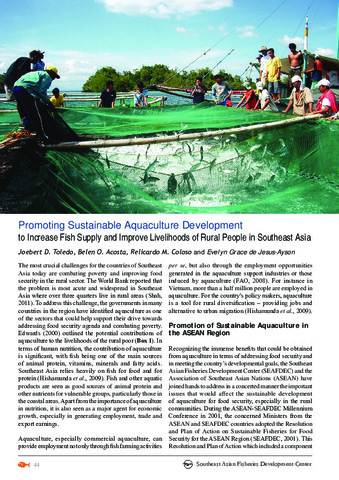
Promoting sustainable aquaculture development to increase fish supply and improve livelihoods of rural people in Southeast Asia


Share
Suggested Citation
Toledo, J. D., Acosta, B. O., Coloso, R. M., & de Jesus-Ayson, E. G. (2011). Promoting sustainable aquaculture development to increase fish supply and improve livelihoods of rural people in Southeast Asia. Fish for the People , 9(2), 44-50. http://hdl.handle.net/20.500.12066/872
Type
magazineArticleISSN
1685-6546Collections
- Fish for the People [41]
Related items
Showing items related by title, author, creator and subject.
-
Institutional capacity development for sustainable aquaculture and fisheries: Strategic partnership with local institutions
(Terrapub, 2008)Many people living in the rural areas in the Philippines, as in other developing countries in Southeast Asia, depend on aquatic resources for their food and livelihood. For the past two decades, the Aquaculture Department of the Southeast Asian Fisheries Development Center (SEAFDEC-AQD) has been working with fishing communities and people’s organizations, business sector, local government units, national government agencies, non-government organizations (NGOs) and academic and other research institutions to promote the efficient conservation, management and sustainable development of the country’s fisheries and aquatic resources so that these may continue to serve the needs of the people today and tomorrow. Using the lessons learned from those two decades of multi-sectoral and inter-disciplinary collaborations, SEAFDEC-AQD launched in late 2006 a project called Institutional Capacity Development for Sustainable Aquaculture (ICDSA) to hasten the transfer to and adoption by coastal villagers of appropriate technologies that would enhance the productivity of aquatic resources and at the same time safeguard the fragile balance of the aquatic ecology. The experience of SEAFDEC in coastal resource management shows that it is important to engage the collaboration of the local government units and other “on-the-ground” institutions, such as NGOs and people’s organizations, to be able to introduce effectively any social and technological interventions to target community-beneficiaries. However, before a fruitful collaboration among these institutions could be attained, there is a need to build their capacities, and those of the beneficiaries, for the vital roles that they play in the implementation of livelihood projects and environmental management programs. As of January 2008, SEAFDEC-AQD is implementing ICDSA projects in four provinces—Antique, Capiz, Guimaras and Northern Samar in central Philippines. In the pipeline are similar projects for a province in southern Philippines and two provinces in the north. -
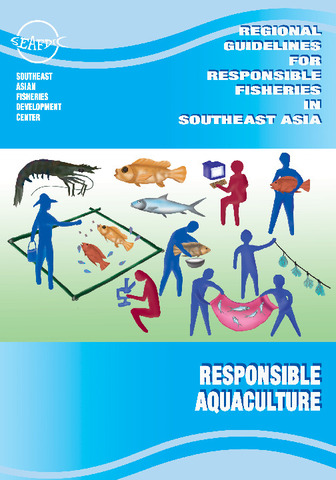
Regional guidelines for responsible fisheries in Southeast Asia: Responsible aquaculture
Bagarinao, TeodoraThis 43-page guidebook presents the code of conduct that has been re-written, expanded, clarified and annotated with definitions and examples to consider the fish farming industries in Southeast Asia. The source of the ... (Aquaculture Department, Southeast Asian Fisheries Development Center, 2005)
-
Orchestrating the southeast Asian aquaculture towards sustainability: SEAFDEC initiative
(Secretariat, Southeast Asian Fisheries Development Center, 2015)Three years after the Philippines became a signatory to the Agreement Establishing the Southeast Asian Fisheries Development Center (SEAFDEC) in January 1968, the Philippine Government submitted a Position Paper during the Fourth Meeting of the SEAFDEC Council in January 1971, formally inviting SEAFDEC to establish a regional aquaculture project in the Philippines. This was anchored on the decision reached during the Third Ministerial Conference for the Economic Development of Southeast Asia in 1968, for SEAFDEC to consider the establishment of a new department to deal with freshwater and brackishwater fish culture, in addition to the already established Research and Training Departments. Subsequently, the Ministerial Conference established a working group of aquaculture experts from the Member Countries to conduct a study on the aquaculture situation in Southeast Asia. Their report which indicated that the new SEAFDEC Department could be established in the Philippines was considered by the Fourth Ministerial Conference for the Economic Development of Southeast Asia in 1969. This led to the series of surveys in the Philippines, conducted by a Survey Mission from the Japanese Overseas Technical Cooperation Agency headed by Dr. Katsuzo Kuronoma, former President of Tokyo University of Fisheries, Japan from 1969 to 1971 to identify the appropriate site of this new Department. Together with counterpart experts from the Philippines, the Survey Mission concluded that the Aquaculture Department would be established in Iloilo Province, Panay Island, Philippines, to undertake aquaculture research in the region, and training of researchers and technicians in aquaculture. Following a conference in September 1972 among representatives from the Philippines and Japan, the Mindanao State University which at that time had already developed the technology for breeding penaeid shrimps, was designated as implementing agency of the Project for the Philippine Government. Although shrimp culture was given priority in the initial project plan, it was also agreed that the new Department could undertake, whenever feasible, the culture of other coastal and brackishwater species, and in a subsequent stage, freshwater fish culture. Based on such recommendations and the commitments of the Governments of Japan and the Philippines to support the operations of the new SEAFDEC Department, the Sixth Meeting of the SEAFDEC Council in July 1973 in Kuala Lumpur, Malaysia agreed to establish the Aquaculture Department in Iloilo, Philippines, adopted the corresponding Plan of Operation and Program of Work, and approved the appointment of Dean Domiciano K. Villaluz as the first Department Chief. True to its word, the Aquaculture Department has since then been pursuing programs on sustainable development and responsible stewardship of aquaculture resources in Southeast Asia through research and promotion of appropriate aquaculture technologies and socio-economic strategies relevant to the sustainability of the aquaculture industry in the region.