Orchestrating the southeast Asian aquaculture towards sustainability: SEAFDEC initiative


Share
Abstract
Three years after the Philippines became a signatory to the Agreement Establishing the Southeast Asian Fisheries Development Center (SEAFDEC) in January 1968, the Philippine Government submitted a Position Paper during the Fourth Meeting of the SEAFDEC Council in January 1971, formally inviting SEAFDEC to establish a regional aquaculture project in the Philippines. This was anchored on the decision reached during the Third Ministerial Conference for the Economic Development of Southeast Asia in 1968, for SEAFDEC to consider the establishment of a new department to deal with freshwater and brackishwater fish culture, in addition to the already established Research and Training Departments. Subsequently, the Ministerial Conference established a working group of aquaculture experts from the Member Countries to conduct a study on the aquaculture situation in Southeast Asia. Their report which indicated that the new SEAFDEC Department could be established in the Philippines was considered by the Fourth Ministerial Conference for the Economic Development of Southeast Asia in 1969. This led to the series of surveys in the Philippines, conducted by a Survey Mission from the Japanese Overseas Technical Cooperation Agency headed by Dr. Katsuzo Kuronoma, former President of Tokyo University of Fisheries, Japan from 1969 to 1971 to identify the appropriate site of this new Department. Together with counterpart experts from the Philippines, the Survey Mission concluded that the Aquaculture Department would be established in Iloilo Province, Panay Island, Philippines, to undertake aquaculture research in the region, and training of researchers and technicians in aquaculture. Following a conference in September 1972 among representatives from the Philippines and Japan, the Mindanao State University which at that time had already developed the technology for breeding penaeid shrimps, was designated as implementing agency of the Project for the Philippine Government. Although shrimp culture was given priority in the initial project plan, it was also agreed that the new Department could undertake, whenever feasible, the culture of other coastal and brackishwater species, and in a subsequent stage, freshwater fish culture. Based on such recommendations and the commitments of the Governments of Japan and the Philippines to support the operations of the new SEAFDEC Department, the Sixth Meeting of the SEAFDEC Council in July 1973 in Kuala Lumpur, Malaysia agreed to establish the Aquaculture Department in Iloilo, Philippines, adopted the corresponding Plan of Operation and Program of Work, and approved the appointment of Dean Domiciano K. Villaluz as the first Department Chief. True to its word, the Aquaculture Department has since then been pursuing programs on sustainable development and responsible stewardship of aquaculture resources in Southeast Asia through research and promotion of appropriate aquaculture technologies and socio-economic strategies relevant to the sustainability of the aquaculture industry in the region.
Suggested Citation
Pongsri, C., Ayson, F. G., Sulit, V. T., Acosta, B. O., & Tongdee, N. (2015). Orchestrating the southeast Asian aquaculture towards sustainability: SEAFDEC initiative. Fish for the People , 13(2), 2-8. http://hdl.handle.net/20.500.12066/962
Type
magazineArticleISSN
1685-6546Collections
- Fish for the People [41]
Related items
Showing items related by title, author, creator and subject.
-
Sustainable aquaculture development in Indonesia
(Aquaculture Department, Southeast Asian Fisheries Development Center, 2021-12)Despite the abundance of potential marine resources, including fisheries, Indonesia is still struggling with several issues, particularly in the aquaculture sector. Environmental issues, aquaculture feeds, fish diseases, and exceeding carrying capacity are some of the many challenges that Indonesia must face these days. The Indonesian government through the Directorate General of Aquaculture (DGA), Ministry of Marine Affairs and Fisheries (MMAF), however, has undertaken efforts to overcome the challenges and at the same time ensuring the sustainability of the sector. Sovereign, competitive, and sustainable aquaculture development policies have been implemented through three main aspects of development: 1) production technology, 2) socioeconomics, and 3) natural resources. Harmonizing and simplifying regulations to encourage investments, interconnecting business chain from downstream to upstream in the industry and strengthening product competitiveness through IndoGAP (Good Aquaculture Practices) implementation are among the steps taken by the government. However, among the efforts to overcome the existing challenges and gaps, Indonesia continues to strive to develop its potential to make Indonesian fish farmers more prosperous and independent in the best possible way. -
Development of a sustainable mangrove crab industry through science-based research
(Secretariat, Southeast Asian Fisheries Development Center, 2017)Farming of mangrove crab (or mud crab) species, e.g. Scylla serrata, S. tranquebarica and S. olivacea has long been established in the Philippines although the preferred species for growing is S. serrata. The Philippines’ total production of mangrove crab from aquaculture in 2013 was estimated at 16,160 metric tons valued at PhP 5.2 billion, making the country the second top producer of mangrove crab in the world (FAO, 2015). The sources of crab seeds for farming are from the wild and in recent years, a small percentage from hatcheries. Degradation of the natural habitat and uncontrolled collection of all sizes of crabs have resulted in the depletion of the natural population of mangrove crab. As a stopgap measure, the Bureau of Fisheries and Aquatic Resources (BFAR) together with the provincial and municipal government issued ordinances that prohibit the gathering and selling of crablets (≤3 cm) outside the municipality of origin to reduce not only the volume of harvest from the natural habitat but also the collection and trading of ovigerous (berried) females. This has resulted to increased acceptability of hatchery-reared crab juveniles by crab growers. Through the R&D efforts of the Philippine-based SEAFDEC Aquaculture Department, dissemination of sustainable management of mangrove crab culture to the region has been intensified for a sustainable mangrove crab industry in Southeast Asia. -
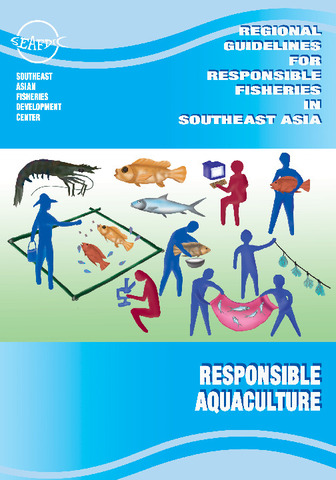
Regional guidelines for responsible fisheries in Southeast Asia: Responsible aquaculture
Bagarinao, TeodoraThis 43-page guidebook presents the code of conduct that has been re-written, expanded, clarified and annotated with definitions and examples to consider the fish farming industries in Southeast Asia. The source of the ... (Aquaculture Department, Southeast Asian Fisheries Development Center, 2005)