SEAFDEC/AQD Institutional Repository: Recent submissions
Now showing items 1041-1060 of 4221
-
Qualitative analysis of the contents of the anterior portion of the oesophagus from adult milkfish, Chanos chanos, captured in Pandan Bay from 10 May-June 1975
(Aquaculture Department, Southeast Asian Fisheries Development Center, 1976)Qualitative analysis of food items in the anterior spiral portion of the oesophagus suggests that adult milkfish feed on both benthic and planktonic materials. -
Spawning of milkfish, Chanos chanos, in captivity
(Aquaculture Department, Southeast Asian Fisheries Development Center, 1976)Newly captured milkfish released 0.8 mm in diameter non-hydrated eggs spontaneously in captivity. After injection with partially purified salmon gonadotropin (SG-G100), 1.2 mm in diameter hydrated eggs were released. These eggs, however, were not fertilized. -
Capture, transport and domestication of adult milkfish, Chanos chanos
(Aquaculture Department, Southeast Asian Fisheries Development Center, 1976)Methods used in the capture, transport and domestication of adult milkfish are described and illustrated. -
Morphological measurements, gonadal development and estimated age of adult milkfish, Chanos chanos captured in Pandan Bay from 10 May - 16 June, 1975
(Aquaculture Department, Southeast Asian Fisheries Development Center, 1976)From 10 May to 16 June, 1975, 106 adult milkfish were captured in an otoshi-ami 500 meters offshore. Of the 106 specimens, 37 were females in various stages of gonadal development or spent and 69 were males of which 41 were sexually mature. The age of these fishes were estimated to be between 3 and 5 years. -
Review of work programmes carried out in India on the biology of the milkfish Chanos chanos
(Aquaculture Department, Southeast Asian Fisheries Development Center, 1976)This account is a brief review of the investigation carried out in India on the various aspects of the biology of the milkfish. It covers the records of observations on the distribution of Chanos fry in the coastal areas, food and feeding of the fish, its growth, maturity, fecundity and spawning, and also certain experimental results on the physiological adaptation of the fish together with the histological structures of its kidney, pituitary and thyroid. While emphasising the paucity of data on the adult milkfish in the wild, the priority areas where information is lacking especially on the spawning ground, reliable identifying characters of the egg as well as on the possible existence of different racial stocks have been discussed. -
Occurrence of milkfish eggs in the adjacent waters of Panay Island, Philippines
(Aquaculture Department, Southeast Asian Fisheries Development Center, 1976)Location of spawning grounds of milkfish is one of the most important steps towards gaining knowledge on the spawning habits of the fish as well as the early life history and nature of its eggs and larvae. The present study is an attempt towards this objective. Surveys were made in selected areas in the sea around the Panay Island and milkfish eggs were collected on several occasions from surface to 20 m depth water by towing with larval nets. The eggs floated in the water in a glass jar. The eggs and newly hatched larvae had the same characteristics as described by Delsman (1929). A comparative study has been made to distinguish milkfish eggs from other more or less similar size pelagic eggs of fishes occurring in the same waters at the same time. -
Notes on food and feeding habits of milkfish (Chanos chanos) from the sea
(Aquaculture Department, Southeast Asian Fisheries Development Center, 1976)Study on the natural food of adult milkfish was made from specimens caught from the open sea. The contents of guts from 15 specimens were qualitatively analysed, and both planktonic as well as benthic forms were encounted. The relationship between the gut length and body length has been worked out. Ten out of 15 milkfish examined were also found to be infected with Acanthocephalan parasites confined mainly to the anterior part of the intestine. -
Milkfish cultivation in Sarawak
(Aquaculture Department, Southeast Asian Fisheries Development Center, 1976)The paper reports the results of experimental rearing of milkfish fry in both fresh and brackishwater ponds in Sarawak. Date on the growth and survival of these imported fry are also given. -
Preliminary capture, husbandry and induced breeding results with the milkfish, Chanos chanos (Forskal)
(Aquaculture Department, Southeast Asian Fisheries Development Center, 1976)The program objective is to breed the milkfish, Chanos chanos (Forskal), in captivity and to raise the fry from the egg, undertaking any research and development which may be necessary to attain that goal. In this, the first year of the project, eight very mature fish were captured and deemed ready for final spawning inducement. One fish (with eggs 0.818 mm in diameter) hydrated and was partially ovulated by two injections of 25 mg salmon gonadotrophin SG-G100. The eggs were not fertilized. The injection procedure or excessive handling and sampling of three other fish resulted in early atresia (reabsorption) of the oocytes. Two fish died from the sampling and handling procedures, and two proved to be too immature with eggs below 0.6 mm in diameter. Preliminary results indicate that oocytes of 0.8 mm and above are at a critical stage (or beyond) at which immediate hypophysation is needed. Injection cannot be delayed. Excessive handling or stress at this stage causes rapid atresia of the oocytes. It appears that oocytes of about 0.7 mm are more suitable for reacting positively to injections. The size of an ovulated egg is about 1.2 mm in diameter. The level and dose rate of SG-G100 used for mullet (20)µg/g body weight) appears too high for the milkfish. A dose of between 12 and 15 µg/g body weight is suggested at present. A resident population of adults of varying ages, numbering over 50 fish, has been assembled. Some were brought from the island of Hawaii to Oahu by land and sea involving 18 hours of travel. All survived the journey. Consequently a small operating satellite field center has been established on Hawaii. A total of 179 dead adult fish have been used for future compilation of age, weight/length, GSI, scale and otolith data. All of the samples are stored. Determination of the GSI for Hawaiian fish indicated a rapid maturation of oocytes and spermatids in June, with a peak spawning period in July and early August. Adult fish have been placed under photoperiod and temperature-regulated conditions to promote maturation out of season. General husbandry methods have been developed for adults in captivity, and a diet formulated which appears to be acceptable. The work on health care is proving to be very informative. Safe handling systems have been developed using ice, and hypotheses made for the results of this treatment and general conditions of stress. Autopsies on dead fish have revealed growths and evidence of heart attack and gastritis. Techniques using commercially available human clinical test kits are proving useful indicators of stress; for example, the presence of hemoglobin and ketones in the mucus increases with stress. Eye lens protein analyses are being undertaken to determine any different racial origins of milkfish. -
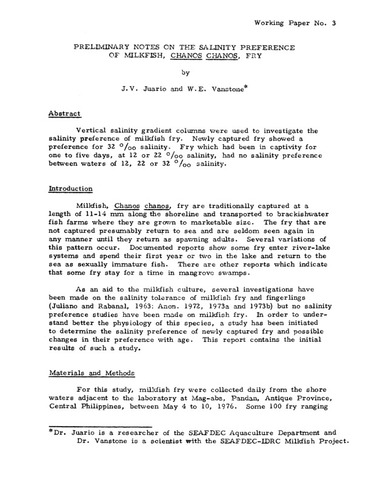
Preliminary notes on the salinity preference of milkfish, Chanos chanos, fry
(Aquaculture Department, Southeast Asian Fisheries Development Center, 1976)Vertical salinity gradient columns were used to investigate the salinity preference of milkfish fry. Newly captured fry showed a preference for 32‰ salinity. Fry which had been in captivity for one to five days, at 12 or 22‰ salinity, had no salinity preference between waters of 12, 22 or 32‰ salinity. -
Effects of salinity on growth of young milkfish, Chanos chanos
(Aquaculture Department, Southeast Asian Fisheries Development Center, 1976)Growth of young milkfish was studied at different levels of salinity over a period 68 days. Results suggested that young milkfish reared in freshwater or less saline sea water grew faster than in sea water. The increase in body weight was neither due to the increase in water content nor increase in feeding rate. The difference in growth rate might be attributed to the deviation from the original acclimating salinity. Mechanisms of the effect of salinity in retarding or accelerating milkfish growth should be investigated in the future. -
Ongoing research studies on maturation and spawning of milkfish, Chanos chanos at the brackishwater shrimp and milkfish culture applied research and training project, Jepara, Indonesia
(Aquaculture Department, Southeast Asian Fisheries Development Center, 1976)The paper gives an account of the research work carried out at Jepara, Indonesia, on induction of maturity of milkfish in ponds and enclosures, and procurement of the spawners from the wild for seed production by hypophysation. Seven to eight years old pond grown milkfish were found sexually immature. Experiments are being conducted for growing and inducing maturity in 1-2 years old milkfish in fertilized ponds with regular tidal flow of water and also under regular hypophysation program. Milkfish spawners collected from sea had a few males in oozing condition and females mostly spent. -
Gonadal response of juvenile protogynous grouper (Epinephelus fuscoguttatus) to long term recombinant follicle-stimulating hormone administration
Palma, Peter ; ; ; ; ; ; (Oxford University Press, 2019-03)
The role of follicle stimulating hormone (FSH) in the gonadal development of protogynous hermaphroditic grouper (E. fuscoguttatus) was investigated. Recombinant giant grouper (E. lanceolatus) FSH (rggFSH) was produced in yeast. Its receptor binding capacity and steroidogenic potency were confirmed in vitro. Weekly injections of rggFSH to juvenile tiger grouper for 8 weeks (100 μg/kg body weight, BW) resulted in significantly larger and more advanced oocytes (cortical alveolar stage vs. primary growth stage in control). Sustained treatment with rggFSH (20 to 38 weeks at 200 μg/kg BW) resulted in significant reduction in gonad size, degeneration of oocytes and proliferation of spermatogonial cells, indicative of female to male sex change. Gene expression analysis showed that, while initiating female to male sex change, the rggFSH significantly suppressed the steroidogenic genes cyp11b, cyp19a1a and foxl2 which restrained the endogenous production of sex steroid hormones thus prevented the differentiation of spermatogonial cells. Expression profile of sex markers dmrt1, amh, figla and bmp15 suggests that the observed sex change was restricted at the initiation stage. Based on these results, we propose that the process of female to male sex change in the protogynous grouper is initiated by FSH, rather than sex steroids and likely involves steroid-independent pathway. The cortical alveolar stage in oocyte development is the critical point after which FSH-induced sex change is possible in grouper.
; ; ; ; ; ; (Oxford University Press, 2019-03)
The role of follicle stimulating hormone (FSH) in the gonadal development of protogynous hermaphroditic grouper (E. fuscoguttatus) was investigated. Recombinant giant grouper (E. lanceolatus) FSH (rggFSH) was produced in yeast. Its receptor binding capacity and steroidogenic potency were confirmed in vitro. Weekly injections of rggFSH to juvenile tiger grouper for 8 weeks (100 μg/kg body weight, BW) resulted in significantly larger and more advanced oocytes (cortical alveolar stage vs. primary growth stage in control). Sustained treatment with rggFSH (20 to 38 weeks at 200 μg/kg BW) resulted in significant reduction in gonad size, degeneration of oocytes and proliferation of spermatogonial cells, indicative of female to male sex change. Gene expression analysis showed that, while initiating female to male sex change, the rggFSH significantly suppressed the steroidogenic genes cyp11b, cyp19a1a and foxl2 which restrained the endogenous production of sex steroid hormones thus prevented the differentiation of spermatogonial cells. Expression profile of sex markers dmrt1, amh, figla and bmp15 suggests that the observed sex change was restricted at the initiation stage. Based on these results, we propose that the process of female to male sex change in the protogynous grouper is initiated by FSH, rather than sex steroids and likely involves steroid-independent pathway. The cortical alveolar stage in oocyte development is the critical point after which FSH-induced sex change is possible in grouper. -
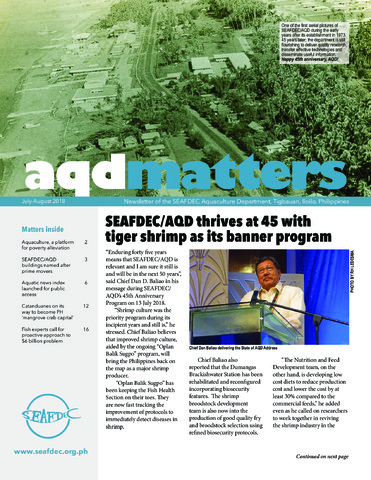
AQD Matters 2018 July - August
(Aquaculture Department, Southeast Asian Fisheries Development Center, 2018) -
Application of poly-β-hydroxybutyrate (PHB)-based biodegradable plastic as artificial substratum in Litopenaeus vannamei culture
Ludevese-Pascual, Gladys; Laranja, Joseph Leopoldo ; Amar, Edgar ; ; (Springer, 2019)
The use of artificial substratum made out of poly-β-hydroxybutyrate (PHB) based biodegradable plastic for penaeid shrimp culture was investigated for the first time. Provision of PHB substratum consisting of PHB type P209 (Biomer, Krailling, Germany) to postlarval whiteleg shrimp Litopenaeus vannamei (106 ± 52 mg) resulted in significantly higher survival (P ≤ 0.05) of 83.6 ± 3.4% as compared to 73.9 ± 3.0% for postlarvae provided with conventional substratum consisting of polyvinylchloride (PVC) pipes. Results on final weight showed significantly higher weight (P ≤ 0.05) of 1008.2 ± 4.5 mg in postlarval whiteleg shrimp provided PHB substratum as compared to 893.4 ± 30.0 mg for postlarvae provided with PVC substratum. The trends of higher visit and preference by postlarval whiteleg shrimp on 10-day and 70-day aged PHB substrata over 10-day and 70-day aged PVC substrata suggest the importance of PHB substratum as grazing area rather than as shelter. Test conducted on water quality also showed a trend towards higher total ammonia-nitrogen (TAN) conversion from an initial concentration of 1.75 ± 0.0 mg L−1 to 0.35 mg ± 0.04 mg L−1 after 72 h with PHB substratum while using no substratum and PVC substratum lead to TAN concentrations of 1.28 ± 0.06 mg L−1 and 1.23 ± 0.10 mg L−1, respectively. Overall, this study indicates that artificial substratum consisting of PHB-based biodegradable plastic increases the quality of postlarval whiteleg shrimp and that it contributes to maintaining good water quality. -
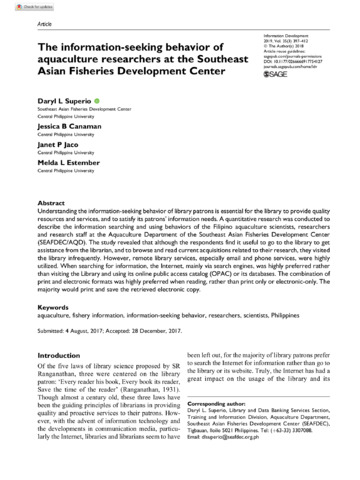
The information-seeking behavior of aquaculture researchers at the Southeast Asian Fisheries Development Center
Superio, Daryl; ; ; (SAGE Publications, 2019)
Understanding the information-seeking behavior of library patrons is essential for the library to provide quality resources and services, and to satisfy its patrons’ information needs. A quantitative research was conducted to describe the information searching and using behaviors of the Filipino aquaculture scientists, researchers and research staff at the Aquaculture Department of the Southeast Asian Fisheries Development Center (SEAFDEC/AQD). The study revealed that although the respondents find it useful to go to the library to get assistance from the librarian, and to browse and read current acquisitions related to their research, they visited the library infrequently. However, remote library services, especially email and phone services, were highly utilized. When searching for information, the Internet, mainly via search engines, was highly preferred rather than visiting the Library and using its online public access catalog (OPAC) or its databases. The combination of print and electronic formats was highly preferred when reading, rather than print only or electronic-only. The majority would print and save the retrieved electronic copy. -
Disaster management practices of academic libraries in Panay island, Philippines: Lessons from typhoon Haiyan
Superio, Daryl; Alayon, Stephen ; (SAGE Publications, 2019)
A disaster management plan is essential because it can guide library personnel on what to do in a critical time. Using an eight-part survey instrument, this paper documents the impact of Typhoon Haiyan on 22 academic libraries in Northern Panay, Western Visayas, Philippines and the disaster management practices that were implemented. The results revealed that although the majority of the libraries do not have a disaster management plan, they all had common disaster management practices that enabled them to save parts of their collections. Moreover, the study revealed that librarians lacked knowledge and skills on disaster management. This paper was presented at the 40th International Association of Aquatic and Marine Science Libraries and Information Centers (IAMSLIC) Annual Conference, Noumea, New Caledonia, September 14–18, 2014. -
An overview of agricultural pollution in the Philippines: The fisheries sector
(World Bank, 2016)This report is part of a national overview of agricultural pollution in the Philippines, commissioned by the World Bank. The overview consists of three ‘chapters’ on the crops, livestock, and fisheries sub-sectors, and a summary report. This ‘chapter’ provides a broad national overview of: (a) the magnitude, impacts, and drivers of pollution related to the fisheries sector’s development with a focus on aquaculture; (b) measures that have been taken by the public sector to manage or mitigate this pollution; and (c) existing knowledge gaps and directions for future research. This report was prepared on the basis of existing literature, recent analyses, and national and international statistics, as well as extensive interviews. It did not involve new primary research and did not attempt to cover pollution issues that arise in the broader aquaculture value chain, relating for instance to processing, packaging and transportation, feed processing, or veterinary drug factories. -
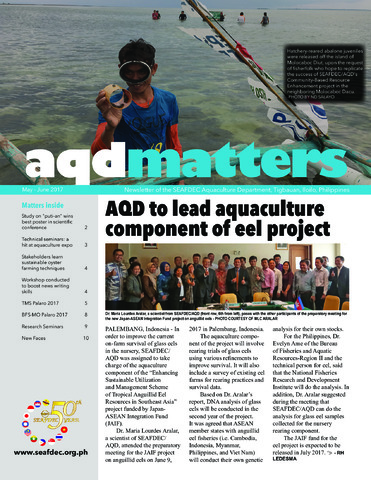
AQD Matters 2017 May - June
(Aquaculture Department, Southeast Asian Fisheries Development Center, 2017) -
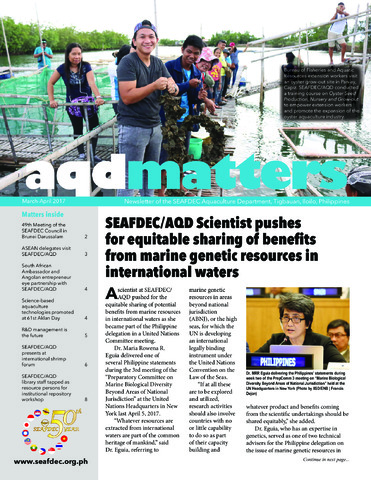
AQD Matters 2017 March - April
(Aquaculture Department, Southeast Asian Fisheries Development Center, 2017)