SEAFDEC/AQD Institutional Repository: Recent submissions
Now showing items 1541-1560 of 4221
-
Are we doing enough? The moral responsibility of a scientist
(Aquaculture Department, Southeast Asian Fisheries Development Center, 1999) -
Milkfish bibliography: a compilation of abstracts on milkfish studies
(WorldFish Center, 2007)Milkfish Bibliography covers 700 references on milkfish biology; broodstock management and fry, fingerling and egg collection and production; milkfish culture systems; health and nutrition; post harvest technology; socioeconomic and related studies; and environment and ecology. Included references range from published/unpublished documents, theses, journal articles, to project reports and conference papers. -
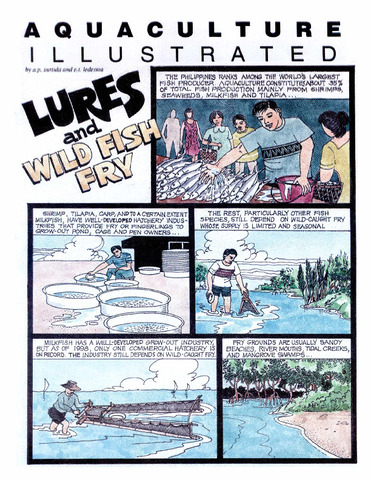
Lures and wild fish fry
(Aquaculture Department, Southeast Asian Fisheries Development Center, 1999) -
Milkfish industry practices
(Aquaculture Department, Southeast Asian Fisheries Development Center, 1999) -
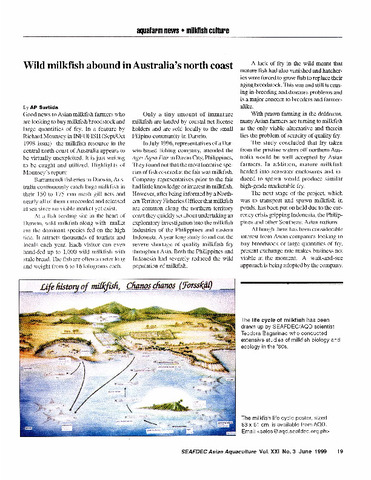
Wild milkfish abound in Australia s north coast
(Aquaculture Department, Southeast Asian Fisheries Development Center, 1999) -
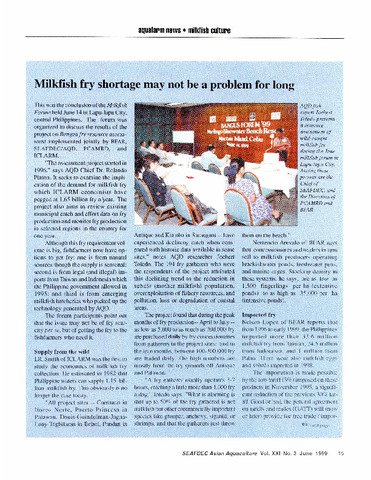
Milkfish fry shortage may not be a problem for long
(Aquaculture Department, Southeast Asian Fisheries Development Center, 1999) -
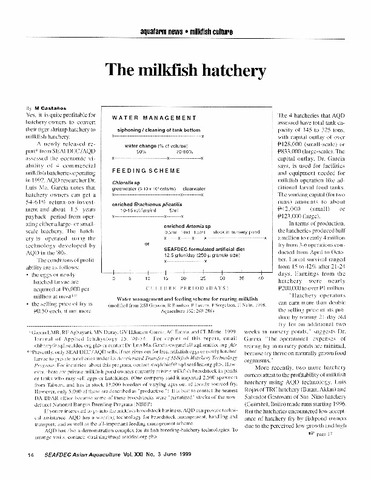
The milkfish hatchery
(Aquaculture Department, Southeast Asian Fisheries Development Center, 1999) -
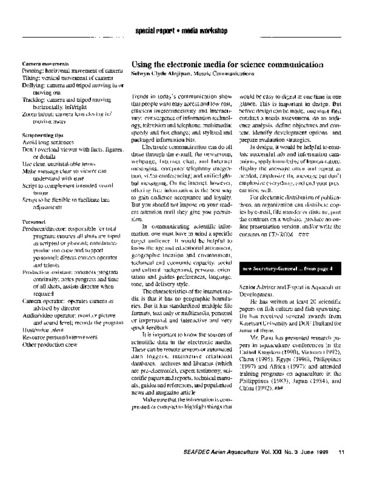
Using the electronic media for science communication
(Aquaculture Department, Southeast Asian Fisheries Development Center, 1999) -
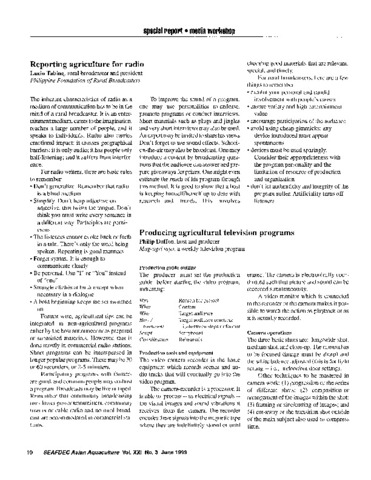
Producing agricultural television programs
(Aquaculture Department, Southeast Asian Fisheries Development Center, 1999) -
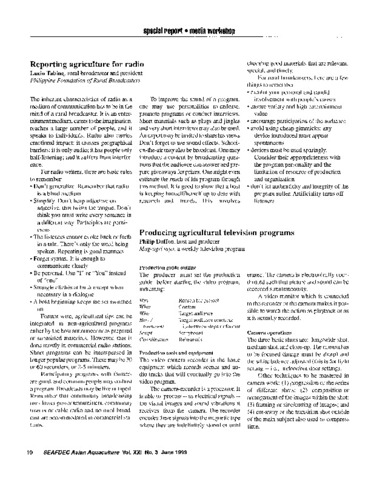
Reporting agriculture for radio
(Aquaculture Department, Southeast Asian Fisheries Development Center, 1999) -
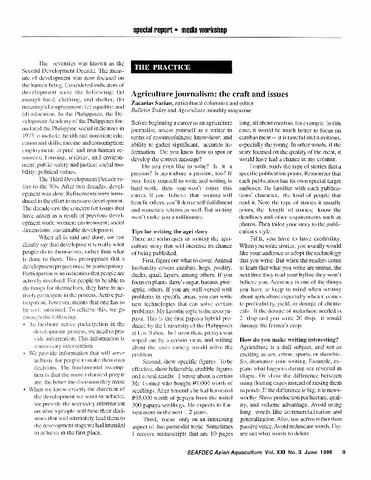
Agriculture journalism: the craft and issues
(Aquaculture Department, Southeast Asian Fisheries Development Center, 1999) -
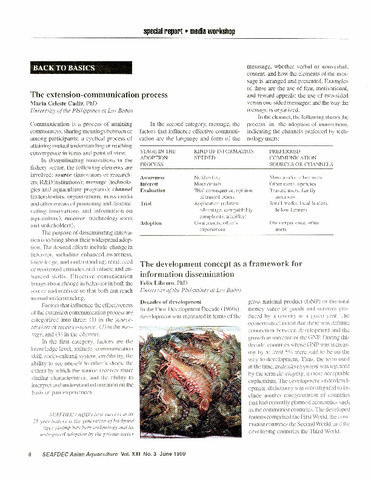
The development concept as a framework for information dissemination
(Aquaculture Department, Southeast Asian Fisheries Development Center, 1999) -
The extension-communication process
(Aquaculture Department, Southeast Asian Fisheries Development Center, 1999) -
Biomass production, proximate composition and fatty acid profile of the local marine thraustochytrid isolate, Schizochytrium sp. LEY7 using low-cost substrates at optimum culture conditions
Ludevese-Pascual, Gladys ; de la Peña, Milagros R. ; (John Wiley and Sons, 2016)
This study was conducted to investigate low-cost substrate alternative and the optimum culture conditions in mass producing the local marine thraustochytrid, Schizochytrium sp. LEY7 isolated from the mangrove leaves of Baybay, Southern Leyte Philippines. Results showed that Schizochytrium sp. LEY7 is able to utilize commercial grade glucose and yeast extract from NaCl-treated baker's yeast as source of carbon and micronutrients respectively. Cost of mass producing the thraustochytrid isolate using the alternative production substrates was substantially reduced. Incubation temperature and salinity levels were the two growth factors significantly affecting the biomass production of the isolate. The short duration of lag phase shown by the isolate suggests a growth advantage in that cells are readily able to adapt to their new environment. Total lipids averaged to 19.4%. Principal fatty acids were palmitic acid (C16:0) with 33.52% and docosahexanoic acid (DHA, C22:6n-3) with 39.92% proportion to total fatty acid. Eicosapentaenoic (C20:5n-3, 1.01%) and arachidonic (C20:4n-3, 0.90%) are present but in relatively lower amount. Our findings showed the potential of low-cost substrate in mass producing the local thraustochytrid isolate, Schizochytrium sp. LEY7 as lipid and polyunsaturated fatty acid source in aquaculture. Biomass production was enhanced by optimizing the culture conditions.
; de la Peña, Milagros R. ; (John Wiley and Sons, 2016)
This study was conducted to investigate low-cost substrate alternative and the optimum culture conditions in mass producing the local marine thraustochytrid, Schizochytrium sp. LEY7 isolated from the mangrove leaves of Baybay, Southern Leyte Philippines. Results showed that Schizochytrium sp. LEY7 is able to utilize commercial grade glucose and yeast extract from NaCl-treated baker's yeast as source of carbon and micronutrients respectively. Cost of mass producing the thraustochytrid isolate using the alternative production substrates was substantially reduced. Incubation temperature and salinity levels were the two growth factors significantly affecting the biomass production of the isolate. The short duration of lag phase shown by the isolate suggests a growth advantage in that cells are readily able to adapt to their new environment. Total lipids averaged to 19.4%. Principal fatty acids were palmitic acid (C16:0) with 33.52% and docosahexanoic acid (DHA, C22:6n-3) with 39.92% proportion to total fatty acid. Eicosapentaenoic (C20:5n-3, 1.01%) and arachidonic (C20:4n-3, 0.90%) are present but in relatively lower amount. Our findings showed the potential of low-cost substrate in mass producing the local thraustochytrid isolate, Schizochytrium sp. LEY7 as lipid and polyunsaturated fatty acid source in aquaculture. Biomass production was enhanced by optimizing the culture conditions. -
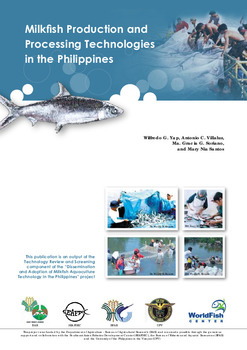
Milkfish production and processing technologies in the Philippines
(WorldFish Center, 2007)This publication describes the various aspects of milkfish production in the Philippines. It covers these areas 1) technology development from a historical perspective, 2) milkfish seed production 3) grow-out in brackishwater ponds 4) grow-out in pens and cages 5)milkfish processing. -
Sandfish culture technology developed
(Manila Bulletin Publishing Corporation, 2011-02) -
Unifying the art, science and business of aquaculture through the information resources and services of SEAFDEC Aquaculture Department Library
Alayon, Stephen; Superio, Daryl ; ; Nemiz, Elvi S. (Secretariat, Southeast Asian Fisheries Development Center, 2013)
Established in 1973 in Tigbauan, Iloilo, Philippines, the Aquaculture Department (AQD) is one of four Departments of the Southeast Asian Fisheries Development Center (SEAFDEC). AQD is mandated to conduct scientific research to generate aquaculture technologies relevant and appropriate for the region; develop human resources; and produce, disseminate and exchange information on aquaculture. AQD is committed to sustainable development and the responsible stewardship of aquaculture resources through science-based research and the promotion of appropriate technologies and information relevant to the Southeast Asian region (SEAFDEC/AQD, 2009). The need to disseminate AQD’s research results is as important as the conduct of research in fisheries and aquaculture as referred to in the Code of Conduct for Responsible Fisheries (Wilkinson and Collins, 2007). In cognizance of the role that AQD should play with respect to its function of disseminating and exchanging information on aquaculture, the AQD Library was established to support the information needs of AQD scientists and staff. In addition, the Library also provides services to visiting researchers, local and international trainees and students, as well as the diverse users from AQD’s partner institutions. During the strategic planning workshop conducted by AQD in 2009, one of the goals identified was for AQD to strengthen the capacities of the aquaculture sector. Matching with such goal, the Library and Data Banking Services Section of the Training and Information Division identified its information dissemination and services target for 2012. Primarily, AQD Library aims to improve accessibility to archived and updated information, and to create a digital library collection of AQD publications and documents. In keeping up its goal of providing quality, current and relevant information, the Library continues to avail of quality print and non-print information resources, to ensure that it keeps abreast of the advancements in aquaculture and fulfil the diverse information needs of users. The Library also introduces innovations in its services with the purpose of unifying the art, science and business of aquaculture, and strengthens its local and international linkages for efficient sharing of knowledge and resources. -
The use of potassium permanganate against trichodiniasis on milkfish (Chanos chanos) fingerlings
Palma, Peter; ; (European Association of Fish Pathologists, 2015)
Trichodiniasis was noted in an intensive milkfish (Chanos chanos) nursery pond in Dumangas, Iloilo, Philippines. It was predominantly caused by a small trichodinid species (body diameter=23-29 µm) with well-developed denticles, identified as Paratrichodina sp. The trichodinid infection resulted in proliferative changes, including clubbing and epithelial hyperplasis of the gill lamellae sufficient to disrupt respiratory function. Tolerance tests of milkfish fingerlings in an earthen pond-simulated environment resulted in a 24 h TL90 value of 1.98 ± 0.25 ppm KMnO4. A treatment of 1.0 ppm KMnO4 was highly efficacious (96%) in eliminating trichodinids on gills with minimal mortality of treated milkfish observed 24 hours post-treatment. -
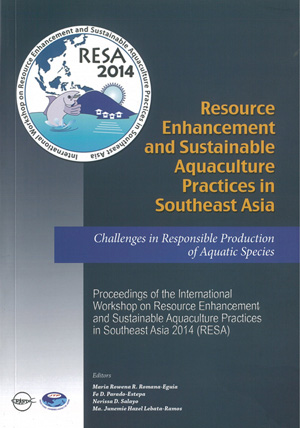
Resource enhancement and sustainable aquaculture practices in Southeast Asia: challenges in responsible production of aquatic species : proceedings of the international workshop on resource enhancement and sustainable aquaculture practices in Southeast Asia 2014 (RESA)
(Aquaculture Department, Southeast Asian Fisheries Development Center, 2015-08)The conference was held in order to promote and augment regional initiatives on resource enhancement and sustainable aquaculture practices, and to contribute to poverty alleviation, livelihood and food security in Southeast Asia. The contributions of the selected participants during the conference which are contained in this volume are cited individually. -
Shrimp metabolism: The roles of lactate dehydrogenase (c31), glycogen phosphorylase (c34) and protein kinase (PK) as revealed by RNA interference
(Aquaculture Department, Southeast Asian Fisheries Development Center, 2015)Energy metabolism is well-studied in vertebrate systems, providing insights on the genes and mechanisms involved in different pathways necessary for the survival of an organism. Yet, such studies are still lacking in invertebrate systems much more in shrimp. An earlier study has showed several contigs from the black tiger shrimp to be homologous to white spot syndrome virus (WSSV), a devastating pathogen in shrimp, including contig 31-WSSVORF82 (c31) and contig 34-WSSVORF21 (c34). This study aims to unveil the roles of three genes: c31, c34 and protein kinase (PK) in the shrimp system and its possible role in WSSV-infection. Rapid amplification of cDNA ends-polymerase chain reaction or RACE-PCR was used to obtain the full-length sequence of c31 and c34, followed by in vivo gene silencing using RNAi technology, and intramuscularly injecting dsRNA to WSSVchallenged Macrobrachium rosenbergii and Penaeus (Marsupenaeus) japonicus. Gene expression followed for healthy shrimps and dsRNA-treated shrimps. Mrc31 was revealed to be the enzyme lactase dehydrogenase (LDH), commonly released during tissue damage and is a marker for disease. The most parsimonious tree pictured Mrc31 to be sister clades to LDH of other shrimp species, Penaeus monodon and P. vannamei, supported with 100% and 72% bootstrap values, respectively. Mrc34 was highly homologous to the glycogen phosphorylase (GP) enzymes of other organisms including that of another shrimp, M. japonicus, bearing a bootstrap value of 99%. For PK, phylogenetic analysis revealed that the three open reading frames (ORFs) from P. monodon, M. rosenbergii and P. japonicus have 30% homology to WSSV-PK supported by a 98% bootstrap value. Mortality data from dsRNA-treated and WSSV-infected shrimps showed that treatment with dsRNA-LDH, GP and PK had significantly higher survival rates compared to that of the controls, Phosphate Buffered Saline (PBS) and Green Fluorescent Protein (GFP). Silencing the three genes in the shrimp has rendered some protective effect against the virus. Gene expression showed that all three genes are present in immune-related organs such as the gills, hepatopancreas and hemocyte. This study is the first to report the possible identities and functions of contigs 31, 34 and PK providing valuable data on the shrimp's genome.