SEAFDEC/AQD Institutional Repository: Recent submissions
Now showing items 3681-3700 of 4221
-
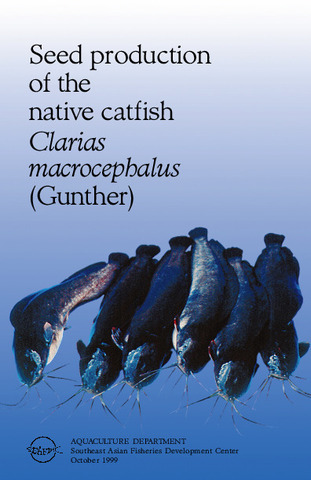
Seed production of the native catfish Clarias macrocephalus [Brochure]
(Aquaculture Department, Southeast Asian Fisheries Development Center, 1999)Describes SEAFDEC/AQD's work on artificially propagating the catfish. -
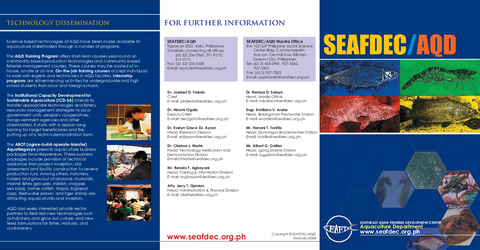
SEAFDEC/AQD
(Aquaculture Department, Southeast Asian Fisheries Development Center, 2008)The flyer contains basic information about AQD, including its vision, mission, departmental and regional programs. -
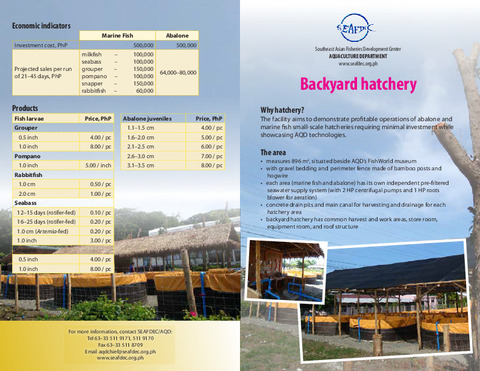
Backyard hatchery
(Aquaculture Department, Southeast Asian Fisheries Development Center, 2009)The flyer contains information on the facility, which aims to demonstrate proftable operations of abalone and marine fsh small-scale hatcheries requiring minimal investment while showcasing AQD technologies. -
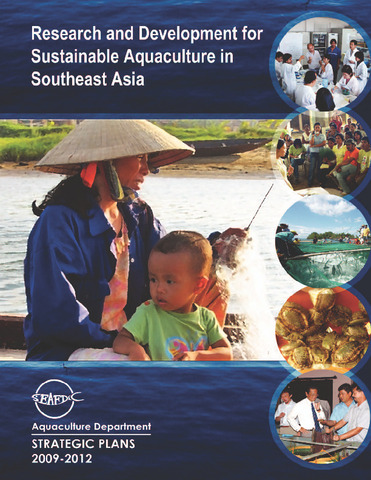
Research and development for sustainable aquaculture in Southeast Asia : SEAFDEC Aquaculture Department strategic plans 2009-2012
(Aquaculture Department, Southeast Asian Fisheries Development Center, 2009)Outlines the strategic plans of the SEAFDEC/AQD for the years 2009 to 2012. In it, the new mission statement is presented as well as the goals, objectives, and targets of its various research, training, information dissemination, and administrative thrusts. -
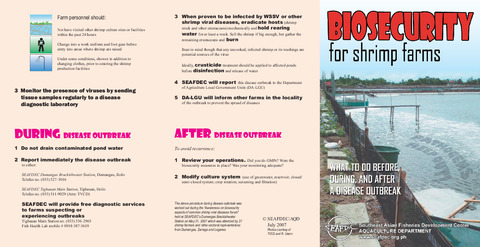
Biosecurity for shrimp farms
(Aquaculture Department, Southeast Asian Fisheries Development Center, 2007)For shrimp farmers, the flyer contains tips on what to do before, during and after a disease outbreak. -
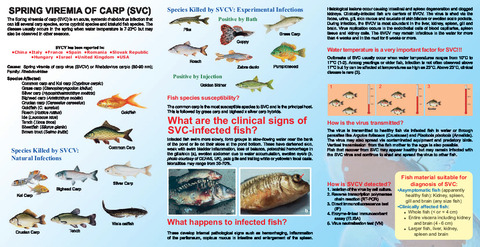
Spring viremia of carp: SVC
(Aquaculture Department, Southeast Asian Fisheries Development Center, 2007)The flyer contains information on the detection of the disease, as well as clinical signs of infected fish and tips on SVC prevention. -
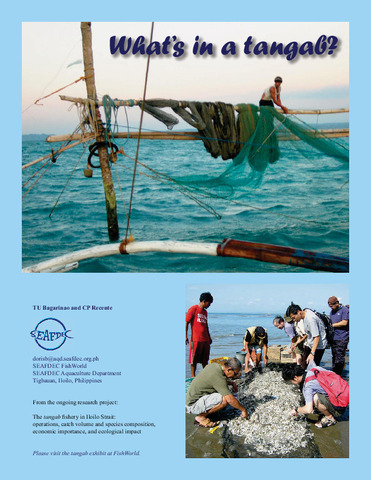
What's in a tangab?
(Aquaculture Department, Southeast Asian Fisheries Development Center, 2008)The flyer contains information about the tangab, which are large fixed filter nets held open by coconut trunks driven into the sea bed, and are operated in Iloilo Strait between Panay Island and Guimaras Island. -
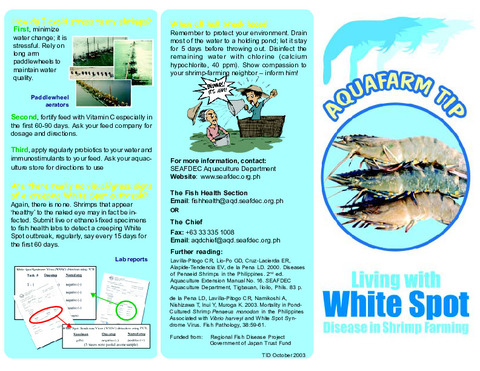
Living with white spot disease in shrimp farming
(Aquaculture Department, Southeast Asian Fisheries Development Center, 2003) -
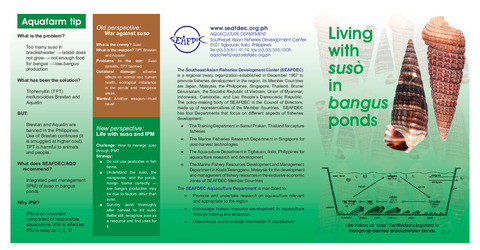
Living with suso in bangus ponds
(Aquaculture Department, Southeast Asian Fisheries Development Center, 2006)A tip for fish farmers, the flyer summarizes the life history of 'suso' or Cerithidea cingulata which are considered pests in bangus or milkfish ponds. Recommends steps to deal with the problem, such as complete sun-drying ... -
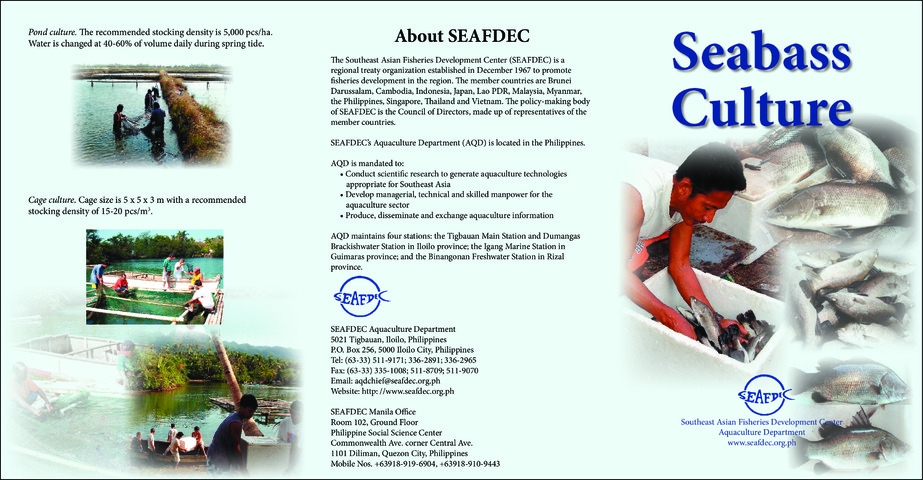
Seabass culture
(Aquaculture Department, Southeast Asian Fisheries Development Center, 2007)The flyer contains information on the culture of seabass from the hatchery, nursery and grow-out phases. -
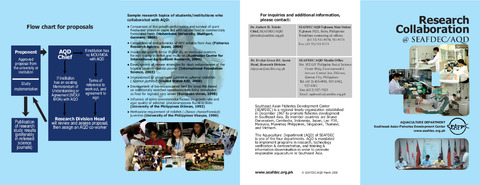
Research collaboration at SEAFDEC/AQD
(Aquaculture Department, Southeast Asian Fisheries Development Center, 2009)Contains information on AQD's collaboration with academic and other research institutions, non-government organizations, private sector and government agencies in SEAFDEC member countries and other parts of the world. ... -
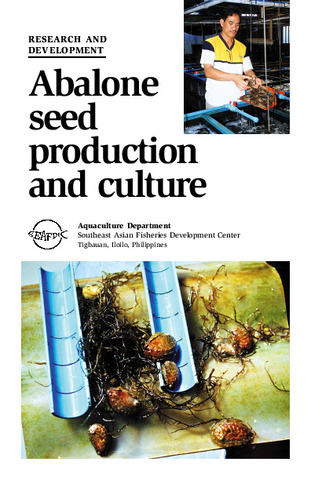
Abalone seed production and culture
(Aquaculture Department, Southeast Asian Fisheries Development Center, 2000)Details the research conducted at AQD for the tropical abalone Haliotis asinina. AQD has developed the rudiments of a hatchery protocol. -
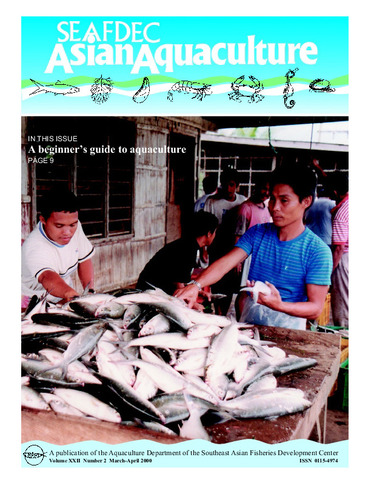
SEAFDEC Asian Aquaculture Volume 22(2) March - April 2000
(Aquaculture Department, Southeast Asian Fisheries Development Center, 2000)In this issue: A beginner's guide to aquaculture. -
The farming of kappaphycus
(Aquaculture Department, Southeast Asian Fisheries Development Center, 1999)Introduces the red seaweed Kappaphycus with notes on the type culture systems, the environmental factors required, initial investment needed, and crop management. -
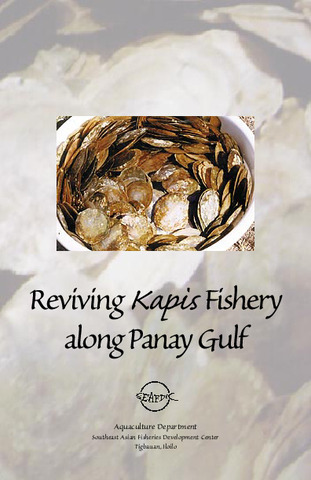
Reviving kapis fishery along Panay Gulf
(Aquaculture Department, Southeast Asian Fisheries Development Center, 2000)Discusses SEAFDEC AQD's work on reviving window-pane shell (kapis) fishery through restocking of breeders along Panay Gulf. -
Mangroves and community aquaculture
(Aquaculture Department, Southeast Asian Fisheries Development Center, 2000)Describes the efforts of AQD to raise mudcrab in pens in mangrove areas in Palawan and Aklan with the participation of local communities. -
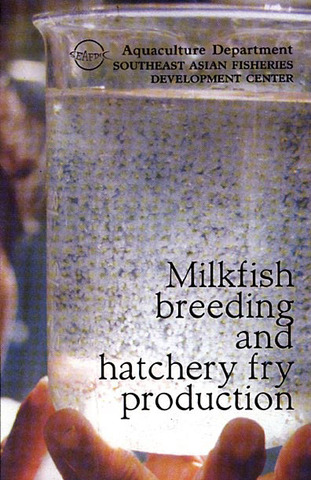
Milkfish breeding and hatchery fry production
(Aquaculture Department, Southeast Asian Fisheries Development Center, 1999)Summarizes the integrated milkfish broodstock and hatchery operation technology developed by SEAFDEC/AQD. -
Milkfish breeding and hatchery technology at SEAFDEC/AQD
(Aquaculture Department, Southeast Asian Fisheries Development Center, 1999)Describes the techniques already adopted by the private sector: broodstock management, broodstock diet, commercial fry production, live transport, and larval diet. A list of AQD research publications on milkfish is included. -
The commercialization of SEAFDEC's milkfish fry production technology
(Aquaculture Department, Southeast Asian Fisheries Development Center, 1999)Illustrates SEAFDEC/AQD's newest hatchery facility -- the Integrated Fish Broodstock and Hatchery Demonstration Complex -- and the Philippine fisheries extension program (Accelerated Transfer of Milkfish Fry Production ... -
Chemicals in Asian aquaculture: need, usage, issues and challenges
(Aquaculture Department, Southeast Asian Fisheries Development Center, 2000)This paper outlines the opening introductory presentation made at the “Expert Meeting on the Use of Chemicals in Aquaculture in Asia,” which was held 20-22 May 1996 at the SEAFDEC facilities in Tigbauan, Iloilo, the Philippines. Its purpose is to provide a balanced and realistic perspective on the needs, issues and challenges with respect to the use of chemicals in Asian aquaculture. We hope to assist participants in identifying development opportunities and in differentiating real hazards from hypothetical threats to cultured organisms, end-users and the environment as a consequence of chemical use. We do not attempt to provide answers to issues related to chemicals in Asian aquaculture, but rather offer some basic directives and opportunities to the workshop participants to assist them in their discussions and in the compilation of realistic recommendations.