SEAFDEC/AQD Institutional Repository: Recent submissions
Now showing items 541-560 of 4221
-
SEAFDEC Aquaculture Department marks 5th year
(Aquaculture Department, Southeast Asian Fisheries Development Center, 1978)In fitting ceremonies July 7 to 9, highlighted by a review of accomplishments by officials of key divisions, the Department marked its first five years as one of three major arms of the Southeast Asian Fisheries Development ... -
How to establish a small-scale hatchery for Penaeus monodon
(Aquaculture Department, Southeast Asian Fisheries Development Center, 1978) -
Milkfish researchers on threshold of another breakthrough
(Aquaculture Department, Southeast Asian Fisheries Development Center, 1978) -
Floating fishpens for rearing fishes in Malaysia
(Aquaculture Department, Southeast Asian Fisheries Development Center, 1978) -
A concept for the transfer of aquaculture technology in Asia
(Aquaculture Department, Southeast Asian Fisheries Development Center, 1978) -
Asian Aquaculture Volume 1(1) July 1978
(Aquaculture Department, Southeast Asian Fisheries Development Center, 1978-07)In this issue: 1) Asian Aquaculture Institute established; 2) The technology continuum: A concept for the transfer of aquaculture technology in Asia; 3) SEAFDEC schedules fishery training programs; 4) Rural thrust - SEAFDEC, ... -
The information-seeking behavior and levels of knowledge, precaution, and fear of college students in Iloilo, Philippines amidst the COVID-19 pandemic
Superio, Daryl ; ; ; ; ; (Elsevier, 2021-06-24)
COVID-19 pandemic is devastating the health, social, and economic well-being of citizens worldwide. The high rates of morbidity and mortality and the absence of vaccines cause fear among the people regardless of age, gender, or social status. People's fear is heightened by misinformation spread across all media types, especially on social media. Filipino college students are one of the top Internet users worldwide and are very active in social media. Hence they are very prone to misinformation. This paper aims to ascertain the levels of knowledge, precaution, and fear of COVID-19 of the college students in Iloilo, Philippines, and determine the effects of their information-seeking behavior on the variables above. This paper is a cross-sectional survey that used a qualitative-quantitative method and snowball sampling technique. Data were gathered among 228 college students using an online survey instrument a few months after the pandemic began. College students were knowledgeable of the basic facts about the highly infectious COVID-19. However, the majority were inclined to believe the myths and misinformation regarding the pandemic. Television was the primary, most believable, and preferred source when seeking information. The Internet as a preferred source of information was significantly associated with a high level of knowledge. In contrast, the information sourced from interpersonal channels were found to make college students very cautious. The local presence of COVID-19 cases had caused college students to fear, likely exacerbated by the plethora of information about the pandemic, mostly from Facebook. This is the first study conducted on the effects of the information-seeking behavior on the levels of knowledge, precaution, and fear of COVID-19 of the college students in Iloilo, Philippines.
; ; ; ; ; (Elsevier, 2021-06-24)
COVID-19 pandemic is devastating the health, social, and economic well-being of citizens worldwide. The high rates of morbidity and mortality and the absence of vaccines cause fear among the people regardless of age, gender, or social status. People's fear is heightened by misinformation spread across all media types, especially on social media. Filipino college students are one of the top Internet users worldwide and are very active in social media. Hence they are very prone to misinformation. This paper aims to ascertain the levels of knowledge, precaution, and fear of COVID-19 of the college students in Iloilo, Philippines, and determine the effects of their information-seeking behavior on the variables above. This paper is a cross-sectional survey that used a qualitative-quantitative method and snowball sampling technique. Data were gathered among 228 college students using an online survey instrument a few months after the pandemic began. College students were knowledgeable of the basic facts about the highly infectious COVID-19. However, the majority were inclined to believe the myths and misinformation regarding the pandemic. Television was the primary, most believable, and preferred source when seeking information. The Internet as a preferred source of information was significantly associated with a high level of knowledge. In contrast, the information sourced from interpersonal channels were found to make college students very cautious. The local presence of COVID-19 cases had caused college students to fear, likely exacerbated by the plethora of information about the pandemic, mostly from Facebook. This is the first study conducted on the effects of the information-seeking behavior on the levels of knowledge, precaution, and fear of COVID-19 of the college students in Iloilo, Philippines. -
Enhanced biosecurity measures for sustainable aquaculture: Shrimp hatchery operations
; ; Mamauag, Roger Edward; ; (Secretariat, Southeast Asian Fisheries Development Center, 2021-01-30)
Long before the COVID-19 pandemic, the Broodstock Facility and Shrimp Hatchery Complex of SEAFDEC Aquaculture Department (AQD) in Tigbauan, Iloilo, Philippines, has already been practicing the best quarantine protocols. The gold standards to ensure the production of diseasefree and high-quality shrimp are being developed by AQD under the program “OPLAN Balik Sugpo” or Operation Plan for Black Tiger Prawn Revival. Initiated in 2017, this Program generally aims to bring back the Penaeus monodon industry of the Philippines and help farmers revive their hopes and venture again into shrimp culture. Under the Program, the disease prevention scheme is currently undergoing verification for responsible management of shrimp broodstock obtained from the natural environment at AQD’s Broodstock Facility, and for the care of the postlarval stage at AQD’s Shrimp Hatchery Complex. -
Exploring the aquaculture potential of ayungin, an endemic freshwater fish in the Philippines
Aya, Frolan (Secretariat, Southeast Asian Fisheries Development Center, 2021-01-30)
In the early 1960s, silver therapon (Leiopotherapon plumbeus), locally known as ayungin, is regarded as one of the most abundant freshwater fishery resources in the largest lake in the Philippines, Laguna de Bay. Smallscale fishing communities around the lake are reliant on this fishery resource for subsistence consumption and livelihood. Recently, ayungin is touted as the most exploited commercial freshwater fish species in most regions of the country. The decline of this important food fish has led to a growing interest in its domestication for culture production and for possible replenishment of depleted stocks in the wild. Therefore, efforts to domesticate, manage, and conserve this native aquatic species have been given a high priority. Due to its readiness to spawn in captivity and successful hatchery production in outdoor tanks, ayungin is considered an emerging species with potential for inland freshwater aquaculture. -
Occurrence and disappearance of a non-native goby Rhinogobius sp. OR in relation to hydrological conditions in the Kamo River, southwestern Japan
Ito, Sayaka; ; ; ; ; ; ; (Springer, 2022-01)
We monitored the abundance of a non-native (Rhinogobius sp. OR) and two native stream gobies (R. fluviatilis and R. nagoyae) over a decade, from 1995 to 2004, in a fixed reach of a tributary of the Kamo River, southwestern Japan. The non-native Rhinogobius sp. OR appeared and reproduced in 1997, when an increased deposition of fine sediments occurred. However, after a severe spate in 1999, the non-native goby almost completely disappeared from the study reach, while the density of the native R. fluviatilis increased. The severe spate is likely to have prevented the establishment of the non-native goby. Our results provide an example of abiotic barriers to invasion. -
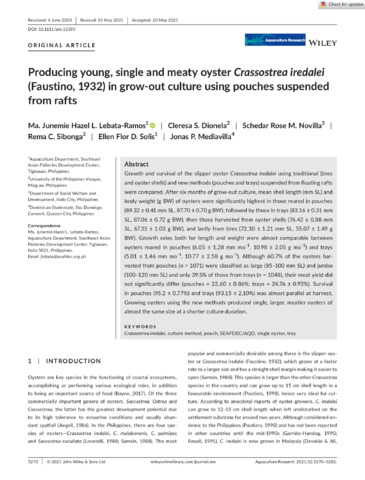
Producing young, single and meaty oyster Crassostrea iredalei (Faustino, 1932) in grow‐out culture using pouches suspended from rafts
Lebata-Ramos, Ma. Junemie Hazel; ; ; Sibonga, Rema ; ; (Wiley, 2021-06-11)
Growth and survival of the slipper oyster Crassostrea iredalei using traditional (tires and oyster shells) and new methods (pouches and trays) suspended from floating rafts were compared. After six months of grow-out culture, mean shell length (mm SL) and body weight (g BW) of oysters were significantly highest in those reared in pouches (89.32 ± 0.41 mm SL, 87.70 ± 0.70 g BW), followed by those in trays (83.16 ± 0.31 mm SL, 87.06 ± 0.72 g BW), then those harvested from oyster shells (76.42 ± 0.88 mm SL, 67.35 ± 1.03 g BW), and lastly from tires (72.30 ± 1.21 mm SL, 55.07 ± 1.49 g BW). Growth rates both for length and weight were almost comparable between oysters reared in pouches (6.05 ± 1.28 mm mo−1, 10.98 ± 2.05 g mo−1) and trays (5.01 ± 1.46 mm mo−1, 10.77 ± 2.58 g mo−1). Although 60.7% of the oysters harvested from pouches (n = 1071) were classified as large (85–100 mm SL) and jumbo (100–120 mm SL) and only 39.5% of those from trays (n = 1048), their meat yield did not significantly differ (pouches = 22.60 ± 0.86%; trays = 24.76 ± 0.93%). Survival in pouches (95.2 ± 0.77%) and trays (93.15 ± 2.10%) was almost parallel at harvest. Growing oysters using the new methods produced single, larger, meatier oysters of almost the same size at a shorter culture duration. -
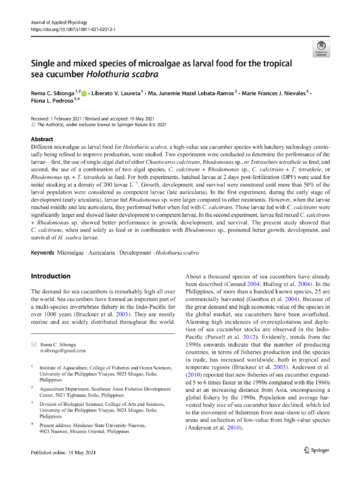
Single and mixed species of microalgae as larval food for the tropical sea cucumber Holothuria scabra
Sibonga, Rema; ; Lebata-Ramos, Ma. Junemie Hazel ; ; (Springer, 2021-05-31)
Different microalgae as larval food for Holothuria scabra, a high-value sea cucumber species with hatchery technology continually being refined to improve production, were studied. Two experiments were conducted to determine the performance of the larvae—first, the use of single-algal diet of either Chaetoceros calcitrans, Rhodomonas sp., or Tetraselmis tetrathele as feed; and second, the use of a combination of two algal species, C. calcitrans + Rhodomonas sp., C. calcitrans + T. tetrathele, or Rhodomonas sp. + T. tetrathele as feed. For both experiments, hatched larvae at 2 days post-fertilization (DPF) were used for initial stocking at a density of 200 larvae L−1. Growth, development, and survival were monitored until more than 50% of the larval population were considered as competent larvae (late auricularia). In the first experiment, during the early stage of development (early aricularia), larvae fed Rhodomonas sp. were larger compared to other treatments. However, when the larvae reached middle and late auricularia, they performed better when fed with C. calcitrans. Those larvae fed with C. calcitrans were significantly larger and showed faster development to competent larvae. In the second experiment, larvae fed mixed C. calcitrans + Rhodomonas sp. showed better performance in growth, development, and survival. The present study showed that C. calcitrans, when used solely as feed or in combination with Rhodomonas sp., promoted better growth, development, and survival of H. scabra larvae. -
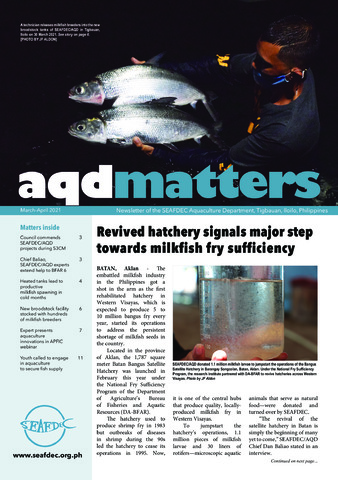
AQD Matters 2021 March - April
(Aquaculture Department, Southeast Asian Fisheries Development Center, 2021-05)In this issue: 1) Council commends SEAFDEC/AQD projects during 53 CM; 2) Chief Baliao, SEAFDEC/AQD experts extend help to BFAR 6; 3) Heated tanks lead to productive milkfish spawning in cold months; 4) New broodstock ... -
Effects of weaning on survival and growth of silver therapon (Leiopotherapon plumbeus) larvae fed live and artificial diet
Aya, Frolan; ; Garcia, Luis Maria (Wiley, 2021-10)
This study examined the effects of early weaning strategies on growth and survival of the silver therapon Leiopotherapon plumbeus larvae. In Trial 1, four larval age groups (8, 14, 20 and 26 days post‐hatch (dph)) were abruptly weaned to commercial powdered tilapia diet and compared with wild copepod‐fed group as the control. In Trial 2, another batch of three weaning age groups were subjected to gradual weaning (8 dph larvae with 8 days co‐feeding, 14 dph larvae with 6 days co‐feeding and 20 dph larvae with 4 days co‐feeding) with Artemia nauplii prior to weaning on commercial powdered prawn diet and compared with a control group consisted of larvae fed exclusively on Artemia nauplii. Both weaning trials were conducted for 21 days. A gradual weaning strategy promoted better survival (22.2%–40.0%) among weaning age groups than the abrupt weaning strategy (2.2%–36.7%). Except for those weaned at 26 dph, abrupt weaning resulted in significantly poor growth and survival among all weaning age groups compared with the wild copepod‐fed control group. The highest survival and growth were observed in 20 dph larvae with 4 days live food co‐feeding, although the values were significantly lower than the Artemia‐fed control group. These results suggest that abrupt weaning at 26 dph, and gradual weaning for 4 days from 20 dph promote successful rearing of silver therapon larvae and that a microparticulate diet specifically formulated for this species needs to be developed. -
Field guide to Philippine mangroves
Primavera, JurgenneAwareness of mangrove importance, particularly for coastal protection, has grown among the general public over the past several years. In turn, this has led to numerous planting initiatives by various groups. However, most ... (Zoological Society of London-Philippines, 2009)
-
Preliminary survey of pests and diseases of eucheumatoid seaweed farms in the Philippines
Faisan, Joseph P., Jr.; ; Sibonga, Rema ; ; ; ; ; ; ; ; ; (Springer, 2021-05-04)
Farmed eucheumatoids are the top aquaculture commodity in the Philippines, contributing more than 60% of total national aquaculture production by volume. Despite significant production losses observed in recent years due to pests and diseases, data relating to the temporal and spatial geographic distribution, seasonality, prevalence, and etiology of these critical problems at the farm level are lacking. Here, we assessed the prevalence of pests and diseases at 16 farm sites within several major seaweed growing areas, including Luzon (Palawan), Visayas (Bohol), and Mindanao (Zamboanga City, Davao del Norte, and Tawi-Tawi). Prevalence of pests and diseases were recorded by assessment of individual seaweed plants in situ, comprising ≥5% of the total number of seaweed plants on each farm. Results from this survey revealed “ice-ice” disease (IID) at all sites, albeit at low prevalence rates of below 25%, the exception being one site where prevalence was 100%. No significant difference in the prevalence of IID was found between farms in shallow (≈0.5 m during low tide) and deep water sites (depths exceeding 4 m during the lowest tide) (p>0.05). Moderate prevalence (26–50%) of the macro-epiphyte pests Sargassum and Ulva was reported in Luzon. Further, epiphytic filamentous algae (EFA), black spots, and evidence of grazing were recorded in several farms with low prevalence (0.2–11.2%). The three farms with the highest prevalence of IID and EFA were evaluated to determine the severity of cover on the thallus of infected plants. A very high severity of IID (76–100% coverage) was observed on the secondary and primary branches, while for EFA, low severity (≤25%) was found in all regions of the thallus. Our results suggest the widespread occurrence of yield-limiting diseases and pests affecting eucheumatoid farms in the Philippines. Strategies for the diagnosis, surveillance, and management of yield-limiting pests and diseases are needed to ensure maintenance and sustainable expansion of this important aquaculture sector in the Philippines. -
Internet use, eHealth literacy and fear of COVID-19 among nursing students in the Philippines
; ; ; ; Superio, Daryl; ; ; ; ; ; (Pablo de Olavide University, 2021-05-03)
The COVID-19 outbreak situation brought into focus not only the safety but also the mental wellbeing of nursing students. At present, the level of fear of COVID-19 and associated factors among nursing students in the Philippines is not well understood. This cross-sectional online survey determined the relationship between Internet use and eHealth literacy with fear of COVID-19. One thousand three hundred and sixty-seven (n=1,367) answered an online survey using the adopted eHealth Literacy Scale (eHEALS), and Fear of COVID-19 Scale (FCV-19S) administered from May 1 to 15, 2020. Descriptive statistics, tests for differences, and correlational analysis were performed. Results indicated that the composite score of the FCV-19S was 3.65, indicating moderate to high levels of fear. Fear of COVID-19 significantly differed based on sex, year level, and location. A significant inverse relationship was found between the average daily use of the Internet and fear of COVID-19. On the other hand, no significant association was noted between eHealth literacy and fear of COVID-19. The first wave of the COVID-19 outbreak has resulted in a far-reaching impact on nursing students' psychological wellbeing. This study highlights the value of the Internet and its use during the outbreak may not always lead to higher fear related to COVID-19. Nursing schools may need to create strategies to promote regulated and responsible Internet use, address students' mental health concerns and develop interventions to respond proactively to mitigate or reduce fear among nursing students during the pandemic. -
Nursery and grow-out culture of the abalone Haliotis asinina on a reef flat: A comparison of growth and survival using different culture containers
Lebata-Ramos, Ma. Junemie Hazel; ; ; Sibonga, Rema ; ; (Elsevier, 2021-08)
The study was conducted to compare four different culture containers [cage, recycled oil container, tray (control), and tube] in the nursery and grow-out culture of the abalone Haliotis asinina on a reef flat. For nursery culture, early juvenile abalone with mean shell length (SL) of 1.30 ± 0.006 cm and mean body weight (BW) of 0.45 ± 0.007 g were stocked in the containers at 100 ind m−2 and reared until they attained the 3 cm SL size required for grow-out culture in three of the four culture containers. For grow-out culture, juvenile abalone harvested from nursery culture with mean SL of 3.23 ± 0.018 cm and mean BW of 7.33 ± 0.131 g were stocked in the containers at 50 ind m−2 and reared until they were harvestable at 5 cm SL cocktail size in three of the four culture containers. The 3 cm SL grow-out size was attained at 90 days of culture (DOC) in recycled containers, trays, and tubes, while the 5 cm SL cocktail size at 180 DOC in the same containers. Abalone reared in tubes had the highest mean SL after 90 DOC in nursery culture (3.21 cm), while those in trays after 180 DOC in grow-out culture (5.30 cm). However, at the end of the nursery and grow-out culture, there were no significant differences in mean SL among the abalone reared in these three culture containers. In both culture phases, abalone reared in cages had the lowest mean SL, 2.88 and 4.44 cm, respectively. Survival was highest in trays (98.64%) during nursery culture and in tubes (96.57%) during grow-out culture. With comparable results in recycled containers, trays, and tubes for both growth and survival at the nursery and grow-out phases, tubes are recommended for use when culture is to be done on reef flats. Tubes are the most stable and durable among the four culture containers tested. They can withstand strong winds and waves and may be reused for several culture runs.