SEAFDEC/AQD Institutional Repository: Recent submissions
Now showing items 561-580 of 4221
-
Factors affecting the spatio-temporal variability in the production of sandfish Holothuria scabra juveniles in floating hapa ocean nursery systems
Altamirano, Jon ; Sinsona, Minin ; Caasi, Olivier Josh ; ; Uy, Wilfredo ; Baylon, Roselyn ; Juinio-Meñez, Marie Antonette (Elsevier, 2021-04)
Hatchery production of the tropical sea cucumber Holothuria scabra or sandfish has been successfully demonstrated in various countries, especially during the past decade. However, the main bottleneck in up-scaling production of larger sandfish juveniles is in the nursery phase where land-based facilities are limited in the Philippines compared to other countries. This has led to some promising pioneering research in ocean-based sandfish nurseries in the Philippines. However, site-specific and seasonal inconsistencies in production levels were observed. In this study, a comprehensive experiment comparing 17 replicated nursery culture operations of sandfish juveniles using floating hapas, was conducted across four sites with distinct geo-climatic zones in the Philippines and at different months from 2013 to 2016. We evaluated the performance of the ocean-based floating hapa nursery system by determining the effects of periphyton characteristics and broad-scale differences in meteorological variables to growth and survival of juvenile sandfish within different geo-climatic zones. Our data confirmed high spatial (across site) and temporal (among trials within site) variability in sandfish culture performances. Wind stress was the most significant driver of this variation, which negatively influenced growth and survival of juveniles especially during Cycle 1 (first 30 d). Sandfish growth was positively related to Chl-a and mean temperature, but was negatively impacted by Wind stress, Autotropic Index (AI), total rainfall (∑Rain), and sea-surface atmospheric pressure; while survival was positively affected by phaeophytin and Ash-Free Dry Weight (AFDW) content of the hapa biofilm. In Cycle 2 (succeeding 31–60 d), growth and survival was greatly influenced negatively by the re-stocked density (number of individuals surviving from Cycle 1), while survival was further affected negatively by ∑Rain and AFDW. Our results provide significant information on suitable ocean nursery conditions, periphyton/biofilm characteristics, and spatial-temporal considerations for optimizing production of H. scabra juveniles in floating hapas. We also highlight the negative effects of increasing biomass density when on-growing larger juveniles in this system. These insights are valuable in optimizing management and operation of ocean nurseries for sandfish, not only in various potential sites in the Philippines, but also in many developing tropical countries in the Indo-Pacific.
; Sinsona, Minin ; Caasi, Olivier Josh ; ; Uy, Wilfredo ; Baylon, Roselyn ; Juinio-Meñez, Marie Antonette (Elsevier, 2021-04)
Hatchery production of the tropical sea cucumber Holothuria scabra or sandfish has been successfully demonstrated in various countries, especially during the past decade. However, the main bottleneck in up-scaling production of larger sandfish juveniles is in the nursery phase where land-based facilities are limited in the Philippines compared to other countries. This has led to some promising pioneering research in ocean-based sandfish nurseries in the Philippines. However, site-specific and seasonal inconsistencies in production levels were observed. In this study, a comprehensive experiment comparing 17 replicated nursery culture operations of sandfish juveniles using floating hapas, was conducted across four sites with distinct geo-climatic zones in the Philippines and at different months from 2013 to 2016. We evaluated the performance of the ocean-based floating hapa nursery system by determining the effects of periphyton characteristics and broad-scale differences in meteorological variables to growth and survival of juvenile sandfish within different geo-climatic zones. Our data confirmed high spatial (across site) and temporal (among trials within site) variability in sandfish culture performances. Wind stress was the most significant driver of this variation, which negatively influenced growth and survival of juveniles especially during Cycle 1 (first 30 d). Sandfish growth was positively related to Chl-a and mean temperature, but was negatively impacted by Wind stress, Autotropic Index (AI), total rainfall (∑Rain), and sea-surface atmospheric pressure; while survival was positively affected by phaeophytin and Ash-Free Dry Weight (AFDW) content of the hapa biofilm. In Cycle 2 (succeeding 31–60 d), growth and survival was greatly influenced negatively by the re-stocked density (number of individuals surviving from Cycle 1), while survival was further affected negatively by ∑Rain and AFDW. Our results provide significant information on suitable ocean nursery conditions, periphyton/biofilm characteristics, and spatial-temporal considerations for optimizing production of H. scabra juveniles in floating hapas. We also highlight the negative effects of increasing biomass density when on-growing larger juveniles in this system. These insights are valuable in optimizing management and operation of ocean nurseries for sandfish, not only in various potential sites in the Philippines, but also in many developing tropical countries in the Indo-Pacific. -
Series: Philippines Recommends Series;No. 100/2021
The Philippines recommends for mangrove crab
(DOST-PCAARRD, 2021) -
[The Philippines recommends for mangrove crab:] Genetics
(DOST-PCAARRD, 2021) -
[The Philippines recommends for mangrove crab:] Postharvest and transport
(DOST-PCAARRD, 2021) -
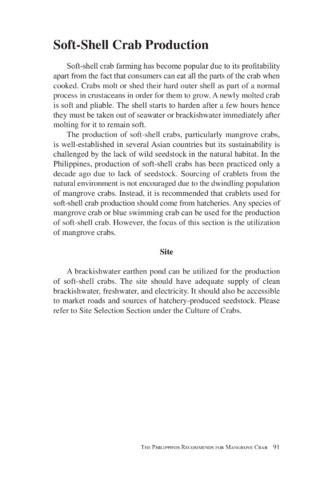
[The Philippines recommends for mangrove crab:] Soft-shell crab production
(DOST-PCAARRD, 2021) -
[The Philippines recommends for mangrove crab:] Grow-out phase
(DOST-PCAARRD, 2021) -
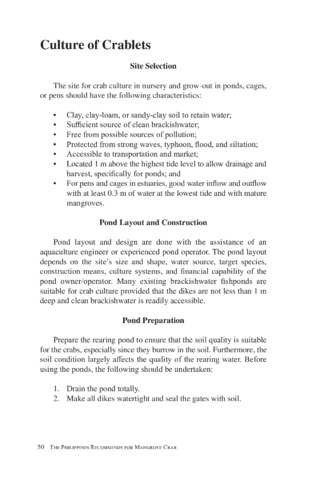
[The Philippines recommends for mangrove crab:] Culture of crablets
(DOST-PCAARRD, 2021) -
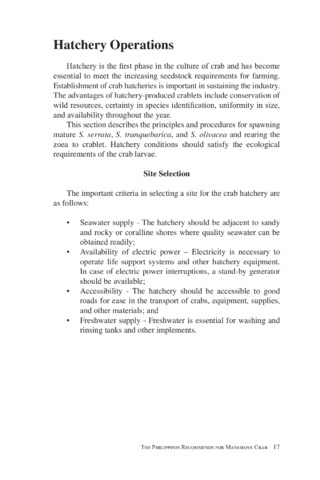
[The Philippines recommends for mangrove crab:] Hatchery operations
(DOST-PCAARRD, 2021) -
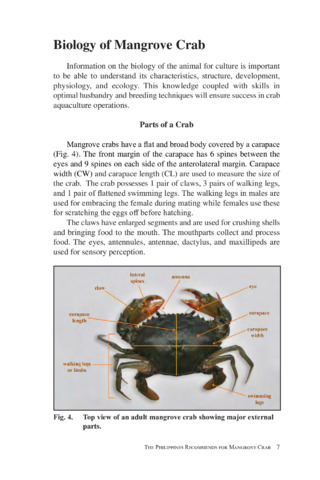
[The Philippines recommends for mangrove crab:] Biology of mangrove crab
(DOST-PCAARRD, 2021) -
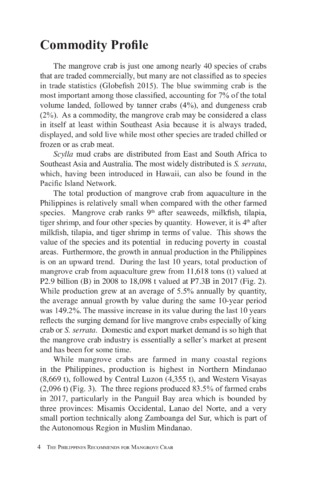
[The Philippines recommends for mangrove crab:] Commodity profile
(DOST-PCAARRD, 2021) -
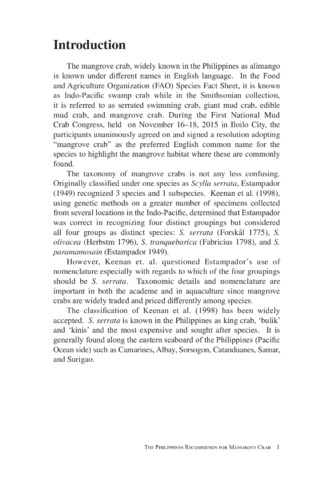
[The Philippines recommends for mangrove crab:] Introduction
(DOST-PCAARRD, 2021) -
Beach forest species and mangrove associates in the Philippines
Primavera, Jurgenne; (Aquaculture Department, Southeast Asian Fisheries Development Center, 2012)
This new publication supported by UNESCO’s Man and Biosphere Programme introduces researchers and the general public to beach forest species and mangroves associates and describes their medicinal, traditional and commercial uses based on recent research and the older, hard-to-access literature. The shorelines and riverbanks of the Philippines were among the first sites opened for human settlement. Not surprisingly, vegetation in the coastal forest was the first to disappear, followed by mangroves and other forest types. Due to their early loss, beach forests are not well studied as other flora and therefore not familiar to the average Filipino. The 2004 Indian Ocean tsunami, and sea-level rise associated with global warming, have highlighted the role of beach forest-mangrove greenbelts in conferring protection on coastal communities. The publication is a collection of 140 species both familiar and poorly known, with around 100 treated exhaustively including scientific names, English names, local/regional names, botanical descriptions and folk uses. -
Growth performance and condition factor of juvenile milkfish (Chanos chanos) cultured in a marine pen in relation to body size and temperature
(Japan International Research Center for Agricultural Sciences (JIRCAS), 2021-04-01)The growth performance and condition factor (CF) of milkfish (Chanos chanos) in relation to body size and temperature were investigated in a shallow marine pen culture system in coastal waters of the Philippines. Three common models were tested to determine the best-fit model for the growth of milkfish, and the logistic model was found to be best for both weight-based and length-based growth. Daily specific growth rate in weight (\(DSGR_{W})\) and length (\(DSGR_{L})\) were positively correlated with water temperature, while both \(DSGR_{W}\) and \(DSGR_{L}\) were correlated negatively with the size of the fish, which supported the fit of the growth model. CF of milkfish exhibited a positive correlation with the feed conversion ratio and significant seasonal variations. The ratio was lower in the fast growth season (dry season) than in the slow growth season (rainy season). By integrating these controversial findings, we were able to posit that low temperature and inefficient feeding makes ‘fat’ fish and vice versa. This may be explained by changes in proximate body composition (e.g., protein and water content) and the change in metabolic rate brought about by different water temperatures. -
Exploring, harnessing and conserving marine genetic resources towards a sustainable seaweed aquaculture
; Sibonga, Rema; ; ; ; ; ; ; ; ; ; ; (Wiley Open Access, 2021-03-27)
Seaweed cultivation is the fastest‐growing aquaculture sector, with a demonstrable potential to drive development in some of the poorest coastal populations worldwide. However, sustainable exploitation, fair access and equitable benefits from marine genetic resources, such as seaweeds have yet to be fully realised. Patchy fundamental knowledge on the genetic diversity and metabolic potential of algae limits their exploitation; scant practical skills and low investment in breeding restricts germplasm availability and the Nagoya protocol has only partially remediated insufficient governance. Further developments and the addressing of knowledge gaps in relation to biosecurity, breeders’ rights and conservation of genetic resources are needed for progress. -
Biodiversity in mangrove-derived aquaculture ponds in Dumangas, Iloilo, Philippines
Bagarinao, Teodora (Science and Technology Information Institute, Department of Science and Technology, 2021-02)
Large tracts of mangroves have been converted into aquaculture ponds and the consequent loss of biodiversity has been much decried. This paper shows that high aquatic biodiversity is retained in mangrove-derived aquaculture ponds in Dumangas, Iloilo, Philippines. Documentation of biodiversity was carried out over two years in 15 adjacent ponds (water areas 0.25–0.9 ha) used for farming penaeid shrimps, mud crabs, milkfish, seabass, rabbitfish, and other fishes. At harvest, these ponds yielded many extraneous non-crop or “bycatch” species, which had been naturally seeded by the tides and had grown (and some species reproduced) over the 2–10 mo that the ponds were underwater. From 21 crop cycles were obtained 8–56 species (from 6–30 taxonomic families) of bycatch fishes and macrocrustaceans with biomass of 2.5–168.4 kg ha–1 and abundance of 2–92 x 103 individuals ha–1, the differences due to pond area, duration of immersion, farming system, crop species, and the bycatch community. Some 85 species (44 families) of fishes occurred in the ponds, including 12 species of gobies, of which the small-size Acentrogobius viganensis, Pseudogobius javanicus, Mugilogobius cavifrons, and Gobiopterus panayensis reached high abundance. Macrocrustaceans consisted of 30 species (nine families), including several penaeid and palaemonid shrimps (Metapenaeus ensis and Nematopalaemon tenuipes were most common) and portunid and grapsid crabs. Mollusks in the ponds included 58 species (24 families), of which Cerithideopsilla cingulata was most abundant. The Dumangas ponds were leaky and allowed tidal recruitment of many mangrove animals despite net screens and chemical treatments. Existing tidal ponds serve as proxy mangrove lagoons (wetlands) that can harbor high aquatic biodiversity. -
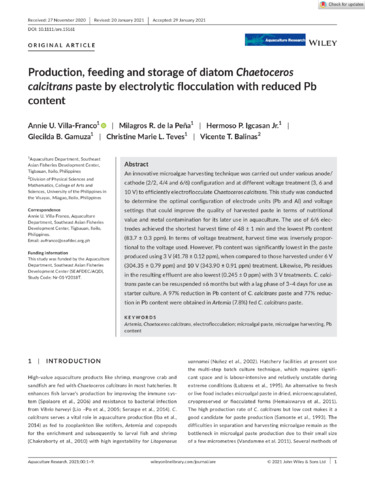
Production, feeding and storage of diatom Chaetoceros calcitrans paste by electrolytic flocculation with reduced Pb content
(Wiley, 2021-03-02)An innovative microalgae harvesting technique was carried out under various anode/cathode (2/2, 4/4 and 6/6) configuration and at different voltage treatment (3, 6 and 10 V) to efficiently electroflocculate Chaetoceros calcitrans. This study was conducted to determine the optimal configuration of electrode units (Pb and Al) and voltage settings that could improve the quality of harvested paste in terms of nutritional value and metal contamination for its later use in aquaculture. The use of 6/6 electrodes achieved the shortest harvest time of 48 ± 1 min and the lowest Pb content (83.7 ± 0.3 ppm). In terms of voltage treatment, harvest time was inversely proportional to the voltage used. However, Pb content was significantly lowest in the paste produced using 3 V (41.78 ± 0.12 ppm), when compared to those harvested under 6 V (304.35 ± 0.79 ppm) and 10 V (343.90 ± 0.91 ppm) treatment. Likewise, Pb residues in the resulting effluent are also lowest (0.245 ± 0 ppm) with 3 V treatments. C. calcitrans paste can be resuspended ≤6 months but with a lag phase of 3–4 days for use as starter culture. A 97% reduction in Pb content of C. calcitrans paste and 77% reduction in Pb content were obtained in Artemia (7.8%) fed C. calcitrans paste. -
Series: GL Conference Series; No. 22
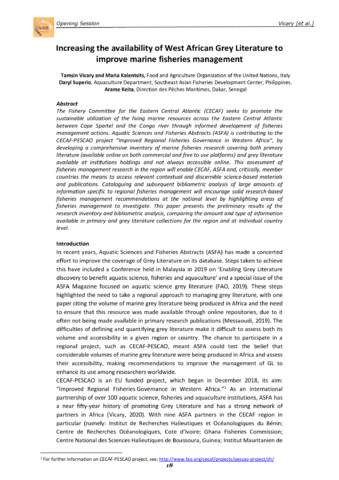
Increasing the availability of West African Grey Literature to improve marine fisheries management
; ; Superio, Daryl; (TextRelease, 2021-02)
The Fishery Committee for the Eastern Central Atlantic (CECAF) seeks to promote the sustainable utilization of the living marine resources across the Eastern Central Atlantic between Cape Spartel and the Congo river through informed development of fisheries management actions. Aquatic Sciences and Fisheries Abstracts (ASFA) is contributing to the CECAF-PESCAO project “Improved Regional Fisheries Governance in Western Africa”, by developing a comprehensive inventory of marine fisheries research covering both primary literature (available online on both commercial and free to use platforms) and grey literature available at institutions holdings and not always accessible online. This assessment of fisheries management research in the region will enable CECAF, ASFA and, critically, member countries the means to access relevant contextual and discernible science-based materials and publications. Cataloguing and subsequent bibliometric analysis of large amounts of information specific to regional fisheries management will encourage solid research-based fisheries management recommendations at the national level by highlighting areas of fisheries management to investigate. This paper presents the preliminary results of the research inventory and bibliometric analysis, comparing the amount and type of information available in primary and grey literature collections for the region and at individual country level. -
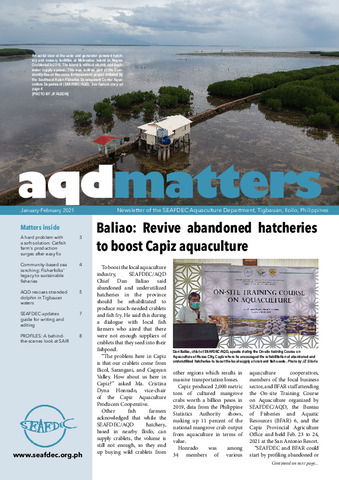
AQD Matters 2021 January - February
(Aquaculture Department, Southeast Asian Fisheries Development Center, 2021-03)In this issue: 1) A hard problem with a soft solution: Catfish farm's production surges easy fix; 2) Community-based sea ranching: Fisherfolks' legacy to sustainable fisheries; 3) AQD rescues stranded dolphin in Tigbauan ... -
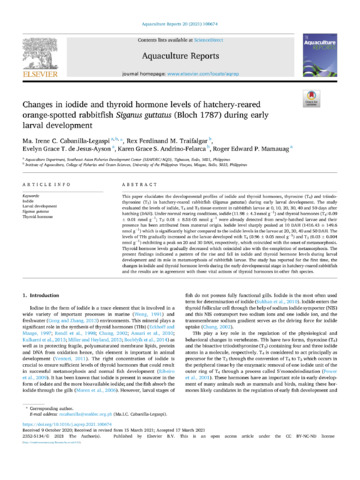
Changes in iodide and thyroid hormone levels of hatchery-reared orange-spotted rabbitfish Siganus guttatus (Bloch 1787) during early larval development
; ; ; ; Mamauag, Roger Edward (Elsevier, 2021-07)
This paper elucidates the developmental profiles of iodide and thyroid hormones, thyroxine (T4) and triiodothyronine (T3) in hatchery-reared rabbitfish (Siganus guttatus) during early larval development. The study evaluated the levels of iodide, T4 and T3 tissue content in rabbitfish larvae at 0, 10, 20, 30, 40 and 50 days after hatching (DAH). Under normal rearing conditions, iodide (11.98 ± 4.3 nmol g−1) and thyroid hormones (T4: 0.09 ± 0.01 nmol g−1; T3: 0.01 ± 8.5E-05 nmol g−1 were already detected from newly-hatched larvae and their presence has been attributed from maternal origin. Iodide level sharply peaked at 10 DAH (1416.43 ± 149.6 nmol g−1) which is significantly higher compared to the iodide levels in the larvae at 20, 30, 40 and 50 DAH. The levels of THs gradually increased as the larvae developed with T4 (0.96 ± 0.05 nmol g−1) and T3 (0.03 ± 0.004 nmol g−1) exhibiting a peak on 20 and 30 DAH, respectively, which coincided with the onset of metamorphosis. Thyroid hormone levels gradually decreased which coincided also with the completion of metamorphosis. The present findings indicated a pattern of the rise and fall in iodide and thyroid hormone levels during larval development and its role in metamorphosis of rabbitfish larvae. The study has reported for the first time, the changes in iodide and thyroid hormone levels during the early developmental stage in hatchery-reared rabbitfish and the results are in agreement with those vital actions of thyroid hormones in other fish species. -
The synergistic impacts of anthropogenic stressors and COVID-19 on aquaculture: A current global perspective
; ; ; ; ; ; ; ; ; Bakiu, Rigers; ; ; ; ; Dong, Yunwei ; ; ; ; ; ; ; ; ; ; ; ; ; ; ; ; ; ; ; ; ; ; ; ; Lebata-Ramos, Ma. Junemie Hazel ; ; ; ; ; ; ; ; ; ; ; ; ; ; ; (Taylor and Francis, 2022-01-02)
The rapid, global spread of COVID-19, and the measures intended to limit or slow its propagation, are having major impacts on diverse sectors of society. Notably, these impacts are occurring in the context of other anthropogenic-driven threats including global climate change. Both anthropogenic stressors and the COVID-19 pandemic represent significant economic challenges to aquaculture systems across the globe, threatening the supply chain of one of the most important sources of animal protein, with potential disproportionate impacts on vulnerable communities. A web survey was conducted in 47 countries in the midst of the COVID-19 pandemic to assess how aquaculture activities have been affected by the pandemic, and to explore how these impacts compare to those from climate change. A positive correlation between the effects of the two categories of drivers was detected, but analysis suggests that the pandemic and the anthropogenic stressors affect different parts of the supply chain. The immediate measurable reported losses varied with aquaculture typology (land vs. marine, and intensive vs. extensive). A comparably lower impact on farmers reporting the use of integrated multitrophic aquaculture (IMTA) methods suggests that IMTA might enhance resilience to multiple stressors by providing different market options under the COVID-19 pandemic. Results emphasize the importance of assessing detrimental effects of COVID-19 under a multiple stressor lens, focusing on areas that have already locally experienced economic loss due to anthropogenic stressors in the last decade. Holistic policies that simultaneously address other ongoing anthropogenic stressors, rather than focusing solely on the acute impacts of COVID-19, are needed to maximize the long-term resilience of the aquaculture sector.