SEAFDEC/AQDINSTITUTIONAL REPOSITORY
    • English
    • 日本語
    • ไทย
    • Bahasa Indonesia
  • English 
    • English
    • 日本語
    • ไทย
    • Bahasa Indonesia
  • Login
View Item 
  •   SEAFDEC/AQD Institutional Repository Home
  • 03 SEAFDEC/AQD External Publications
  • Journal Articles, Conference Papers and Book Chapters by SEAFDEC Staff
  • Journal Articles
  • View Item
  •   SEAFDEC/AQD Institutional Repository Home
  • 03 SEAFDEC/AQD External Publications
  • Journal Articles, Conference Papers and Book Chapters by SEAFDEC Staff
  • Journal Articles
  • View Item
JavaScript is disabled for your browser. Some features of this site may not work without it.

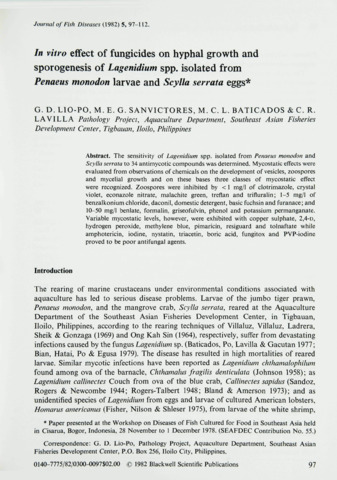
In vitro effect of fungicides on hyphal growth and sporogenesis of Lagenidium spp. isolated from Penaeus monodon larvae and Scylla serrata eggs.
  • Global styles
  • MLA
  • Vancouver
  • Elsevier - Harvard
  • APA
  • Help
Thumbnail
View/Open
Date
1982
Author
Lio-Po, Gilda D.
Sanvictores, M. E. G.
Baticados, Maria Cecilia L.
Lavilla, Celia R.
Page views
2,195
ASFA keyword
fungal diseases ASFA
fungicides ASFA
growth ASFA
shellfish culture ASFA
sporogenesis ASFA
AGROVOC keyword
Lagenidium AGROVOC
Penaeus monodon AGROVOC
Scylla serrata AGROVOC
Taxonomic term
Penaeus monodon GBIF
Scylla serrata GBIF
Metadata
Show full item record


Share 
 
Abstract
The sensitivity of Lagenidium spp. isolated from Penaeus monodon and Scylla serrata to 34 antimycotic compounds was determined. Mycostatic effects were evaluated from observations of chemicals on the development of vesicles, zoospores and mycelial growth and on these bases three classes of mycostatic effect were recognized. Zoospores were inhibited by < 1 mg/1 of clotrimazole, crystal violet, econazole nitrate, malachite green, treflan and trifluralin; 1-5 mg/1 of benzalkonium chloride, daconil, domestic detergent, basic fuchsin and furanace; and 10-50 mg/1 benlate, formalin, griseofulvin, phenol and potassium permanganate. Variable mycostatic levels, however, were exhibited with copper sulphate, 2,4-D, hydrogen peroxide, methylene blue, pimaricin, resiguard and tolnaftate while amphotericin, iodine, nystatin, triacetin, boric acid, fungitox and PVP-iodine proved to be poor antifungal agents.
Description
Contribution No. 55.
URI
http://hdl.handle.net/10862/1128
Suggested Citation
Lio-Po, G. D., Sanvictores, M. E. G., Baticados, M. C. L., & Lavilla, C. R. (1982). In vitro effect of fungicides on hyphal growth and sporogenesis of Lagenidium spp. isolated from Penaeus monodon larvae and Scylla serrata eggs. Journal of Fish Diseases, 5(2), 97-112. https://doi.org/10.1111/j.1365-2761.1982.tb00463.x 
DOI
10.1111/j.1365-2761.1982.tb00463.x
Type
Article
ISSN
1365-2761
Collections
  • Journal Articles [1267]

Related items

Showing items related by title, author, creator and subject.

  • Thumbnail

    Philippine National Standard: Organic aquaculture 

    Bureau of Agriculture and Fisheries Standards (Bureau of Agriculture and Fisheries Standards, 2016)
    The Philippine National Standard (PNS) for Organic Aquaculture (PNS/BAFS 112:2016) was originally prepared and adopted in 2012. Organic aquaculture encourages polyculture production system, promotes the use of indigenous/endemic species under the extensive and semi-intensive culture systems, reduces/minimizes inputs of artificial ingredients, prohibits the use of genetically modified organisms (GMOs), and considers ecological conditions necessary for sustainable aquaculture production. The PNS for Organic Aquaculture was revised by the Technical Working Group (TWG) organized by the Bureau of Agriculture and Fisheries Standards (BAFS) through a Department of Agriculture (DA) Special Order No.476, Series of 2015. The TWG is composed of members representing the Bureau of Fisheries and Aquatic Resources (BFAR), Organic Certification Center of the Philippines (OCCP), Southeast Asian Fisheries Development Center Aquaculture Department (SEAFDEC-AQD), Philippine Council for Agriculture, Aquatic and Natural Resources Research and Development (PCAARRD) and Central Luzon State University (CLSU). This PNS was presented and reviewed during the consultative meetings with the concerned stakeholders in Region I (Pangasinan) and Region XI (Davao City). Comments gathered during the consultations were carefully evaluated by the TWG and included accordingly in the final version of this standard. Drawn from the general principles of the Philippine National Standard on Organic Agriculture, this PNS on Organic Aquaculture attempts to cover the aquaculture production and postharvest operations in order to ensure the integrity of organic products. The requirements for the inclusion of Substances and Criteria for the development of the list of substances shall follow the Philippine National Standards for Organic Aquaculture and the Guidelines for the Production, Processing, Labelling and Marketing of Organically Produced Foods (GL 32-1999). The revision of this PNS was undertaken in order to achieve equivalence with the existing international standards and its future amendment, and takes into consideration the new developments and inclusion of the identified potential species for organic aquaculture. Thus, this PNS identifies minimum requirements on documentation, conversion to organic aquaculture, parallel production, selection of site, interaction with surrounding ecosystem, organic fertilization, aquatic plants, aquatic animal sources/origin, breeding and hatchery management, aquatic animal nutrition and feeding, aquatic animal health and welfare, harvesting, post-harvest handling, transport and processing, storage, and social aspects.
  • Thumbnail

    Management of feeding aquaculture species 

    Alava, Veronica R. (Aquaculture Department, Southeast Asian Fisheries Development Center, 2002)
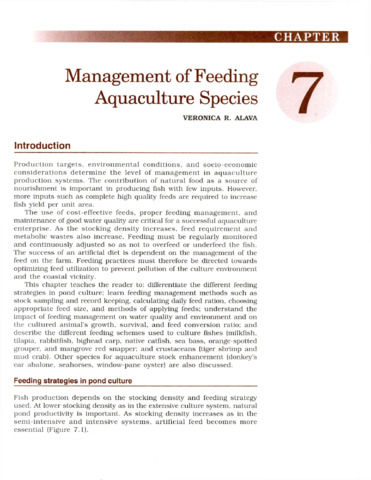
    This chapter teaches the reader to: differentiate the different feeding strategies in pond culture; learn feeding management methods such as stock sampling and record keeping, calculating daily feed ration, choosing appropriate feed size, and methods of applying feeds; understand the impact of feeding management on water quality and environment and on the cultured animal’s growth, survival, and feed conversion ratio; and describe the different feeding schemes used to culture fishes (milkfish, tilapia, rabbitfish, bighead carp, native catfish, sea bass, orange-spotted grouper, and mangrove red snapper; and crustaceans (tiger shrimp and mud crab). Other species for aquaculture stock enhancement (donkey’s ear abalone, seahorses, window-pane oyster) are also discussed.
  • Thumbnail

    Competitive and comparative advantages of brackishwater aquaculture of tiger shrimp, mud crab, and milkfish in the Philippines in 1985-1995 

    Gonzales, Leonardo A.; Elca, C. D.; Gonzales, V. A.; Alviola IV, Pedro A.; Paraguas, F. J.; Olalo, C. (Bureau of Agricultural Research, Department of Agriculture, 2007)
    The brackishwater aquaculture sector contributes considerably to the growth of the fisheries sector. Tiger shrimp Penaeus monodon, mud crab Scylla serrata, and milkfish Chanos chanos, in particular are efficient users of domestic resources and earners of foreign exchange. These three commodity sectors have not been fully developed because of inadequate policies in research, technology generation, and extension, and in public investment and support services in production, marketing, and post-harvest processing. Our analysis used the domestic resource cost approach. The average resource cost ratios for the Philippines were 0.44 for tiger shrimp, 0.66 for mud crab, and 0.35 for milkfish. If the peso overvaluation is corrected, the comparative advantage can be dramatically enhanced with respective resource cost ratios of 0.36 and 0.55, and 0.28. Given the current international market and production technologies for these commodities, competitive and comparative advantage can be sustained above the breakeven border price per kilogram of US$6–7 for tiger shrimp, US$5–6 for mud crab, and about US$1 for milkfish. The actual border prices per kilogram during the past five years have been higher at US$12.34 for tiger shrimp, US$8.39 for mud crab, and US$2.39 for milkfish. At current domestic costs and border prices of the these commodities, the advantage in exports may be sustained at yields per hectare greater than about 2 mt tiger shrimp, 100 kg mud crabs, and 500 kg milkfish. To enhance the efficiency of production of these commodities, the following areas of intervention are needed:
    • Technology improvements in seed production from the hatchery of tiger shrimp, mud crab, and milkfish
    • Research and technologies for diagnosis, prevention, and control of diseases of tiger shrimp (e.g. luminous bacteria)
    • Training in farm management to enhance the skills of small-scale pond operators
    • Public investments in infrastructures and support services including credit access to enhance efficient flow of goods and services from the farm to strategic market outlets
    • Market development to ensure sustainable outlets for brackishwater pond production
    • Reforms in trade and exchange rate policies to enhance global competitiveness

© SEAFDEC/AQD  2026
Send Feedback | Subscribe


Browse

All of SAIRCommunities & CollectionsBy Issue DateAuthorsTitlesSubjectsThis CollectionBy Issue DateAuthorsTitlesSubjects

My Account

LoginRegister

Statistics

View Usage Statistics

© SEAFDEC/AQD  2026
Send Feedback | Subscribe


Export citations

Export the current results of the search query as a citation list. Select one of the available citation styles, or add a new one using the "Citations format" option present in the "My account" section.

The list of citations that can be exported is limited to items.

Export citations

Export the current item as a citation. Select one of the available citation styles, or add a new one using the "Citations format" option present in the "My account" section.

Export Citations

DOCUMENT REQUEST NOT AVAILABLE

This publication is still available (in PRINT) and for sale at AQD bookstore. The library is currently restricted to send PDF of publications that are still for sale.

You may contact bookstore@seafdec.org.ph or visit AQD bookstore for orders.

FILE UNDER EMBARGO

This file associated with this publication is currently under embargo. This will be available for download after the embargo date.