Intestinal glucose transport in carnivorous and herbivorous marine fishes

View/
Date
1983Page views
1,690ASFA keyword

AGROVOC keyword
Taxonomic term

Metadata
Show full item recordShare
Abstract
The influx and transepithelial movements of glucose and their effects on the electrophysiology and Na transport in upper and lower intestines of the herbivorous surgeonfish, Acanthurus mata , and carnivorous eel, Gymnothorax undulatus , were measured. The K t G and J max G of glucose influx into the tissues were higher in the surgeonfish upper intestine than in the surgeonfish lower intestine or in both segments of the eel intestine. A prominent diffusion-like transport component was also measured in all four segments during influx experiments. Net transepithelial glucose fluxes (0.05 mM) were greater in eel intestine than in those of the surgeonfish largely due to an apparent lower apical membrane permeability of the former coincident with reduced backflux of glucose from epithelium to lumen. All four stripped intestinal segments exhibited non-significant (from zero; P >0.05) or small, serosa-negative transepithelial potential differences (-0.1 to -2.2 mV), and low transepithelial resistances (40–88 O cm -2 ). Each tissue displayed significant ( P P >0.05) change the transepithelial resistance, but did induce a significant ( P J net Na with added luminal glucose, these increased net cation fluxes were not quite significant ( P >0.05). It is concluded that coupled Na-glucose transport occurs in these tissues, but that metabolic enhancement of unrelated current-generating mechanisms also takes place and may modify depolarizing effects of organic solute transfer.
Suggested Citation
Ferraris, R. P., & Ahearn, G. A. (1983). Intestinal glucose transport in carnivorous and herbivorous marine fishes. Journal of Comparative Physiology B: Biochemical, Systemic, and Environmental Physiology , 152(1), 79-90. https://doi.org/10.1007/BF00689731
Type
ArticleISSN
0174-1578Collections
- Journal Articles [1262]
Related items
Showing items related by title, author, creator and subject.
-
Temperature and size range for the transport of juvenile donkey's ear abalone Haliotis asinina Linne
(Blackwell Publishing, 2011)Live transport of hatchery-produced juvenile donkey's ear abalone Haliotis asinina Linne was examined to evaluate the effect of transportation on the survival of juvenile abalone. Simulated transport experiments were ... -
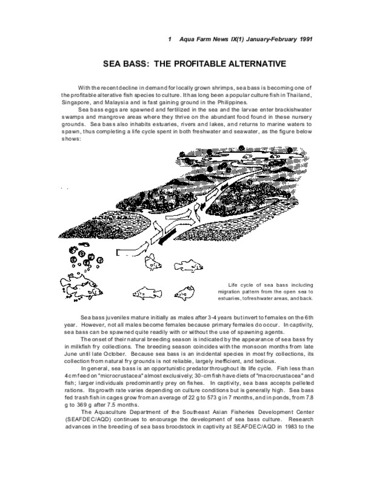
Sea bass: The profitable alternative
(Aquaculture Department, Southeast Asian Fisheries Development Center, 1991) -
Milkfish breeding and hatchery technology at SEAFDEC/AQD
(Aquaculture Department, Southeast Asian Fisheries Development Center, 1999)Describes the techniques already adopted by the private sector: broodstock management, broodstock diet, commercial fry production, live transport, and larval diet. A list of AQD research publications on milkfish is included.