Temperature and size range for the transport of juvenile donkey's ear abalone Haliotis asinina Linne

Share
Abstract
Live transport of hatchery-produced juvenile donkey's ear abalone Haliotis asinina Linne was examined to evaluate the effect of transportation on the survival of juvenile abalone. Simulated transport experiments were conducted to determine the appropriate temperature using 5, 10 and 20 g L−1 of ice to air volume for 8 h and the appropriate size using two size groups (Size A, 15–20 mm, 0.5–1.3 g, and Size B, 30–35 mm, 5.3–8.5 g) up to 24-h out-of-water live transport. Survival was significantly higher (P<0.001) when 10 g L−1 of ice was used to decrease the temperature to the range of 17–23 °C. At this temperature, both size groups subjected to simulated transport for 8 and 10 h had 100% survival after 48 h, while mortality occurred in abalones subjected to 16 and 24 h of simulated transport. The Size B abalone subjected to 24 h of transport had significantly higher survival (64.4 ± 2.9%) (P<0.001) than the Size A abalone (5.5 ± 1.6%) after 48 h. Live juvenile abalone were successfully transported to the field applying the protocols developed in the lab experiment. This study serves as a guide for handling and shipping live juvenile abalone.
Suggested Citation
Buen-Ursua, S. M. A., & Ludevese, G. (2011). Temperature and size range for the transport of juvenile donkey's ear abalone Haliotis asinina Linne. Aquaculture Research , 42(8), 1206-1213. https://doi.org/10.1111/j.1365-2109.2010.02712.x
Type
ArticleISSN
1365-2109Collections
- Journal Articles [1267]
Related items
Showing items related by title, author, creator and subject.
-
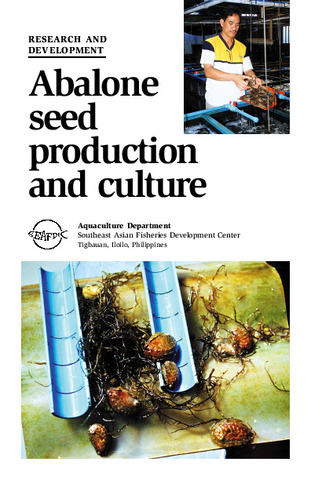
Abalone seed production and culture
(Aquaculture Department, Southeast Asian Fisheries Development Center, 2000)Details the research conducted at AQD for the tropical abalone Haliotis asinina. AQD has developed the rudiments of a hatchery protocol. -
Evolution of genome size within the genus Haliotis (Vetigastropoda: Haliotidae)
(National Shellfisheries Association, 2018)Genome size (C-value) and the percentage of adenine and thymine nucleotides in the genome (AT content) are fundamental characteristics of every species, and very important parameters in molecular cytogenetic and phylogenic studies, and for the progress of whole-genome sequencing. In this study, the C-value and AT content of nine abalone species inhabiting the Northwest Pacific (around Japan), Southeast Asia, South Africa, and Oceania were determined using flow cytometry. C-value ranged from 1.32 pg for Haliotis varia (Southeast Asia) to 2.01 pg for Haliotis laevigata (Oceania), and AT content ranged from 58.0% for Haliotis planata (Southeast Asia) to 66.3% for Haliotis diversicolor aquatilis (Southeast Asia). Reported chromosome numbers ranged from 2n = 32 to 36, and were higher in Oceanian, South African, and Northwest Pacific species (2n = 36) compared with the Southeast Asian group (2n = 32). This increase of chromosome number in the Oceanian species seems to be related to an increase in the DNA amount, unlike that of Haliotis midae (South African species). An increase of the C-value associated with an increase in DNA amount was also shown in the North Pacific group. These results suggest that increases in the DNA amount occurred independently in the ancestor of each of the different lineages. -
Research on seaweeds and mollusks
(Aquaculture Department, Southeast Asian Fisheries Development Center, 1995)Research on seaweeds focused on the carrageenan-producing Kappaphycus alvarezii and the agar-producing Gracilaria spp. Growth of K. alvarezii was better on horizontal lines than on vertical or cluster lines from bamboo rafts. All morphotypes (brown green, and red) grew faster at 50 cm than at 100 cm below the water surface, but the green morphotype showed better carrageenan properties. A socioeconomic survey of K. alvarezii farming in Panagatan Cays, Antique revealed that a farmer has an average annual production of 3 tons/ha (dry) with the fixed bottom and hanging longline methods. Three species of Gracilaria in natural beds in lloilo showed monthly variations in biomass and agar quality; G. heteroclada had the highest biomass and gel strength. When this species was grown in tanks, growth and agar sulfate content were influenced by the interaction of light, salinity, and nutrients. Enriched and unenriched stocks of G. heteroclada differed in agar quality. When G. heteroclada was grown with the tiger shrimp Penaeus monodon in extensive ponds, the highest growth rate and production were obtained at the seaweed stocking density of 250 g/m2; this was in November when average water temperature, transparency, and salinity were low. Salinity tolerance varies among Gracilaria species.Oyster (Crassostrea iredalei) and mussel (Perna viridis) farming in Western Visayas were assessed in 1992 in terms of the culture methods, socioeconomics, marketing, and profitability. A more localized survey of oyster and mussel fanning was conducted through rapid rural appraisal in two coastal towns in 1993. A farmer-participatory study followed in 1994 for the culture of oysters, mussels, seaweeds, and rabbitfishes in a river mouth in Dumangas, lloilo. Green mussel, brown mussel (Modiolus metcalfei), and seaweeds transplanted to Dumangas from Capiz have reproduced. In another study, the green mussel was tested as a biological filter in tiger shrimp ponds; shrimps stocked with mussels grew better than those without. A nationwide survey on the Placuna placenta fishery in 1993 showed 27 remaining 'kapis' beds; many others have been depleted due to excessive gathering, pollution, siltation, and trawling. Broodstocks are being developed to produce 'kapis' seed for grow-out and restocking. For the first time at AQD, adult donkey-ear abalone Haliotis asinina from the wild spawned naturally in laboratory tanks. Juvenile abalones can be successfully grown on Gracilaria or abalone diet.