Apparent digestibility of diets with various carbohydrate levels and the growth response of Penaeus monodon

View/
Date
1991Page views
2,800ASFA keyword

AGROVOC keyword
Taxonomic term

Metadata
Show full item recordShare
Abstract
The digestibility of four isonitrogenous practical diets (40% crude protein) containing different levels (5%, 15%, 25% and 35%) of gelatinized breadflour as carbohydrate source were determined for P. monodon (average weight 30–40 g). The digestibility coefficients for protein ranged from 92.8 to 94.3%. Crude fat digestibility ranged from 90.0 to 92.8% and dry matter digestibility from 75.7 to 86.9%. Carcass crude protein was similar in all treatments but carcass crude fat decreased significantly (P<0.05) with increasing dietary carbohydrate.
The same diets were fed to a group of smaller P. monodon (average initial weight=0.139±0.011 g) for 8 weeks. Weight gain, specific growth rate (SGR), feed conversion ratio (FCR) and survival rate did not differ significantly (P>0.05) among treatments. However, weight gain and SGR were lowest and FCR was poorest with 35% carbohydrate.
Suggested Citation
Catacutan, M. R. (1991). Apparent digestibility of diets with various carbohydrate levels and the growth response of Penaeus monodon. Aquaculture , 95(1-2), 89-96. https://doi.org/10.1016/0044-8486(91)90075-I
Type
ArticleISSN
0044-8486Collections
- Journal Articles [1266]
Related items
Showing items related by title, author, creator and subject.
-
Series: Aquaculture extension manual; No. 19
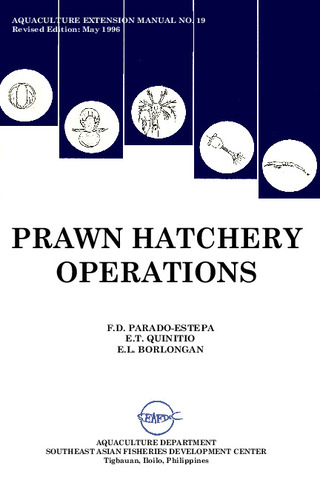
Prawn hatchery operations
; Quinitio, Emilia T. ; (Aquaculture Department, Southeast Asian Fisheries Development Center, 1996-05)
The manual, an updated version of the 1984 SEAFDEC/AQD manual, presents the underlying principles and step-by-step instructions of prawn larval and post-larval rearing. The techniques described are not only applicable to Penaeus monodon, but may also be modified and applied to other penaeid and metapenaeid species. The following aspects are covered: Site selection; Life cycle; Hatchery design and planning; Hatchery operations; Diseases; and Economics.
; (Aquaculture Department, Southeast Asian Fisheries Development Center, 1996-05)
The manual, an updated version of the 1984 SEAFDEC/AQD manual, presents the underlying principles and step-by-step instructions of prawn larval and post-larval rearing. The techniques described are not only applicable to Penaeus monodon, but may also be modified and applied to other penaeid and metapenaeid species. The following aspects are covered: Site selection; Life cycle; Hatchery design and planning; Hatchery operations; Diseases; and Economics. -
Series: Aquaculture extension manual; No. 19
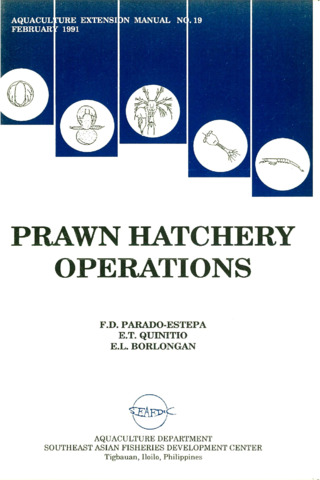
Prawn hatchery operations
; Quinitio, Emilia T.; (Aquaculture Department, Southeast Asian Fisheries Development Center, 1991-02)
The manual, an updated version of the 1984 SEAFDEC/AQD manual, presents the underlying principles and step-by-step instructions of prawn larval and post-larval rearing. The techniques described are not only applicable to Penaeus monodon, but may also be modified and applied to other penaeid and metapenaeid species. The following aspects are covered: Site selection; Life cycle; Hatchery design and planning; Hatchery operations; Diseases; and Economics. -
Management of feeding aquaculture species
(Aquaculture Department, Southeast Asian Fisheries Development Center, 2002)This chapter teaches the reader to: differentiate the different feeding strategies in pond culture; learn feeding management methods such as stock sampling and record keeping, calculating daily feed ration, choosing appropriate feed size, and methods of applying feeds; understand the impact of feeding management on water quality and environment and on the cultured animal’s growth, survival, and feed conversion ratio; and describe the different feeding schemes used to culture fishes (milkfish, tilapia, rabbitfish, bighead carp, native catfish, sea bass, orange-spotted grouper, and mangrove red snapper; and crustaceans (tiger shrimp and mud crab). Other species for aquaculture stock enhancement (donkey’s ear abalone, seahorses, window-pane oyster) are also discussed.