Analysis of nitrite in aqueous solutions containing concentrated matrix ions using an octadecyl-poly(vinyl alcohol) gel microbore column and an electrochemical detector


Share
Abstract
The importance of the analysis of low level nitrite concentrations in aqueous samples is increasing in various fields such as environmental, food, and aquaculture chemistry. Recent progress in ion chromatography paved the way to the direct analysis of nitrite in water samples at ppm to sub ppb levels. However, analysis of low level nitrite in highly concentrated salt matrix still remains a difficult problem. The presence of a large amount of the matrix ion makes establishment of an ion exchange equilibrium very difficult in the column, often resulting in bad peak shapes [1].
In previous papers, we reported the analysis of a nitrite and other anions in chloride matrix on a conventional low capacity anion-exchange column by means of a heart-cut and recycling method [1] and by using a potassium chloride eluent [2]. To monitor the nitrite peak, both a UV detector and a conductimetric detector has been used [3]. Several groups have demonstrated the potential of an electrochemical detector for a specific and sensitive detection of nitrate. [4-6].
Poly(vinyl alcohol) (PVA) gel have been introduced recently as a chemically stable HPLC column packings [7-9]. It was found that when an acidic eluent was employed, a PVA gel and its acylated gel columns produced large capacity factors for nitrite [10].
Suggested Citation
Rokushika, S., Kihara, K., Yamamoto, F. M., & Subosa, P. F. (1991). Analysis of nitrite in aqueous solutions containing concentrated matrix ions using an octadecyl-poly(vinyl alcohol) gel microbore column and an electrochemical detector. Journal of High Resolution Chromatography , 14(1), 68-70. https://doi.org/10.1002/jhrc.1240140118
Type
ArticleISSN
1521-4168Collections
- Journal Articles [1266]
Related items
Showing items related by title, author, creator and subject.
-
Artificial incubation for intensive fry production of Nile tilapia Oreochromis niloticus (L.)
(Aquaculture Department, Southeast Asian Fisheries Development Center, 1996)Two experiments were conducted to evaluate and compare the production, quality, and survival of eggs and the subsequent growth and survival of fry in two small scale production systems: (i) natural incubation (NI), and (ii) egg collection followed by artificial incubation in upwelling glass funnels (AI). Cost benefits analysis was applied to the production figures to compare the economic viability of the two methods. The results were used to design a fry production system for the intensive production of Genetically Male Tilapia (GMT) from limited numbers of novel YY-male broodstock. -
Series: Summary of Proceedings No. 1/2013;
The recreational value of Taal Volcano protected landscape: An exploratory benefit transfer application
(PCAARRD-DOST, 2013)Some landscapes that have significant value to people are protected through statute. Protected landscapes that serve as popular recreational resources and destinations hold significant use values for the people that visit them. Recognition of these recreational benefits of protected landscapes provides a sound economic rationale for their management. This paper provides estimates of the potential magnitude of recreational value via benefit transfers of Taal Volcano Protected Landscape in the Philippines - a major tourist attraction and designated as one of the key priority biodiversity areas for protection. Taal Volcano Protected Landscape is a popular area for recreation activities such as hiking, day-camping, picnicking, bird watching, horseback riding, fishing, boating, wind surfing, sailing, rowing, and kayaking. Benefit transfer is the use of information from research conducted on other sites (i.e., the study sites) to pose questions at a site (i.e., Taal Volcano Protected Landscape, the policy site) that lacks primary research. Benefit transfer approaches include: 1) transferring of values or functions from a single site or set of similar sites, and 2) estimating a meta-regression transfer function that can be used to predict values for the policy site in question. One study site in the Philippines was selected and used in a point estimate transfer application. Likewise, a meta-regression transfer function model was estimated based on selected study sites from the US. These study sites were selected based on their similarity in terms of recreation activity, climate, and/or site characteristics with that of the Taal Volcano Protected Landscape. Furthermore, implicit price deflators and purchasing power parity are incorporated to account for income and cost of living differences between the study and policy sites. Exogenous factors, such as differences in individual preferences, cultural, and institutional conditions between the Philippines and the United States are beyond the scope of this paper, but these have the potential to invalidate the result of an international benefit transfer. Results show that point estimate transfer approach provided a better estimate of access value than meta-regression benefit function transfer approach. While in-sample benefit transfer predictions of the metaregression model show an absolute percentage transfer error of 18%, the simple out-of-sample prediction result has very high absolute percentage transfer error (1,231%). Hence, in policy application, a model with more than 100% transfer error is not suggested. The estimated welfare estimate of recreational access using point estimate transfer was P36/person per trip in 2006. The aggregated recreational benefits at the Taal Volcano Protected Landscape in 2006 was P9.7 million from 155,701 visitors at the Batangas side and P118.9 million from 1,906,242 visitors at the Cavite side, for a sum of about P128 million. This access value is not equivalent to economic resources that can be generated when visitor use fees is imposed to the users. User fees should be based on a willingness-to-pay (WTP) study that captures public perceptions and WTP fees, among others. -
Series: Aquaculture extension manual; No. 67
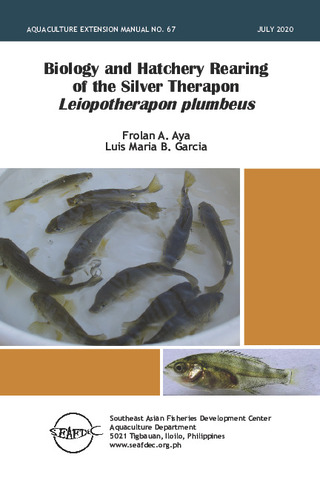
Biology and hatchery rearing of the silver therapon Leiopotherapon plumbeus
Aya, FrolanKnown for its tasty flesh, silver therapon, locally known as ayungin, has been regarded to be one of the most valuable edible native freshwater species in the Philippines. Demands for this fish species remain high which ... ; Garcia, Luis Maria (Aquaculture Department, Southeast Asian Fisheries Development Center, 2020-07)