Aquaculture development in Singapore

วันที่
1988Page views
6,923ASFA keyword
seed (aquaculture) 
stocking density
crustacean culture
husbandry diseases
pond culture
mussel culture
seed production
prawn culture
crab culture
aquarium culture
brackishwater aquaculture
aquaculture systems
aquaculture development
cage culture
feeding experiments
ornamental fishes
mariculture
freshwater aquaculture
breeding stock
fish culture
stocking density
crustacean culture
husbandry diseases
pond culture
mussel culture
seed production
prawn culture
crab culture
aquarium culture
brackishwater aquaculture
aquaculture systems
aquaculture development
cage culture
feeding experiments
ornamental fishes
mariculture
freshwater aquaculture
breeding stock
fish culture
AGROVOC keyword
Taxonomic term

เมตาดาต้า
แสดงระเบียนรายการเต็มShare
นามธรรม
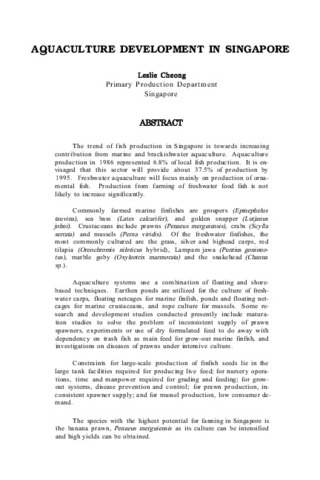
The trend of fish production in Singapore is towards increasing contribution from marine and brackishwater aquaculture. Aquaculture production in 1986 represented 6.8% of local fish production. It is envisaged that this sector will provide about 37.5% of production by 1995. Freshwater aquaculture will focus mainly on production of ornamental fish. Production from farming of freshwater food fish is not likely to increase significantly.
Commonly farmed marine finfishes are groupers (Epinephelus tauvina), sea bass (Lates calcarifer), and golden snapper (Lutjanus johni). Crustaceans include prawns (Penaeus merguiensis), crabs (Scylla serrata) and mussels (Perna viridis). Of the freshwater finfishes, the most commonly cultured are the grass, silver and bighead carps, red tilapia (Oreochromis niloticus hybrid), Lampam jawa (Puntius gonionotus), marble goby (Oxyleotrix marmorata) and the snakehead (Channa sp.).
Aquaculture systems use a combination of floating and shorebased techniques. Earthen ponds are utilized for the culture of freshwater carps, floating netcages for marine finfish, ponds and floating netcages for marine crustaceans, and rope culture for mussels. Some research and development studies conducted presently include maturation studies to solve the problem of inconsistent supply of prawn spawners, experiments or use of dry formulated feed to do away with dependency on trash fish as main feed for grow-out marine finfish, and investigations on diseases of prawns under intensive culture.
Constraints for large-scale production of finfish seeds lie in the large tank facilities required for producing live feed; for nursery operations, time and manpower required for grading and feeding; for growout systems, disease prevention and control; for prawn production, inconsistent spawner supply; and for mussel production, low consumer demand.
The species with the highest potential for fanning in Singapore is the banana prawn, Penaeus merguiensis as its culture can be intensified and high yields can be obtained.
การอ้างอิง
Cheong, L. (1988). Aquaculture development in Singapore. In J. V. Juario & L. V. Benitez (Eds.), Perspectives in Aquaculture Development in Southeast Asia and Japan: Contributions of the SEAFDEC Aquaculture Department. Proceedings of the Seminar on Aquaculture Development in Southeast Asia, 8-12 September 1987, Iloilo City, Philippines. (pp. 117-128). Tigbauan, Iloilo, Philippines: SEAFDEC, Aquaculture Department.
Type
Conference paperISBN
971851113Xคอลเลกชัน
- ADSEA '87 [20]
Related items
Showing items related by title, author, creator and subject.
-
Aquaculture in Malaysia
(Aquaculture Department, Southeast Asian Fisheries Development Center, 1995)Aquaculture in Malaysia is experiencing rapid growth. Total production in 1992 amounted to 79,699 tons valued at RM 207.4 million. These figures are 23% and 25% higher than the previous year's. Semi-culture of the cockle Anadara granosa was still predominant, contributing about 70% of the total output. Culture and production of the oyster Crassostrea iredalei is still insignificant. Sea bass Lates calcarifer constituted over 80% of the production from marine cages. Cage culture of grouper Epinephelus sp., snapper Lutjanus sp. and pompano Trachinotus blochii were also done in much smaller scale. The mangrove snapper Lutjanus argentimaculatus was recently spawned in captivity and larvae and juveniles were produced. In 1992, the tiger shrimp Penaeus monodon constituted about 87% of brackishwater pond production. Pond culture of the white shrimp P. merguiensis and the mudcrab Scylla sp. is at the experimental stage. Red tilapia hybrid was the major freshwater species cultured in cages, with 1,486 tons harvested in 1992. Freshwater pond production was valued at RM 100.85 million, 22% of which was due to the eel Anguilla japonica. Production of freshwater ornamental fishes is also becoming significant. Other exotic species recently bred and cultured are the African catfish Clarias gariepinus and the pacu Piaractus brachypomus. The indigenous freshwater catfish Mystus nemurus and carp Probarbus julleini have recently been bred in captivity and cultured experimentally. Lately, there have been attempts to culture non-conventional species such as the bullfrog Rana catesbeiana, the soft-shell turtle Trionyx sinensis, and aquatic ornamental plants. -
Aquaculture development in Thailand
(Aquaculture Department, Southeast Asian Fisheries Development Center, 1988)Aquaculture practised in Thailand is in the form of pond culture and cage culture in freshwater, brackishwater and coastal areas. The main species cultured include freshwater prawns, brackishwater shrimp, cockles, mussels, and various freshwater and marine finfishes. There is good potential for increased production from freshwater, brackishwater and marine aquaculture. However, the 1983 production of 145 000 mt represents only about 6% of Thailand's total fish production and production in this subsector has fluctuated widely. It will be several years before aquaculture production will contribute substantially to total production. Nonetheless, the culture of high value species of shrimp and fish could contribute significantly to export earnings during the next 5 to 10 years. Conducted primarily by government agencies, research and development are along the lines of increasing seed supply, establishing new culture techniques or improving older ones. The Department of Fisheries (DOF) together with some private companies have ventured into the development and testing of artificial diets for the various cultured species using a variety of indigenous feed stuffs. It is estimated that with adequate investments and appropriate support, aquaculture production will increase from 145 000 mt in 1983 to 378 000 mt in 1991, showing an annual increase of about 13% over this period. Major increases would come from bivalve mariculture (131 000 mt), brackishwater ponds (36 000 mt) freshwater ponds (46 000 mt) and brackishwater cage culture (20 000 mt). -
The Philippine aquaculture industry
(Aquaculture Department, Southeast Asian Fisheries Development Center, 1988)The aquaculture sector of the Philippine fishing industry registered the highest growth rate of 12.5% in 1977-1986. The contribution of aquaculture to the total fish production was equivalent to 24% in 1986 compared to only 85 in the early 1970's. In terms of quantity, the mariculture subsector registered the highest growth rate of 10.2% in 1982-1986, whereas in terms of value the brackishwater fishpond subsector showed the highest growth rate of 33%. Meanwhile, freshwater aquaculture production exhibited a negative growth rate due to reduction of activities in Laguna de Bay and the slow expansion in hectarage of the commercial freshwater fishponds. Research by several agencies concentrated heavily on the culture of milkfish (Chanos chanos), tilapia (Oreochromis niloticus), Chinese carps (Aristichthys nobilis and Hypophthalmichthys molitrix), tiger prawn (Penaeus monodon), and sea bass (Lates calcarifer). Innovations in seaweed, oyster, and mussel farming are also discussed. Research directions are presented to assure an ecologically sustainable growth in aquaculture with emphasis on countryside development.