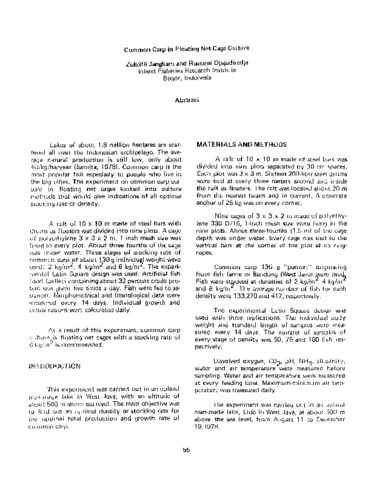
Common carp in floating net cage culture


Share
นามธรรม
The main objective of this experiment was to determine the optimal density or stocking rate for the optimal total production and growth rate of common carp, Cyprinus carpio . A raft of 10 x 10 m made of steel bars with drums as floaters was divided into nine plots. A cage of polyethylene 3 x 3 x 2 m, 1 inch mesh size was hung in every plot. About three fourths of the cage was under water. Three stages of stocking rate of common carp of about 130 g individual weight were used: 2 kg/m2, 4 kg/m2 and 6 kg/m2. The experimental Latin Square design was used. Artificial fish food (pellet) containing about 32 percent crude protein was given five times a day. Fish were fed to satiation. Morphometrical and limnological data were measured every 14 days. Individual growth and actual rations were calculated daily. As a result of this experiment, common carp culture is floating net cages with a stocking rate of 6 kg/m2 is recommended.
การอ้างอิง
Jangkaru, Z., & Djajadiredja, R. (1979). Common carp in floating net cage culture. In Proceedings of the International Workshop on Pen Cage Culture of Fish, 11-22 February 1979, Tigbauan, Iloilo, Philippines (pp. 55-60). Tigbauan, Iloilo, Philippines: Aquaculture Department, Southeast Asian Fisheries Development Center.
Type
Conference paperคอลเลกชัน
Related items
Showing items related by title, author, creator and subject.
-
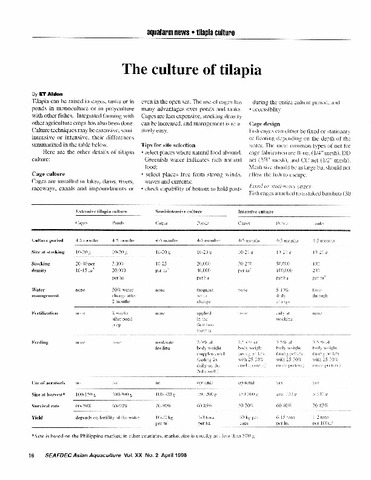
The culture of tilapia
(Aquaculture Department, Southeast Asian Fisheries Development Center, 1998) -
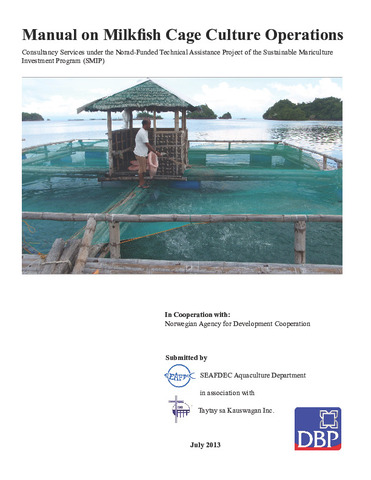
Manual on milkfish cage culture operations
(Aquaculture Department, Southeast Asian Fisheries Development Center, 2013-07)Milkfish (Chanos chanos, or bangus) culture is the largest finfish aquaculture industry in the Philippines and continues to be a top aquaculture commodity primarily because it is easy to culture and can be grown in a wide range of environments. Milkfish thrives in freshwater, brackishwater, marine, and even hypersaline habitats. Milkfish production is increasing rapidly with much of the production moving away from the traditional culture in brackishwater ponds to fish cages in coastal marine waters. To provide a general view of the milkfish culture industry, brief descriptions on breeding, hatchery production, and nursery operation are included in this manual. This manual is meant to serve as a guide for those interested to venture into marine cage farming of milkfish. Milkfish culture has been practiced in the Philippines, Indonesia, and Taiwan for centuries and has been the focus of aquaculture research in a number of institutions for several decades. Innovations in culture practices as a result of information from research data and from farmer’s experiences have been adopted by industry practitioners and these are documented in the recently published book entitled Milkfish Aquaculture in Asia (Liao and Leano, 2010). The recent concern about the rapid growth of aquaculture and its possible environmental impacts, and risks that can threaten the sustainability of this expanding industry has also been the subject of many conferences to develop good management practices in aquaculture. Principles and guidelines on better management practices in marine finfish culture had been drafted and included in this manual. -
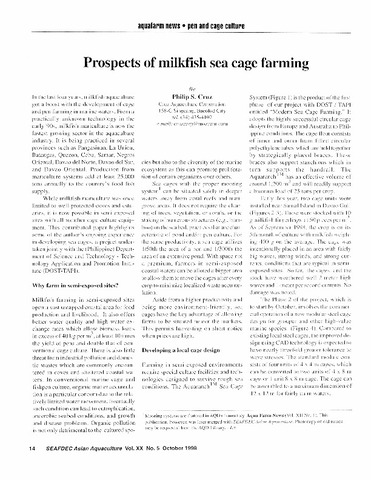
Prospects of milkfish sea cage farming
(Aquaculture Department, Southeast Asian Fisheries Development Center, 1998)