02 SEAFDEC/AQD Collaborative Publications: Recent submissions
111-115 / 453
-
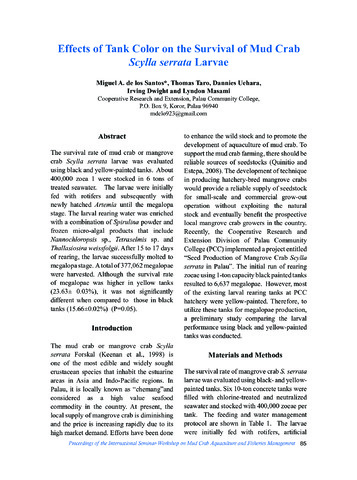
Effect of tank color on the survival of mud crab Scylla serrata larvae
(Rajiv Gandhi Centre for Aquaculture (MPEDA), 2015)The survival rate of mud crab or mangrove crab Scylla serrata larvae was evaluated using black and yellow-painted tanks. About 400,000 zoea 1 were stocked in 6 tons of treated seawater. The larvae were initially fed with rotifers and subsequently with newly hatched Artemia until the megalopa stage. The larval rearing water was enriched with a combination of Spirulina powder and frozen micro-algal products that include Nannochloropsis sp., Tetraselmis sp. and Thallasiosira weissfolgii. After 15 to 17 days of rearing, the larvae successfully molted to megalopa stage. A total of 377,062 megalopae were harvested. Although the survival rate of megalopae was higher in yellow tanks (23.63± 0.03%), it was not significantly different when compared to those in black tanks (15.66±0.02%) (P=0.05). -
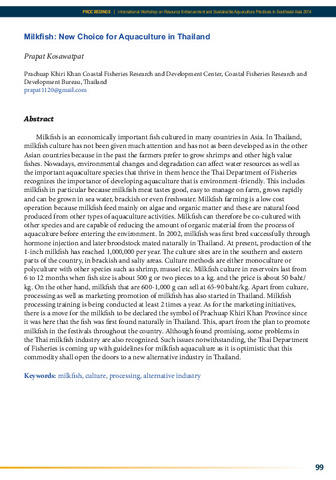
Milkfish: New choice for aquaculture in Thailand
(Aquaculture Department, Southeast Asian Fisheries Development Center, 2015)Milkfish is an economically important fish cultured in many countries in Asia. In Thailand, milkfish culture has not been given much attention and has not as been developed as in the other Asian countries because in the past the farmers prefer to grow shrimps and other high value fishes. Nowadays, environmental changes and degradation can affect water resources as well as the important aquaculture species that thrive in them hence the Thai Department of Fisheries recognizes the importance of developing aquaculture that is environment-friendly. This includes milkfish in particular because milkfish meat tastes good, easy to manage on farm, grows rapidly and can be grown in sea water, brackish or even freshwater. Milkfish farming is a low cost operation because milkfish feed mainly on algae and organic matter and these are natural food produced from other types of aquaculture activities. Milkfish can therefore be co-cultured with other species and are capable of reducing the amount of organic material from the process of aquaculture before entering the environment. In 2002, milkfish was first bred successfully through hormone injection and later broodstock mated naturally in Thailand. At present, production of the 1-inch milkfish has reached 1,000,000 per year. The culture sites are in the southern and eastern parts of the country, in brackish and salty areas. Culture methods are either monoculture or polyculture with other species such as shrimp, mussel etc. Milkfish culture in reservoirs last from 6 to 12 months when fish size is about 500 g or two pieces to a kg. and the price is about 50 baht/ kg. On the other hand, milkfish that are 600-1,000 g can sell at 65-90 baht/kg. Apart from culture, processing as well as marketing promotion of milkfish has also started in Thailand. Milkfish processing training is being conducted at least 2 times a year. As for the marketing initiatives, there is a move for the milkfish to be declared the symbol of Prachuap Khiri Khan Province since it was here that the fish was first found naturally in Thailand. This, apart from the plan to promote milkfish in the festivals throughout the country. Although found promising, some problems in the Thai milkfish industry are also recognized. Such issues notwithstanding, the Thai Department of Fisheries is coming up with guidelines for milkfish aquaculture as it is optimistic that this commodity shall open the doors to a new alternative industry in Thailand. -
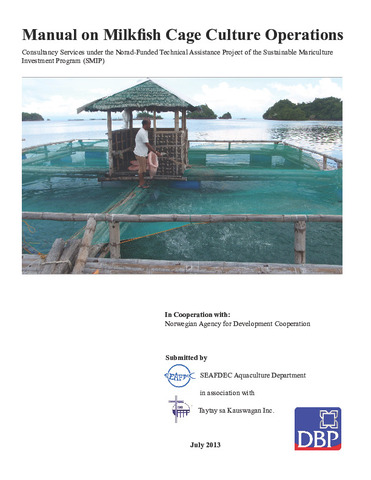
Manual on milkfish cage culture operations
(Aquaculture Department, Southeast Asian Fisheries Development Center, 2013-07)Milkfish (Chanos chanos, or bangus) culture is the largest finfish aquaculture industry in the Philippines and continues to be a top aquaculture commodity primarily because it is easy to culture and can be grown in a wide range of environments. Milkfish thrives in freshwater, brackishwater, marine, and even hypersaline habitats. Milkfish production is increasing rapidly with much of the production moving away from the traditional culture in brackishwater ponds to fish cages in coastal marine waters. To provide a general view of the milkfish culture industry, brief descriptions on breeding, hatchery production, and nursery operation are included in this manual. This manual is meant to serve as a guide for those interested to venture into marine cage farming of milkfish. Milkfish culture has been practiced in the Philippines, Indonesia, and Taiwan for centuries and has been the focus of aquaculture research in a number of institutions for several decades. Innovations in culture practices as a result of information from research data and from farmer’s experiences have been adopted by industry practitioners and these are documented in the recently published book entitled Milkfish Aquaculture in Asia (Liao and Leano, 2010). The recent concern about the rapid growth of aquaculture and its possible environmental impacts, and risks that can threaten the sustainability of this expanding industry has also been the subject of many conferences to develop good management practices in aquaculture. Principles and guidelines on better management practices in marine finfish culture had been drafted and included in this manual. -
Evaluation standard for assessing mariculture parks
(Aquaculture Department, Southeast Asian Fisheries Development Center, 2013-07)The Evaluation Standard for the Sustainable Mariculture Investment Program (SMIP) of the Development Bank of the Philippines (DBP) is designed to provide an objective and detailed mechanism for assessing investment ... -
Sustainable Mariculture Investment Program (completion report)
(Aquaculture Department, Southeast Asian Fisheries Development Center, 2013-07)