02 SEAFDEC/AQD Collaborative Publications: Recent submissions
Now showing items 141-145 of 453
-
Series: Summary of Proceedings No. 1/2013;
Petrographic analysis of rocks and sediments around the seven lakes of San Pablo City, Laguna: Implications to sulfate distribution and provenance
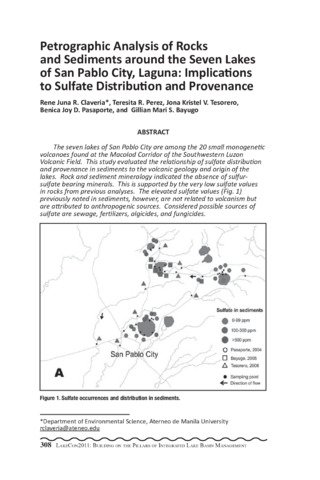
(PCAARRD-DOST, 2013)The seven lakes of San Pablo City are among the 20 small monogenetic volcanoes found at the Macolod Corridor of the Southwestern Luzon Volcanic Field. This study evaluated the relationship of sulfate distribution and provenance in sediments to the volcanic geology and origin of the lakes. Rock and sediment mineralogy indicated the absence of sulfursulfate bearing minerals. This is supported by the very low sulfate values in rocks from previous analyses. The elevated sulfate values (Fig. 1) previously noted in sediments, however, are not related to volcanism but are attributed to anthropogenic sources. Considered possible sources of sulfate are sewage, fertilizers, algicides, and fungicides. -
Series: Summary of Proceedings No. 1/2013;
ILBM: The Laguna de Bay experience
(PCAARRD-DOST, 2013)The Laguna Lake Development Authority (LLDA), in its four decades of existence, is the only lake management institution in the Philippines. It was created in 1966 through Republic Act 4850. Since then, several laws and decrees were passed that further strengthened the powers and functions of LLDA. This paved the way for the formulation of policies and in the implementation of plans and programs in accordance with its general mandate to promote and accelerate the development and balanced growth of the Laguna de Bay Region with due regard for environmental management. In 2003, the Laguna de Bay, through the efforts of the LLDA, was among the 26 case study lakes from different parts of the world in the international project: Towards a Lake Basin Management Initiative (LBMI): Sharing Lessons and Experiences from GEF and non-GEF Lake Basin Management Projects. This was implemented by a number of international institutions led by the International Lake Environment Committee Foundation with funding from the Global Environment Facility. The experiences and lessons of the LLDA in lake basin management, together with other key institutions and lakes from five continents, were shared to the international lake stakeholders in order to guide ongoing and future programs on lake management. Further into the evolution of the LBMI project is the development of the Integrated Lake Basin Management Approach (ILBM) by International Lake Environment Committee (ILEC) and Shiga University of Japan, of which the LLDA is again one of the key institutions chosen in the assessment and applicability of the ILBM approach. All the six pillars of ILBM, namely, Institutions, Policies, Participation, Finance, Technology, and Information (Fig. 1) are under the management of Laguna de Bay. Yet, the big challenge of integration and coordination were magnified when Typhoon Ondoy happened in 2009 (Fig. 2). The devastation in the watershed, the loss of lives and properties, the flooding caused by denuded forests, uncontrolled development, and blocked waterways have shown that while the six pillars are present, they are not of the same strength. This has prompted the LLDA to revise its Master Plan in 2011 under the ILBM approach to reinforce and strengthen the weak pillars, to address the current pressures in the lake and in the watershed, and to respond to opportunities for better lake basin management. -
Series: Summary of Proceedings No. 1/2013;
Carbon credits for lake basin management
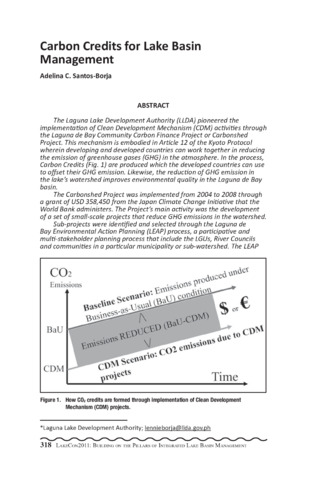
(PCAARRD-DOST, 2013)The Laguna Lake Development Authority (LLDA) pioneered the implementation of Clean Development Mechanism (CDM) activities through the Laguna de Bay Community Carbon Finance Project or Carbonshed Project. This mechanism is embodied in Article 12 of the Kyoto Protocol wherein developing and developed countries can work together in reducing the emission of greenhouse gases (GHG) in the atmosphere. In the process, Carbon Credits (Fig. 1) are produced which the developed countries can use to offset their GHG emission. Likewise, the reduction of GHG emission in the lake s watershed improves environmental quality in the Laguna de Bay basin. The Carbonshed Project was implemented from 2004 to 2008 through a grant of USD 358,450 from the Japan Climate Change Initiative that the World Bank administers. The Project s main activity was the development of a set of small-scale projects that reduce GHG emissions in the watershed. Sub-projects were identified and selected through the Laguna de Bay Environmental Action Planning (LEAP) process, a participative and multi-stakeholder planning process that include the LGUs, River Councils and communities in a particular municipality or sub-watershed. The LEAP process was developed under another World Bank and Dutch Governmentfunded project, the Laguna de Bay Institutional Strengthening and Community Participation Project or LISCOP that was implemented almost as the same time as the Carbonshed Project. The small-scale CDM sub-projects (Fig. 2) are being implemented by local government units (LGUs) with technical support from the LLDA and funding support under the LISCOP project. The first bundle under the Methane Avoidance Category consists of seven LGU sub-projects on Materials Recovery Facility with Composting. A significant milestone, both for the LLDA and for the participating LGUs was reached on March 16, 2008 with the registration of the Laguna de Bay Community Waste Management Project: Avoidance of Methane Production from Biomass Decay through Composting-1 to the United Nations Framework Convention on Climate Change- Clean Development Mechanism Executive Board (UNFCCC-CDMEB). The estimated Carbon Emission Reduction was 6,058 tons CO2-e. The buyers of Carbon Emission Reduction (CER), which translates into Carbon Credits is the Community Development Carbon Fund (CDCF). An Emission Reduction Purchase Agreement (ERPA) was signed on June 30, 2006 between the LLDA, representing the CDM-project participants and the World Bank, representing the CDCF. A sub-ERPA was then signed between the LLDA and the project participants as a commitment to meet the obligations under the ERPA. The Carbonshed Project has also established a mechanism to ensure that the money from the carbon credits will be used for operational costs of the existing composting facilities or for new environmental and social investments in the localities implementing these projects. -
Series: Summary of Proceedings No. 1/2013;
Treating Laguna de Bay water to Philippine National Standards for drinking water with high-performance membranes
(PCAARRD-DOST, 2013)The demand for reliable water supplies has been growing for years and is increasingly urgent in the Philippines. Using membrane technology, difficult-to-treat water sources are now viable water supply options. Hollow-fiber microfiltration (MF) membrane systems are especially effective in treating surface water supplies such as lakes, rivers, and reservoirs and are now used to supplement or to replace conventional water treatment technologies, e.g., rapid-mix, coagulation, sedimentation, and multimedia filtration. These low-pressure polymeric hollow-fiber membrane systems are used globally to treat surface and groundwaters for drinking water. High-quality drinking water (turbidity<0.1 NTU) can be assured by MF membranes, which effectively remove Cryptosporidium and Giardia and exceed United States EPA Surface Water Treatment Rule (SWTR) logremoval requirements. Hollow-fiber MF membrane systems made of the fluorocarbon polyvinylidenefluoride (PVDF) provide comprehensive oxidant compatibility that allows the oxidation and subsequent removal of iron and manganese. Taste and odor compounds are oxidized or removed by coagulants or powdered activated carbon. Automated integrity test procedures assure long-term membrane reliability. Low-pressure microfiltration technology is combined with reverse osmosis that removes dissolved solids caused by saltwater intrusion into the lake. This combined membrane system provides drinking water that surpasses the stringent water purity specifications of the Philippine National Standards for Drinking Water. Membrane systems can consistently produce drinking water with turbidity below 0.1 NTU, independent of feed water quality. This paper discusses design considerations for a custom-designed integrated membrane system combining hollow-fiber membrane technology with reverse osmosis to produce 100 million liters per day of potable and palatable drinking water (Fig.1). -
Series: Summary of Proceedings No. 1/2013;
Epipelic diatoms of Lake Caliraya, Laguna, Philippines
(PCAARRD-DOST, 2013)A taxonomic survey of diatom flora was conducted through sediments (from 25 cm to 200 cm depth) along the shoreline of Lake Caliraya, a man-made lake in Laguna Province, Philippines. There were a total of 63 diatom taxa belonging to three classes and 28 genera. About 93% were pennate diatoms and the other 7% are centric diatoms. Cocconeis placentula, Sellphora pupula, and Gomphonema accuminatum var. turris were the more abundant and frequently occurring pennate diatom species in the study. More frequently occurring centric diatoms include Aulacoseira granulata and Cyclotella menehegniana. Rarely occurring diatoms in this lake were also noted, including Synedra incisa, Fragilaria crotonensis, Bacillaria paxillifer, Craticula perotettii, and Amphora ovalis.