02 SEAFDEC/AQD Collaborative Publications: Recent submissions
Now showing items 171-175 of 453
-
Milkfish bibliography: a compilation of abstracts on milkfish studies
(WorldFish Center, 2007)Milkfish Bibliography covers 700 references on milkfish biology; broodstock management and fry, fingerling and egg collection and production; milkfish culture systems; health and nutrition; post harvest technology; socioeconomic and related studies; and environment and ecology. Included references range from published/unpublished documents, theses, journal articles, to project reports and conference papers. -
Shrimp pond effluents and water quality in Imbang River, Negros Occidental
(Bureau of Agricultural Research, Department of Agriculture, 2007)The contribution of shrimp farm effluents to the pollution load in Imbang River, Negros Occidental was measured during the period May 1993 to February 1995. Shrimp pond effluents were characterized and the pollution load estimated. The pond effluents had low average nitrite (0.0025 ppm) and nitrate (0.06 ppm) and optimum (for shrimp culture) pH 7.9, phosphate 0.15 ppm, dissolved oxygen 5.20 ppm, and salinity 23.3 ppt. Ammonia was 0.13 ppm on average in most farms, above the safe level for shrimp, and total suspended solids was 23 ppm, about 2.5x the allowed limit for effluents. Biochemical oxygen demand (20 ppm) and settleable solids (0.15 ppm) were still with acceptable limits. Residues of organochlorine pesticides were present at very low concentrations, well below the safe levels for aquatic life. Most of the pollution load came from the regular water exchanges over the 4-month crop cycle, at least every two weeks in low-density farms and more frequently in the high-density farms. The total draining of pond water at harvest contributed a minor load. Total solids from shrimp farms contributed a huge load, about 181,325 mt/yr. Total suspended solids contributed 1,285 mt/yr and settleable solids <1 mt/yr. The total BOD load was 154,367 kg/yr. The phosphate load was about 1,080 kg/yr, and the total nitrogen load was 1,225 kg/yr. The effects of effluent release from farms were localized. Upstream water quality and other uses of the river were not affected. Since most of the shrimp farms were located 1.5–2 km from the sea, the release of effluents during water exchange and at harvest did not adversely affect water quality downstream of these farms. Where such draining increased the levels of ammonia, phosphate, and total suspended solids in the river, the effect was significant only within 250 m from the release point, and the pollutants were dissipated about 550–800 m downstream The other water quality variables were at low levels in the pond effluents and did not affect the river water during draining. Often the concentrations of pollutants in the river were higher before than during draining of pond effluents. Stations upstream of the release sites of pond effluents often had high pollutant concentrations from other upstream sources. -
Sugar mill effluents and water quality in Imbang River and Malisbog River, Negros Occidental
(Bureau of Agricultural Research, Department of Agriculture, 2007)The effluents of two sugar mills and the effects on water quality in the receiving rivers were studied. Sugar mill A was located in Barangay Dos Hermanas in Talisay and discharged directly into Imbang River. Sugar Mill B was located in Barangay Hawaiian in Silay City and discharged into Malisbog River, a tributary of Imbang. Both sugar mills had sedimentation tanks and lagoons for partial wastewater treatment prior to discharge. Water sampling was done at 13 stations at effluent discharge sites and also upstream and downstream of these sites. The sugar mill effluents were particularly high in biochemical oxygen demand (BOD 109–419 mg/l), total suspended solids (168–384 mg/l), and total solids (1,185–1,234 mg/l), also high in ammonia (0.2–0.5 mg/l) and water temperature (31–38°C), but low in dissolved oxygen (2–5 mg/l). Measured stream flows varied at the different stations and were generally lowest at stations near sugar mill A and at stations near sugar mill B. At these sites, the depth of Imbang River varied from about 10 cm during low water flow in December–May to about 2 m during high water flow in June–November. During normal low flows, the sugar mill effluent comprised 75–85% of the total stream volume, causing highly polluted conditions immediately below the outlets. Sugar mill A discharged high annual loads of solids, BOD, nitrate, and phosphate into Imbang River, whereas sugar mill B loaded plenty of solids, BOD, ammonia, and phosphate into Malisbog River. The sugar cane milling season in Negros Occidental started in October and ended in May, coincident with the dry season. Significantly higher levels of BOD and nutrients, but lower DO, were observed in the river during the milling season (see figures in Gonzales et al., this volume), both because of greater discharge and lower dilution by lower stream flows. River water quality was better at the stations upstream than downstream of the sugar mills. Stations near the sugar mills had BOD, ammonia, and solids at concentrations exceeding the allowable limits set for river water by the Department of Environment and Natural Resources. -
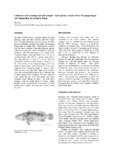
Collection of the orange-spotted grouper Epinephelus coioides from Tinagong Dagat and Sapian Bay in northern Panay
(Bureau of Agricultural Research, Department of Agriculture, 2007)In Capiz, northern Panay, grouper catches by hand picking, hook and line, shelters, and fish corral were low throughout the year, on average 1-3 fish from each fishing operation, but higher in Tinagong Dagat than in Sapian Bay. Epinephelus coioides was the most common of the three grouper species collected; E. quoyanus and E. malabaricus were not numerous. The 882 specimens of E. coioides from Tinagong Dagat measured from 3.6 to 39 cm in standard length; the 250 E. coioides from Sapian Bay were between 1.7 and 31.2 cm SL. The size distribution showed a modal length of about 17 cm SL (21% of the fish) in Tinagong Dagat, and 11 cm (26%) in Sapian Bay. Small juveniles 2–8 cm were collected from Tinagong Dagat in January-April 1993, but not in Jan-Apr 1994. Such small juveniles were also collected from Sapian Bay in January and in April–August 1993. Groupers 9–23 cm occurred year round, but the 9–15 cm group was more abundant from January to June. At both sites, groupers >30 cm could hardly be found. Both grouper habitats experienced wide ranges of water temperature, salinity, and dissolved oxygen during the year. -
Fish catch and fisher incomes before and after installation of artificial reefs in Panguil Bay, northern Mindanao
(Bureau of Agricultural Research, Department of Agriculture, 2007)Two artificial reef complexes (10 modules) were deployed in Panguil Bay in 1990. The effect of the ARs on the fish catch and fisher incomes was studied from March 1993 to April 1994 in Purok 3, 4, 6, and 7 in San Antonio, Ozamis City and in Poblacion 1 and 4 in Clarin, Misamis Occidental. Clarin‘s 40 full-time fisher respondents had 50 outrigger boats, all without engines, and used 181 fishing gears, 93% of them simple or multiple hand lines. San Antonio‘s 80 full-time fisher respondents had 87 non-motor boats and 44 motor boats and used 489 fishing gears, 86% of them bottom-set gill nets. The fishers worked an average of 19 days a month and four hours a day. The fishing grounds were mostly between 3 and 3.5 km from shore, and the gears were operated in waters about 50 m deep. Of about 17,000 kg of fish harvested in Clarin and San Antonio over one year, 33% came from bottom-set gill nets, 32% from bottom-set long lines, and 28% from multiple hand lines. The catch included a great variety of fishes, plus shrimps and cuttlefish; threadfins made up 13% of the total volume by weight, slipmouths 10%, and sardines 7%. The catch ranged from 2,382 kg valued at P75,862 in Purok 3 to 3,212 kg worth P97,303 in Poblacion 1, but in Purok 7, the catch was 2,965 kg worth P123,195. The average annual revenues of fishers was P24,191 in San Antonio and P11,472 in Clarin, corresponding to monthly earnings of P2,016 and P956, respectively. The revenues and net incomes were low, but the returns on investment were high (78–300%). The fishing boat, with or without engine and gas, was the major expense incurred by the fishers. Between 1989 and 1993–94, the volume of fish catch increased two-fold in San Antonio and four-fold in Clarin. The average annual income of fishers in the six villages increased by 10–60% after the ARs, and the average annual expenses also increased by 5–30%. In 1993-94, the computed return on investment was 105% in San Antonio and 274% in Clarin, higher than in 1989.