02 SEAFDEC/AQD Collaborative Publications: Recent submissions
Now showing items 61-65 of 453
-
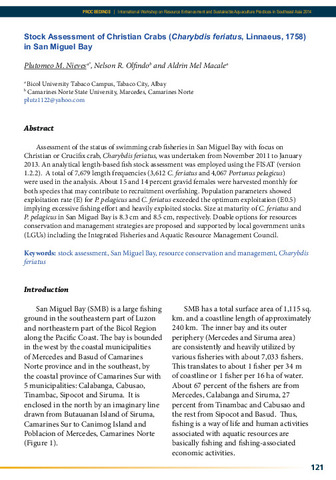
Stock assessment of christian crabs (Charybdis feriatus, Linnaeus, 1758) in San Miguel bay
(Aquaculture Department, Southeast Asian Fisheries Development Center, 2015)Assessment of the status of swimming crab fisheries in San Miguel Bay with focus on Christian or Crucifix crab, Charybdis feriatus, was undertaken from November 2011 to January 2013. An analytical length-based fish stock assessment was employed using the FISAT (version 1.2.2). A total of 7,679 length frequencies (3,612 C. feriatus and 4,067 Portunus pelagicus) were used in the analysis. About 15 and 14 percent gravid females were harvested monthly for both species that may contribute to recruitment overfishing. Population parameters showed exploitation rate (E) for P. pelagicus and C. feriatus exceeded the optimum exploitation (E0.5) implying excessive fishing effort and heavily exploited stocks. Size at maturity of C. feriatus and P. pelagicus in San Miguel Bay is 8.3 cm and 8.5 cm, respectively. Doable options for resources conservation and management strategies are proposed and supported by local government units (LGUs) including the Integrated Fisheries and Aquatic Resource Management Council. -
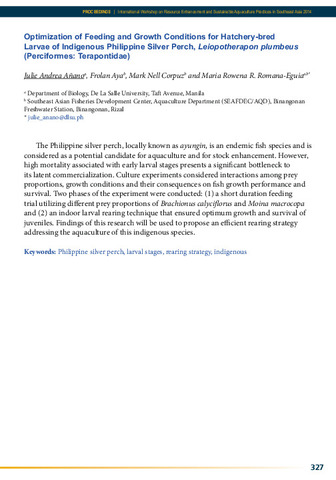
Optimization of feeding and growth conditions for hatchery-bred larvae of indigenous Philippine silver perch, Leiopotherapon plumbeus (Perciformes: Terapontidae)
; Aya, Frolan ; ; Romana-Eguia, Maria Rowena R. (Aquaculture Department, Southeast Asian Fisheries Development Center, 2015)
The Philippine silver perch, locally known as ayungin, is an endemic fish species and is considered as a potential candidate for aquaculture and for stock enhancement. However, high mortality associated with early larval stages presents a significant bottleneck to its latent commercialization. Culture experiments considered interactions among prey proportions, growth conditions and their consequences on fish growth performance and survival. Two phases of the experiment were conducted: (1) a short duration feeding trial utilizing different prey proportions of Brachionus calyciflorus and Moina macrocopa and (2) an indoor larval rearing technique that ensured optimum growth and survival of juveniles. Findings of this research will be used to propose an efficient rearing strategy addressing the aquaculture of this indigenous species.
; ; Romana-Eguia, Maria Rowena R. (Aquaculture Department, Southeast Asian Fisheries Development Center, 2015)
The Philippine silver perch, locally known as ayungin, is an endemic fish species and is considered as a potential candidate for aquaculture and for stock enhancement. However, high mortality associated with early larval stages presents a significant bottleneck to its latent commercialization. Culture experiments considered interactions among prey proportions, growth conditions and their consequences on fish growth performance and survival. Two phases of the experiment were conducted: (1) a short duration feeding trial utilizing different prey proportions of Brachionus calyciflorus and Moina macrocopa and (2) an indoor larval rearing technique that ensured optimum growth and survival of juveniles. Findings of this research will be used to propose an efficient rearing strategy addressing the aquaculture of this indigenous species. -
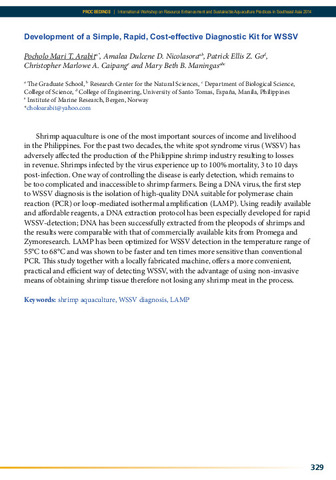
Development of a simple, rapid, cost-effective diagnostic kit for WSSV
(Aquaculture Department, Southeast Asian Fisheries Development Center, 2015)Shrimp aquaculture is one of the most important sources of income and livelihood in the Philippines. For the past two decades, the white spot syndrome virus (WSSV) has adversely affected the production of the Philippine shrimp industry resulting to losses in revenue. Shrimps infected by the virus experience up to 100% mortality, 3 to 10 days post-infection. One way of controlling the disease is early detection, which remains to be too complicated and inaccessible to shrimp farmers. Being a DNA virus, the first step to WSSV diagnosis is the isolation of high-quality DNA suitable for polymerase chain reaction (PCR) or loop-mediated isothermal amplification (LAMP). Using readily available and affordable reagents, a DNA extraction protocol has been especially developed for rapid WSSV-detection; DNA has been successfully extracted from the pleopods of shrimps and the results were comparable with that of commercially available kits from Promega and Zymoresearch. LAMP has been optimized for WSSV detection in the temperature range of 55°C to 68°C and was shown to be faster and ten times more sensitive than conventional PCR. This study together with a locally fabricated machine, offers a more convenient, practical and efficient way of detecting WSSV, with the advantage of using non-invasive means of obtaining shrimp tissue therefore not losing any shrimp meat in the process. -
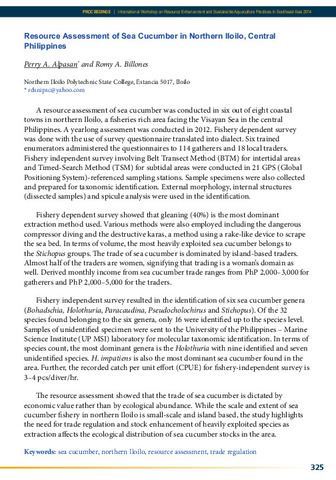
Resource assessment of sea cucumber in northern Iloilo, central Philippines
(Aquaculture Department, Southeast Asian Fisheries Development Center, 2015)A resource assessment of sea cucumber was conducted in six out of eight coastal towns in northern Iloilo, a fisheries rich area facing the Visayan Sea in the central Philippines. A yearlong assessment was conducted in 2012. Fishery dependent survey was done with the use of survey questionnaire translated into dialect. Six trained enumerators administered the questionnaires to 114 gatherers and 18 local traders. Fishery independent survey involving Belt Transect Method (BTM) for intertidal areas and Timed-Search Method (TSM) for subtidal areas were conducted in 21 GPS (Global Positioning System)-referenced sampling stations. Sample specimens were also collected and prepared for taxonomic identification. External morphology, internal structures (dissected samples) and spicule analysis were used in the identification. Fishery dependent survey showed that gleaning (40%) is the most dominant extraction method used. Various methods were also employed including the dangerous compressor diving and the destructive karas, a method using a rake-like device to scrape the sea bed. In terms of volume, the most heavily exploited sea cucumber belongs to the Stichopus groups. The trade of sea cucumber is dominated by island-based traders. Almost half of the traders are women, signifying that trading is a woman's domain as well. Derived monthly income from sea cucumber trade ranges from PhP 2,000-3,000 for gatherers and PhP 2,000-5,000 for the traders. Fishery independent survey resulted in the identification of six sea cucumber genera (Bohadschia, Holothuria, Paracaudina, Pseudocholochirus and Stichopus). Of the 32 species found belonging to the six genera, only 16 were identified up to the species level. Samples of unidentified specimen were sent to the University of the Philippines - Marine Science Institute (UP MSI) laboratory for molecular taxonomic identification. In terms of species count, the most dominant genera is the Holothuria with nine identified and seven unidentified species. H. impatiens is also the most dominant sea cucumber found in the area. Further, the recorded catch per unit effort (CPUE) for fishery-independent survey is 3-4 pcs/diver/hr. The resource assessment showed that the trade of sea cucumber is dictated by economic value rather than by ecological abundance. While the scale and extent of sea cucumber fishery in northern Iloilo is small-scale and island based, the study highlights the need for trade regulation and stock enhancement of heavily exploited species as extraction affects the ecological distribution of sea cucumber stocks in the area. -
Targeting essential gene utilizing RNA interference to protect the ailing shrimp/prawn industry against WSSV
(Aquaculture Department, Southeast Asian Fisheries Development Center, 2015)The white spot syndrome virus (WSSV) remains to be the most widespread and devastating infectious agent that has hit particularly the marine shrimp aquaculture industry worldwide. To date, there are no known effective strategies that can combat WSSV infection. This study aimed to elucidate host-pathogen interaction through the functional study of host - gene. Utilizing RNA Interference, the function of contig23 (c23) in the shrimp genome, identified to have high homology with WSSVORF-325, was determined. Three set-ups were prepared for treatment of c23-, GFP-dsRNA, and PBS using Macrobrachium rosenbergii freshwater prawns. Each treatment group was challenged with WSSV and survival rate was recorded. C23-, and GFP-dsRNA injected prawns showed a significant survival rate of 100%, in contrast to 20% of the PBS injected prawns at 10 days post-infection (dpi). Results showed that injection of c23- and GFP-dsRNA prior to challenge with WSSV, delayed and reduced mortality in contrast to PBS-treated prawns, which showed high mortality. Gene expression analysis showed silencing of both WSSV and c23 at day 3 post-WSSV challenge. This study proved that c23-dsRNA has a protective effect on WSSVchallenged prawns and highlights its involvement in the infectivity of WSSV in M. rosenbergii.