Bacterial flora in the hepatopancreas of pond-reared Penaeus monodon juveniles with luminous vibriosis
View/
Date
1998Page views
2,925ASFA keyword

AGROVOC keyword
Taxonomic term

Metadata
Show full item recordShare
Abstract
Quantification and characterization of bacterial flora in the hepatopancreas (hp) of pond-reared Penaeus monodon juveniles affected with luminous bacteria were conducted in 1994 and 1995. Shrimp samples were taken from 23 grow-out ponds, 14 of which had disease outbreaks. Luminous bacterial (LB) load of the shrimps' hp with (mean=2.4×101 colony forming units (CFU)/hp) and without (mean=0.3×101 CFU/hp) disease outbreaks were comparable during the first 15 days of culture (DOC). During disease outbreaks at 18 to 32 DOC, however, LB load of affected shrimps (mean=9.0×10⁴ CFU/hp) were higher than healthy shrimps (mean=7.0×101 CFU/hp). At 50 to 60 DOC, levels of LB were comparable in older shrimps with or without disease. Total viable and presumptive Vibrio counts were also comparable in both shrimp samples from 1 to 60 DOC. Characterization of the 172 bacterial isolates collected showed that most (90.12%) were Vibrio species dominated by V. harveyi (27.91%), V. splendidus II (13.37%) and V. parahaemolyticus (10.46%).
Suggested Citation
Leaño, E. M., Lavilla-Pitogo, C. R., & Paner, M. G. (1998). Bacterial flora in the hepatopancreas of pond-reared Penaeus monodon juveniles with luminous vibriosis. Aquaculture , 164(1-4), 367-374. https://doi.org/10.1016/S0044-8486(98)00201-4
Type
ArticleISSN
0044-8486Collections
- Journal Articles [1267]
Related items
Showing items related by title, author, creator and subject.
-
Series: Aquaculture extension manual; No. 16
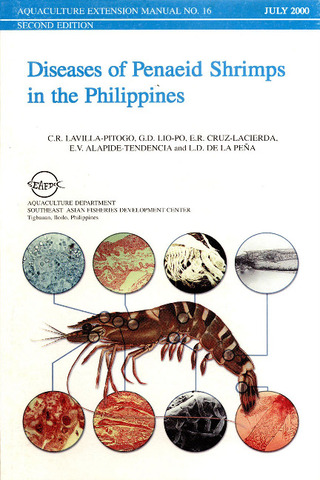
Diseases of penaeid shrimps in the Philippines
; ; ; Tendencia, Eleonor ; (Aquaculture Department, Southeast Asian Fisheries Development Center, 2000)
The manual provides information on the diseases that affect the 3 major species of shrimps cultured in the Philippines: Penaeus monodon, P. merguiensis and P. indicus. It includes the common name of the disease, causative agent, species affected, stages affected, gross signs, effects on the host and methods of prevention and treatment. This revised edition includes newly discovered diseases. It is hoped that the manual will be of considerable help to shrimp farmers in identifying the disease and lead to prevention or early disease diagnosis and control.
; (Aquaculture Department, Southeast Asian Fisheries Development Center, 2000)
The manual provides information on the diseases that affect the 3 major species of shrimps cultured in the Philippines: Penaeus monodon, P. merguiensis and P. indicus. It includes the common name of the disease, causative agent, species affected, stages affected, gross signs, effects on the host and methods of prevention and treatment. This revised edition includes newly discovered diseases. It is hoped that the manual will be of considerable help to shrimp farmers in identifying the disease and lead to prevention or early disease diagnosis and control. -
Microbial diseases of prawns
(Aquaculture Department, Southeast Asian Fisheries Development Center, 1988) -
Important diseases of Penaeid shrimps
(National Taiwan Ocean University; The Fisheries Society of Taiwan; Asian Fisheries Society; World Aquaculture Society, 2016)In tropical Asia, the two main species of penaeid shrimps that are widely cultured are the black tiger shrimp (Penaeus monodon) and the Pacific white shrimp (Penaeus (Litopenaeus) vannamei). The former species is indigenous in most Asian countries while the latter is indigenous in the Americas and was introduced to Asian countries in the late 1990s. In this chapter, only details of the economically-important microbial infections in Asia in these two penaeid shrimps are presented and arbitrarily grouped as viral, bacterial, fungal and parasitic diseases. Viral infections are divided further into two groups: DNA viruses; and, RNA viruses. The infections attributed to DNA viruses are: White Spot Disease (WSD) Disease, Penaeus stylirostris densovirus (PstDNV) previously known as Infectious Hypodermal and Hematopoietic Necrosis Virus (IHHNV) Disease, Penaeus monodon densovirus (PmDNV) formerly known as Hepatopancreatic Parvo-like Virus (HPV) Disease and Penaeus monodon nucleopoly-hedrovirus (PemoNPV) previously known as Monodon Baculovirus (MBV) Disease. The shrimp infections caused by RNA viruses are: Yellow Head Virus (YHV) Disease, Taura Syndrome Virus (TSV) Disease, and Infectious Myonecrosis Virus (IMNV) Disease. For bacterial diseases, the list includes Luminous Bacterial Disease, Non-luminous Vibrio Infections, and Acute Hepatopancreatic Necrosis Disease (AHPND). Fungal disease includes Larval mycosis, while parasitic disease includes the current emerging threat to the shrimp industry, the Hepatopancreatic Microsporidiosis caused by Enterocytozoon hepatopenaei (EHP).