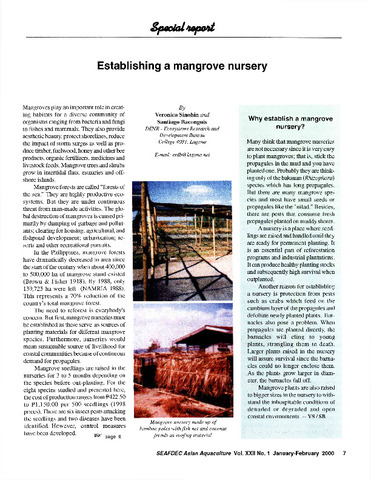
Establishing a mangrove nursery


Share
นามธรรม
Mangroves play an important role in creating habitats for a diverse community of organisms ranging from bacteria and fungi to fishes and mammals. They grow in intertidal flats, estuaries and offshore islands. In the Philippines, mangrove forests have dramatically decreased in area since the start of the century, and therefore there is a need to reforest. However, first mangrove nurseries must be established since they serve as sources of planting materials for different mangrove species. Furthermore, nurseries would mean a sustainable source of livelihood for coastal communities because of continuous demand for propagules. A brief account is given of procedures as to the establishment of a mangrove nursery, describing the construction of a nursery, preparation of potting materials, seed collection, seed sowing, and maintenance and protection. Details are provided of the most common true mangrove species in the Philippines. The mangrove nursery is a place for raising and tending seedlings until they are ready for permanent planting. The establishment of mangrove nurseries is in line with government s efforts to rehabilitate the coastal and mangrove ecosystems.
การอ้างอิง
Sinohin, V., & Baconguis, S. (2000). Establishing a mangrove nursery. SEAFDEC Asian Aquaculture , 22(1), 7-8, 28-30. http://hdl.handle.net/10862/1773
Type
magazineArticleISSN
0115-4974คอลเลกชัน
Related items
Showing items related by title, author, creator and subject.
-
Mangroves as nurseries: Shrimp populations in mangrove and non-mangrove habitats
(Elsevier, 1998)A total of 4845 penaeids belonging to nine species—Metapenaeus anchistus, M. ensis, M. moyebi, M. philippinensis, Penaeus merguiensis, P. monodon, P. semisulcatus, P. latisulcatus and Metapenaeopsis palmensis—were collected by pocket seine monthly over 13 months from mangrove and non-mangrove sites in Guimaras, Philippines. The restricted distribution of the three dominant species—M. ensisandP. merguiensisto the brackish water riverine mangrove, andM. anchistusto the high-salinity island mangrove and tidal flat—is probably related to different salinity and substrate preferences. Abundance and size composition of the major species suggest a strong nursery role for the riverine mangrove (high juvenile densities, relatively small sizes year-round), limited nursery use of the island mangrove (fewer shrimps, larger size ranges, presence of maturing females) and a non-nursery use (e.g. foraging) in the tidal flat. Penaeid recruitment to the river had two peaks in November and May when the average salinity was ∼20 (Practical Salinity Scale) and water temperatures were high (30–31 °C). The spatio-temporal pattern of penaeid species in Guimaras shows partitioning across habitats and seasonal recruitment influenced by physical and biological factors. -
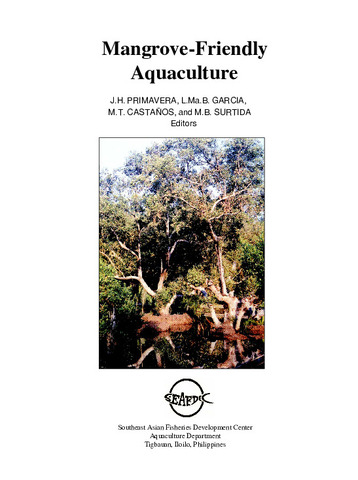
Mangrove-Friendly Aquaculture : Proceedings of the Workshop on Mangrove-Friendly Aquaculture organized by the SEAFDEC Aquaculture Department, January 11-15, 1999, Iloilo City, Philippines
(Aquaculture Department, Southeast Asian Fisheries Development Center, 2000)The proceedings have three review papers on the mangroves of Southeast Asia, silvofisheries, and Indonesia's integrated mangrove forest and aquaculture systems. The rest of the papers, all on mangrove-friendly aquaculture efforts are from the Philippines, Japan, Thailand, Vietnam, Malaysia, Brunei Darussalam, Indonesia, and Cambodia. All the countries represented had varied methodologies, with Cambodia in its initial stages while some countries like Indonesia and Thailand have tested methodologies. The proceedings include a tabulation of the reported mangrove-friendly technology by country -- e.g. silvofisheries in ponds (mangrove and fish/shrimp/mudcrab) and pens (mangrove and mudcrab). The workshop recommendations are classified into three major topics: problems associated with mangroves, problems associated with aquaculture practices, and socioeconomic and cultural issues. -
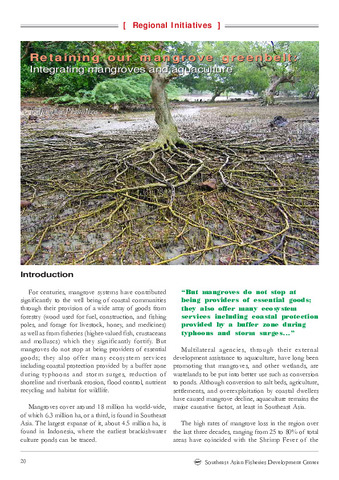
Retaining our mangrove greenbelt: Integrating mangroves and aquaculture
Primavera, Jurgenne (Secretariat, Southeast Asian Fisheries Development Center, 2004)
Although multilateral agencies in Southeast Asia have long been promoting that mangroves, and other wetlands, are wastelands to be put into better use, such as conversion to ponds. However, there is a need for Mangrove Friendly Aquaculture (MFA) technology in the intertidal forest, or swamp, which does not require the clearing of trees. MFA may be defined on 2 levels: 1) silvofisheries or aquasilviculture, where the low density culture of crabs, shrimps and fish is integrated with mangroves; and, 2) mangrove filters where mangrove forests are used to absorb the excess nutrients in the effluents from high-density culture ponds. A review is made of MFA practices belonging to the first category. Discussion is on a country basis, moving from traditional systems in Indonesia, to the introduced technologies in Indonesia, Vietnam, the Philippines and Malaysia. It is hoped that this review will be of use to scientists, aquaculturists, policy makers and governmental/NGOs interested in making aquaculture more ecologically sound and socially responsible.
(Secretariat, Southeast Asian Fisheries Development Center, 2004)
Although multilateral agencies in Southeast Asia have long been promoting that mangroves, and other wetlands, are wastelands to be put into better use, such as conversion to ponds. However, there is a need for Mangrove Friendly Aquaculture (MFA) technology in the intertidal forest, or swamp, which does not require the clearing of trees. MFA may be defined on 2 levels: 1) silvofisheries or aquasilviculture, where the low density culture of crabs, shrimps and fish is integrated with mangroves; and, 2) mangrove filters where mangrove forests are used to absorb the excess nutrients in the effluents from high-density culture ponds. A review is made of MFA practices belonging to the first category. Discussion is on a country basis, moving from traditional systems in Indonesia, to the introduced technologies in Indonesia, Vietnam, the Philippines and Malaysia. It is hoped that this review will be of use to scientists, aquaculturists, policy makers and governmental/NGOs interested in making aquaculture more ecologically sound and socially responsible.