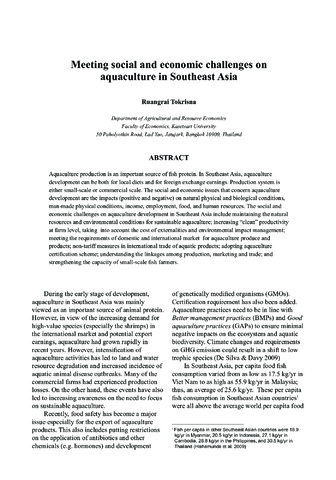
Meeting social and economic challenges on aquaculture in Southeast Asia.


Share
Abstract
Aquaculture production is an important source of fish protein. In Southeast Asia, aquaculture development can be both for local diets and for foreign exchange earnings. Production system is either small-scale or commercial scale. The social and economic issues that concern aquaculture development are the impacts (positive and negative) on natural physical and biological conditions, man-made physical conditions, income, employment, food, and human resources. The social and economic challenges on aquaculture development in Southeast Asia include maintaining the natural resources and environmental conditions for sustainable aquaculture; increasing "clean" productivity at farm level, taking into account the cost of externalities and environmental impact management; meeting the requirements of domestic and international market for aquaculture produce and products; non-tariff measures in international trade of aquatic products; adopting aquaculture certification scheme; understanding the linkages among production, marketing and trade; and strengthening the capacity of small-scale fish farmers.
Suggested Citation
Tokrisna, R. (2011). Meeting social and economic challenges on aquaculture in Southeast Asia. In B. O. Acosta, R. M. Coloso, E. G. T. de Jesus-Ayson, & J. D. Toledo (Eds.), Sustainable aquaculture development for food security in Southeast Asia towards 2020. Proceedings of the Regional Technical Consultation on Sustainable Aquaculture Development in Southeast Asia Towards 2020 (pp. 45-51). Tigbauan, Iloilo, Philippines: SEAFDEC Aquaculture Department.
Type
Conference paperISBN
9789718511992Related items
Showing items related by title, author, creator and subject.
-
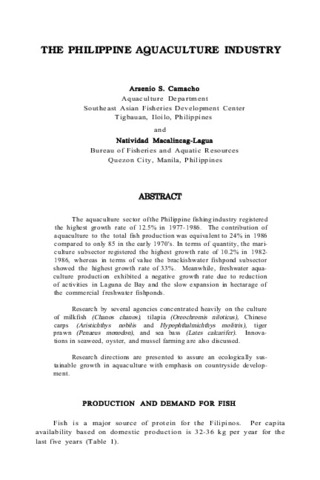
The Philippine aquaculture industry
(Aquaculture Department, Southeast Asian Fisheries Development Center, 1988)The aquaculture sector of the Philippine fishing industry registered the highest growth rate of 12.5% in 1977-1986. The contribution of aquaculture to the total fish production was equivalent to 24% in 1986 compared to only 85 in the early 1970's. In terms of quantity, the mariculture subsector registered the highest growth rate of 10.2% in 1982-1986, whereas in terms of value the brackishwater fishpond subsector showed the highest growth rate of 33%. Meanwhile, freshwater aquaculture production exhibited a negative growth rate due to reduction of activities in Laguna de Bay and the slow expansion in hectarage of the commercial freshwater fishponds. Research by several agencies concentrated heavily on the culture of milkfish (Chanos chanos), tilapia (Oreochromis niloticus), Chinese carps (Aristichthys nobilis and Hypophthalmichthys molitrix), tiger prawn (Penaeus monodon), and sea bass (Lates calcarifer). Innovations in seaweed, oyster, and mussel farming are also discussed. Research directions are presented to assure an ecologically sustainable growth in aquaculture with emphasis on countryside development. -
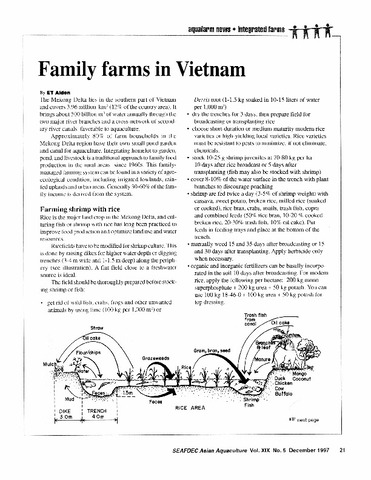
Family farms in Vietnam
(Aquaculture Department, Southeast Asian Fisheries Development Center, 1997) -
Nursery and grow-out operation and management of Penaeus monodon (Fabricius)
(Aquaculture Department, Southeast Asian Fisheries Development Center, 1988)The results of research on nursery and grow-out rearing of prawn conducted by the SEAFDEC Aquaculture Department for over a decade are reviewed. Different rearing facilities designed to accommodate hatchery-produced prawn fry are presented with corresponding data on growth, survival and production. Studies on stocking density, fertilization/natural food production, water management, feeds and feeding schemes and harvest/post-harvest handling are evaluated and viable technology identified. Diseases, pests and predators and other factors considered as production constraints are also mentioned. The success in hatchery operation for prawn coupled by the gradual emergence of nursery and grow-out rearing technology have triggered off a technology-dependent prawn industry. When SEAFDEC AQD was established in 1973, there were very few commercial prawn monoculture ventures in the country. Prawn pond production was mostly an incidental crop in milkfish culture. At present, various prawn grow-out techniques ranging from extensive, semi-intensive and intensive culture systems are in practice. SEAFDEC AQD focused its research on the extensive and semi-intensive culture systems which are within the reach of most farmers in contrast to the intensive system that is highly capital-intensive. There have been much work done in nursery and grow-out operations, but much remains to be done in research, among which are the development of nutritionally-efficient and low-cost feed, control of diseases, etc.