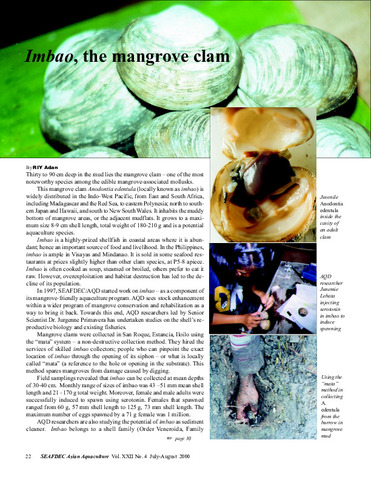
Collection of the clam Anodontia edentula in mangrove habitats in Panay and Guimaras, central Philippines

ดู/
วันที่
2002Page views
NaNASFA keyword

AGROVOC keyword
Taxonomic term


เมตาดาต้า
แสดงระเบียนรายการเต็มShare
นามธรรม
The mangrove clam Anodontia edentula is highly prized in the Philippines for its flavor and large size. Because this infaunal species is found down to one meter deep in mangrove areas, harvesting the clam reportedly damages mangrove stands. To evaluate such reports, a survey of collection methods was undertaken in Panay and Guimaras, central Philippines in August 1997-December 1999. Host to chemosynthetic bacterial symbionts that utilize sulfide as energy source, A. edentula are strategically situated in sulfide-rich anoxic substrates but also gain access to oxygenated seawater through a ventilation burrow or tube. By locating the opening of this burrow, collectors can detect the presence of a buried clam and harvest it nondestructively with a blade or bare hands. In contrast, the indiscriminate tilling of wide mangrove areas can damage mangrove plants. Most collectors were 40-45 years old with 22-30 years collection experience, married with 5-7 children, and had low educational attainment. They sold clams directly in the local markets or through middlemen (to restaurants and beach resorts); sales provided from 10% to 100% of daily family income. Collectors complained of decreasing clam sizes and numbers and the physically strenuous work of collecting.
การอ้างอิง
Primavera, J., Lebata, M. J. H. L., Gustilo, L. F., & Altamirano, J. (2002). Collection of the clam Anodontia edentula in mangrove habitats in Panay and Guimaras, central Philippines. Wetlands Ecology and Management , 10(5), 363-370. https://doi.org/10.1023/A:1020983218203
Type
ArticleISSN
0923-4861คอลเลกชัน
- Journal Articles [1266]
Related items
Showing items related by title, author, creator and subject.
-
Imbao, the mangrove clam
(Aquaculture Department, Southeast Asian Fisheries Development Center, 2000) -
Molluscan aquaculture in the Philippines: A review
Lebata-Ramos, Ma. Junemie Hazel (Springer, 2023-04-25)
Molluscs are among the most valuable resources of the Philippines, an archipelagic country of 7,107 islands bounded by 36,000 km of coastline and 26.6 million ha of coastal waters. In 2020, production from mussels and oysters alone valued at PhP1.552 billion. As primary sources of food and livelihood for marginalized fisherfolk, they are considered important in food security, nutrition, and poverty alleviation. Nevertheless, for almost a century, mollusc culture remained small-scale, with most fish farmers investing in non-fed species, like mussels and oysters. Moreover, mollusc culture in the country is still dependent on wild sources of seed stocks, making production unsustainable and unreliable. This dependence on the wild seed stocks will continue until the issue of the lack of commercial-scale hatcheries or the limited capacity of existing hatcheries to produce seeds, both for top and emerging mollusc aquaculture species, is resolved. Although technologies from broodstock management to post-harvest are available in some species, the lack of capital and the limited government support limit these artisanal fishers from doing large commercial-scale culture. This paper summarizes what has been done and published on the leading mollusc species cultured in the Philippines. Future research activities may be designed based on the research gaps to refine available technologies and develop new ones to improve culture production. The lack of or limited relevant information on the viable economics of the different culture techniques at different culture phases, the limited availability of post-harvest technologies, and the sparse or lack of genetic information for these leading mollusc species are among the gaps that need to be addressed.
(Springer, 2023-04-25)
Molluscs are among the most valuable resources of the Philippines, an archipelagic country of 7,107 islands bounded by 36,000 km of coastline and 26.6 million ha of coastal waters. In 2020, production from mussels and oysters alone valued at PhP1.552 billion. As primary sources of food and livelihood for marginalized fisherfolk, they are considered important in food security, nutrition, and poverty alleviation. Nevertheless, for almost a century, mollusc culture remained small-scale, with most fish farmers investing in non-fed species, like mussels and oysters. Moreover, mollusc culture in the country is still dependent on wild sources of seed stocks, making production unsustainable and unreliable. This dependence on the wild seed stocks will continue until the issue of the lack of commercial-scale hatcheries or the limited capacity of existing hatcheries to produce seeds, both for top and emerging mollusc aquaculture species, is resolved. Although technologies from broodstock management to post-harvest are available in some species, the lack of capital and the limited government support limit these artisanal fishers from doing large commercial-scale culture. This paper summarizes what has been done and published on the leading mollusc species cultured in the Philippines. Future research activities may be designed based on the research gaps to refine available technologies and develop new ones to improve culture production. The lack of or limited relevant information on the viable economics of the different culture techniques at different culture phases, the limited availability of post-harvest technologies, and the sparse or lack of genetic information for these leading mollusc species are among the gaps that need to be addressed. -
Oxygen, sulphide and nutrient uptake of the mangrove mud clam Anodontia edentula (Family: Lucinidae)
Lebata, Ma. Junemie Hazel L. (Elsevier, 2001)
Oxygen, sulphide and nutrient (ammonia, nitrite and phosphate) uptake of Anodontia edentula was measured. Oxygen and sulphide were measured from sealed containers provided with 1 l fresh mangrove mud (sulphide source) and seawater (oxygen source) with two treatments (with and without clam) at 16 replicates each. Oxygen, sulphide and other parameters were measured at days 1 (initial), 3 and 5 (final). Nutrients were measured from containers filled with 1.5 l wastewater from a milkfish broodstock tank with two treatments (with and without clam) at eight replicates each. Ammonia, NO2 and PO4 were measured at days 0 (initial) 3, 6, 9 and 12 (final). Results showed significantly decreasing oxygen and sulphide concentrations in treatment with clams (ANOVA, p < 0.001). A significantly higher ammonia concentration (ANOVA, p < 0.05) was observed in treatment with clams while no significant difference was observed in nitrite and phosphate between the two treatments. A decreasing ammonia and an increasing nitrite trend was also observed in both treatments starting at day 3.