In observance of the Lenten season, please be advised of the following adjustments to our repository services:
- Effective Date: Afternoon of April 1, 2026
- Service Resumption: Monday, April 6, 2026
Our repository remains online for browsing; however, "Request a Copy" responses will be paused starting April 1, 2026 afternoon. Standard processing and responses will resume on April 6, 2026. Thank you for your patience!
Influence of various dietary synthetic carotenoids on bio-defence mechanisms in rainbow trout, Oncorhynchus mykiss (Walbaum)

View/
Date
2001Author

Page views
3,164ASFA keyword

AGROVOC keyword
Metadata
Show full item recordShare
Abstract
This study examined the influence of different carotenoids on growth and some immune indices in rainbow trout. Six semipurified casein-based diets were formulated to contain one of three different carotenoids: astaxanthin, canthaxanthin and β-carotene, at 100 mg kg−1, each of them with vitamins A, C and E either added or omitted. The two control diets contained no carotenoids and were either with or without the vitamins. Rainbow trout weighing about 140 g were fed the diets for 9 weeks. Specific growth rate, feed:gain ratio and nonspecific immune parameters were determined. Growth and feed conversion were similar among the groups. Immune parameters like production of reactive oxygen species by head kidney leukocytes and plasma total immunoglobulin levels did not vary with the treatment. Serum complement activity in both β-carotene groups and the vitamin-containing astaxanthin group were significantly higher than both the control fish. Serum lysozyme activity in the vitamin-containing β-carotene and astaxanthin groups were significantly different from both control groups. Phagocytic activity was also high in the vitamin-containing β-carotene and astaxanthin groups compared with the controls. For phagocytic index, in addition to the foregoing groups, the vitamin-containing canthaxanthin group gave better results compared with the controls. The vitamin-containing astaxanthin and β-carotene groups also exhibited better nonspecific cytotoxicity for the peripheral blood lymphocytes at all effector-to-target ratios. Thus, among the carotenoids studied, β-carotene and astaxanthin elevated humoral factors such as serum complement and lysozyme activity, as well as cellular factors such as phagocytosis and nonspecific cytotoxicity. In the presence of the vitamins the carotenoids exerted a greater influence on the bio-defense mechanisms of rainbow trout.
Suggested Citation
Amar, E. C., Kiron, V., Satoh, S., & Watanabe, T. (2001). Influence of various dietary synthetic carotenoids on bio-defence mechanisms in rainbow trout, Oncorhynchus mykiss (Walbaum). Aquaculture Research , 32(Suppl. 1), 162-173. https://doi.org/10.1046/j.1355-557x.2001.00051.x
Type
ArticleISSN
1355-557XCollections
- Journal Articles [1267]
Related items
Showing items related by title, author, creator and subject.
-
The essential nutrients: Vitamins
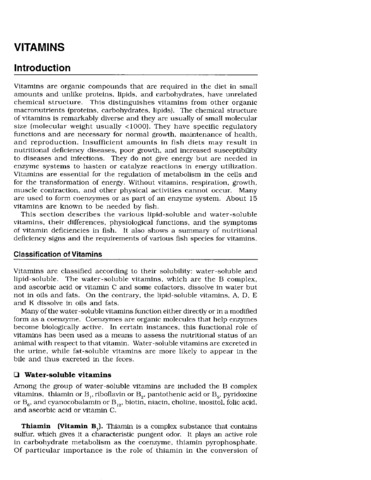
(Aquaculture Department, Southeast Asian Fisheries Development Center, 2002)This section describes the various lipid-soluble and water-soluble vitamins, their differences, physiological functions, and the symptoms of vitamin deficiencies in fish. It also shows a summary of nutritional deficiency signs and the requirements of various fish species for vitamins. -
Effect of prepared diet and vitamins A, E and C supplementation on the reproductive performance of cage-reared bighead carp Aristichthys nobilis (Richardson)
(Blackwell Publishing, 2000)Twenty-month-old bighead carp, Aristichthys nobilis (Richardson), were fed prepared dry diets for 20 months in cages in Laguna de Bay, Philippines, to determine the effect on reproductive performance. The experimental diets were similar in composition except for the combinations of vitamins being tested. Diet 1 was supplemented with vitamins A, E and C; diets 2, 3 and 4 each lacked one of the supplementary vitamins; and diet 5 did not include any vitamin supplementation. Bighead carp that relied solely on natural food without a prepared diet served as a control. The total of six treatments each had two replicates. Results showed that the onset of gonad maturation was 2–3 months earlier in the fish that were fed the prepared diets regardless of vitamin supplementation, when compared with the fish that were fed natural food (control). Moreover, the prepared diets enhanced egg hatchability which was significantly higher in fish that were fed diet 1 (+ vitamins A, E and C, 80.5 ± 18.1%) and diet 3 (– vitamin E, 78.5 ± 1.1%) than in those fish that were fed natural food (control) (36.5 ± 31.3%). Mean number of 3-day-old larvae was highest in fish fed on diet 1 (34 525 ± 1732), followed closely by fish that were fed diet 3 (32 420 ± 3909). A low number of 3-day-old larvae was obtained from fish fed the natural diet (14 490 ± 4331) as well as in fish that were fed diet 2 (– vitamin A, 14 347 ± 4863), diet 4 (– vitamin C, 21 407 ± 5840) and diet 5 (– vitamin A, E and C, 12 191 ± 1439). Other criteria for reproduction such as relative fecundity, fertilization rate, and hatching rate did not differ significantly (P > 0.05) among treatments. The addition of vitamins also had no significant effects on weight gain of adult fish. -
Rapid wound healing in African catfish, Clarias gariepinus, fed diets supplemented with ascorbic acid
(Society of Israeli Aquaculture and Marine Biotechnology, 2001)Wound healing in African catfish, Clarias gariepinus, fed diets supplemented with ascorbic acid was studied under laboratory conditions. Fish weighing approximately 80-110 g were stocked in 500 l aquaria in a static water system and fed one of five test diets containing different levels of microencapsulated ascorbic acid (0, 0.06, 0.10, 0.30 and 0.70 g AsA/100 g feed). After two weeks, all experimental fish were wounded by making a 1 x 1 cm dorso-lateral incision above the lateral line of the fish. Wounded tissues were sampled for histopathological analysis 4, 8, 24, 48 and 96 hours, 6, 8, 10, 12 and 14 days after making the incision. There were significant differences in weight gain, specific growth rate (SGR) and feed conversion ratio among the dietary treatments. Weight gain and SGR of fish fed the ascorbic acid free diet were lower than those of fish fed diets supplemented with ascorbic acid. The wound healing response showed a direct correlation to ascorbate level in the diet. Fibroblasts were present at 96 h irrespective of the ascorbic acid level. As 14 days, fish fed no ascorbic acid had some regeneration of muscle tissues, whereas fish fed diets containing supplemental ascorbic acid had a normal epidermis, dermis and muscle structure. There was no mortality during the experimental period, and fish fed ascorbic acid free diets did not exhibit any deficiency signs. Results of this study indicate that about 0.10-0.70 g AsA/100 g feed is needed for wound repair in African catfish.