Genetic diversity of wild and cultured black tiger shrimp (Penaeus monodon) in the Philippines using microsatellites

View/
Date
2001Author
Page views
3,241ASFA keyword

AGROVOC keyword
Taxonomic term

Metadata
Show full item recordShare
Abstract
Six microsatellites were used to study (1) the genetic diversity of wild Penaeus monodon shrimp from four geographic regions (Palawan, Quezon, Capiz and Negros Occidental-W) in the Philippines, and (2) its association with the status of mangroves and intensity of shrimp culture systems in these regions. Two cultured populations (Negros Occidental-C and Antique) were used for comparison. All six microsatellite loci were polymorphic. A total of 184 different alleles were found over all loci. The total number of alleles per locus ranged from 6 to 54, with allele size ranging from 159 base pairs (bp) to 400 bp. The observed heterozygosity of the six loci ranged from 0.47 to 1.00. The number of genotypes per locus ranged from 5 to 70. Fst values showed significant genetic differentiation among the four wild populations. Genetic differences between wild populations were also detected by pairwise comparison based on genotypic and allelic frequencies. Genetic differentiation among wild populations exhibited a positive correlation with mangrove status and intensity of culture systems at P=0.083. The Negros Occidental-W population, which originated from an area with the most severe mangrove loss and the most intensive culture systems, was the most significantly differentiated population. It also showed less genotypes per locus than the other three wild populations, suggesting a decrease in genetic diversity in this population. The population from Capiz, a province with a wide area of extensive culture ponds and few remaining secondary mangroves was the second most differentiated population. The Quezon population, which originated from an area with a few extensive culture ponds and less mangrove destruction, was not genetically different from the Palawan population, which was from a pristine site with mostly primary mangroves and no major aquaculture industry. The cultured populations showed less genetic diversity and were significantly different from the four wild populations based on pairwise Fst values and pairwise comparisons of allelic and genotypic frequencies. The results suggest that (a) there was a significant genetic differentiation among the wild P. monodon populations in the Philippines, and (b) the cultured populations were significantly differentiated from the natural populations. More replicate samples from each of the geographic regions are needed to conclusively determine the possibility of an association between genetic differentiation and the status of mangroves and/or intensity of shrimp culture systems.
Suggested Citation
Xu, Z., Primavera, J., de la Peña, L. D., Pettit, P., Belak, J., & Alcivar-Warren, A. (2001). Genetic diversity of wild and cultured black tiger shrimp (Penaeus monodon) in the Philippines using microsatellites. Aquaculture , 199(1-2), 13-40. https://doi.org/10.1016/S0044-8486(00)00535-4
Type
ArticleISSN
0044-8486Collections
- Journal Articles [1263]
Related items
Showing items related by title, author, creator and subject.
-
Swollen hindgut syndrome (SHG) in hatchery-reared Penaeus monodon postlarvae
(Fish Health Section, Asian Fisheries Society, 2002)In the course of routine microscopic analysis of hatchery-reared Penaeus monodon postlarvae, several batches were found with hindgut abnormalities not previously described in shrimp postlarvae. The abnormality was named ... -
Series: ICLARM Conf. Proc. 64
Genetic research at the Southeast Asian Fisheries Development Center/Aquaculture Department
Basiao, Zubaida (ICLARM - The World Fish Center, 2001)
Southeast Asia is endowed with a variety of species that can be cultured as food fish. Since 1973, the Southeast Asian Fisheries Development Center/Aquaculture Department (SEAFDEC/AQD) has devoted research efforts to ...
(ICLARM - The World Fish Center, 2001)
Southeast Asia is endowed with a variety of species that can be cultured as food fish. Since 1973, the Southeast Asian Fisheries Development Center/Aquaculture Department (SEAFDEC/AQD) has devoted research efforts to ... -
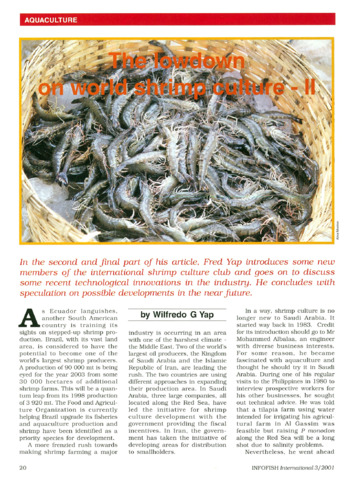
The lowdown on world shrimp culture - II
(INFOFISH, 2001)This paper introduces some new members of the international shrimp culture club and goes on to discuss some recent technological innovations in the industry, particularly the polyculture of tilapia (mainly Oreochromis ...