Pen culture of mud crab Scylla serrata in tidal flats reforested with mangrove trees

ดู/
วันที่
2002Page views
1,458ASFA keyword

AGROVOC keyword
Taxonomic term

เมตาดาต้า
แสดงระเบียนรายการเต็มShare
นามธรรม
Growth and survival of mixed sex mud crabs Scylla serrata (Forskal), held in 200 m2 pens located in reforested mangrove tidal flats, were evaluated. The effects of stocking density (0.5 or 1.5 m−2) and feed (salted fish bycatch or a mixed diet of 75% salted brown mussel flesh and 25% salted fish bycatch) were determined in a replicated factorial experiment. Duration of the experiment was 160 days. There were no significant differences (P>0.05) in growth, apparent feed conversion ratio (FCR), survival, and production among the two types of feed. Regardless of feed, the mean±SE FCR of 5.30±0.34 and survival of 56.00±1.90% at 0.5 m−2 stocking density were significantly better (P<0.05) than at 1.5 m−2 stocking density (7.6±0.63 FCR and 33.00±3.61% survival). However, growth was not significantly affected by stocking density. Cost–return analysis on a per crop per 200 m2 basis showed that the use of either of the two stocking densities with either diet was economically viable with a return on capital investment of 49–68%. However, crabs stocked at 1.5 m−2 and fed a mixed diet of 75% salted brown mussel flesh and 25% salted fish bycatch is more profitable. The integration of crab aquaculture within natural mangroves is therefore feasible in the Philippines, providing both immediate and long-term commercial and environmental benefits.
การอ้างอิง
Triño, A. T., & Rodriguez, E. M. (2002). Pen culture of mud crab Scylla serrata in tidal flats reforested with mangrove trees. Aquaculture , 211(1-4), 125-134. https://doi.org/10.1016/S0044-8486(01)00890-0
Type
ArticleISSN
0044-8486คอลเลกชัน
- Journal Articles [1262]
Related items
Showing items related by title, author, creator and subject.
-
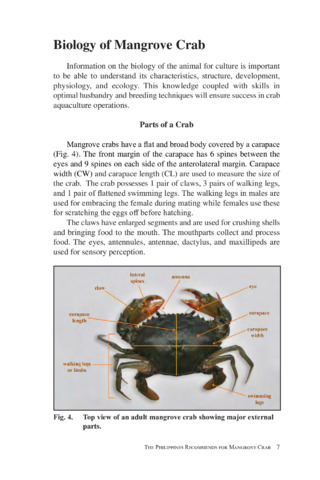
[The Philippines recommends for mangrove crab:] Biology of mangrove crab
(DOST-PCAARRD, 2021) -
The reestablishment of mangrove crabs (Scylla spp.) in an abandoned pond following natural mangrove recolonization
Lebata-Ramos, Ma. Junemie Hazel ; ; Sibonga, Rema (Wiley, 2024-01)
Scylla spp. are among the most economically important fisheries resources derived from the mangroves. However, the widespread mangrove destruction resulted in the loss of habitat, thus the dwindling capture production ...
; ; Sibonga, Rema (Wiley, 2024-01)
Scylla spp. are among the most economically important fisheries resources derived from the mangroves. However, the widespread mangrove destruction resulted in the loss of habitat, thus the dwindling capture production ... -
Aqua-mangrove integrated farming: Shrimp and mud crab culture in coastal and inland tidal flats with existing reforested or natural growth of mangroves
(Aquaculture Department, Southeast Asian Fisheries Development Center, 2000)Throughout the tropics, mangroves are being destroyed at an increasing rate for the development of aquaculture ponds. In the Philippines, for instance, mangroves were about 400,000 to 500,000 ha in 1918 but were reduced ...