Shell marking by artificial feeding of the tropical abalone Haliotis asinina Linne juveniles for sea ranching and stock enhancement
View/
Date
2003Page views
2,931ASFA keyword

AGROVOC keyword
Taxonomic term

Metadata
Show full item recordShare
Abstract
A method of marking abalone (Haliotis asinina Linne) for sea ranching and stock enhancement purposes was developed. Three-month-old abalone juveniles (11.8-mm shell length, 0.28 g) were fed artificial diets for 1, 2, or 3 weeks. The width of the bluish-green shell band produced by abalone juveniles was 1.7, 2.6, and 4.2 mm after 1, 2, or 3 weeks of feeding respectively. The growth and survival of juveniles fed artificial diets did not differ from that of juveniles fed the seaweed Gracilariopsis bailinae (control). Feeding the diet-fed juveniles with the seaweed thereafter produced the natural brownish shell, thus forming a sandwiched bluish-green band. An experimental release in outdoor tanks with natural growth of seaweeds and diatoms, and in a marine reserve showed that the shell band remained clear and distinct, indicating the usefulness of this shell marking method in sea ranching and stock enhancement of abalone.
Suggested Citation
Gallardo, W. G., Bautista-Teruel, M. N., Fermin, A. C., & Marte, C. L. (2003). Shell marking by artificial feeding of the tropical abalone Haliotis asinina Linne juveniles for sea ranching and stock enhancement. Aquaculture Research , 34(10), 839-842. https://doi.org/10.1046/j.1365-2109.2003.00890.x
Type
ArticleISSN
1355-557X; 1365-2109Collections
- Journal Articles [1267]
Related items
Showing items related by title, author, creator and subject.
-
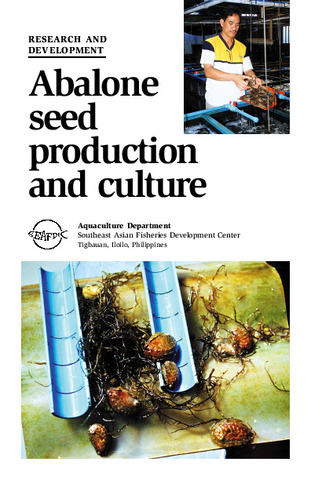
Abalone seed production and culture
(Aquaculture Department, Southeast Asian Fisheries Development Center, 2000)Details the research conducted at AQD for the tropical abalone Haliotis asinina. AQD has developed the rudiments of a hatchery protocol. -
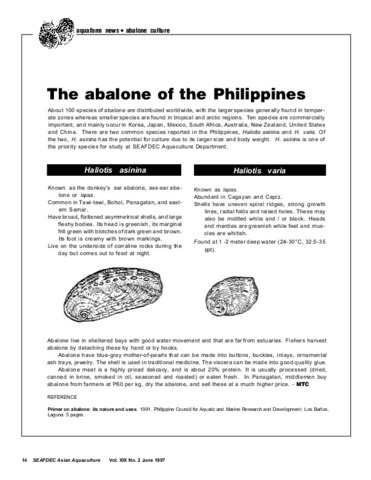
The abalone of the Philippines
(Aquaculture Department, Southeast Asian Fisheries Development Center, 1997) -
Temperature and size range for the transport of juvenile donkey's ear abalone Haliotis asinina Linne
(Blackwell Publishing, 2011)Live transport of hatchery-produced juvenile donkey's ear abalone Haliotis asinina Linne was examined to evaluate the effect of transportation on the survival of juvenile abalone. Simulated transport experiments were conducted to determine the appropriate temperature using 5, 10 and 20 g L−1 of ice to air volume for 8 h and the appropriate size using two size groups (Size A, 15–20 mm, 0.5–1.3 g, and Size B, 30–35 mm, 5.3–8.5 g) up to 24-h out-of-water live transport. Survival was significantly higher (P<0.001) when 10 g L−1 of ice was used to decrease the temperature to the range of 17–23 °C. At this temperature, both size groups subjected to simulated transport for 8 and 10 h had 100% survival after 48 h, while mortality occurred in abalones subjected to 16 and 24 h of simulated transport. The Size B abalone subjected to 24 h of transport had significantly higher survival (64.4 ± 2.9%) (P<0.001) than the Size A abalone (5.5 ± 1.6%) after 48 h. Live juvenile abalone were successfully transported to the field applying the protocols developed in the lab experiment. This study serves as a guide for handling and shipping live juvenile abalone.