SEAFDEC/AQDINSTITUTIONAL REPOSITORY
    • English
    • 日本語
    • ไทย
    • Bahasa Indonesia
  • English 
    • English
    • 日本語
    • ไทย
    • Bahasa Indonesia
  • Login
View Item 
  •   SEAFDEC/AQD Institutional Repository Home
  • 03 SEAFDEC/AQD External Publications
  • Journal Articles, Conference Papers and Book Chapters by SEAFDEC Staff
  • Conference Proceedings
  • View Item
  •   SEAFDEC/AQD Institutional Repository Home
  • 03 SEAFDEC/AQD External Publications
  • Journal Articles, Conference Papers and Book Chapters by SEAFDEC Staff
  • Conference Proceedings
  • View Item
JavaScript is disabled for your browser. Some features of this site may not work without it.

Training needs and provision in developing countries of the Asia-Pacific region

  • Global styles
  • MLA
  • Vancouver
  • Elsevier - Harvard
  • APA
  • Help
Thumbnail
View/Open
Date
2007
Author
Lavilla-Pitogo, Celia R.
Page views
1,472
ASFA keyword
animal diseases ASFA
aquaculture ASFA
aquatic animals ASFA
developing countries ASFA
disease control ASFA
disease recognition ASFA
training ASFA
AGROVOC keyword
Asia AGROVOC
Metadata
Show full item record

Share 
 
Abstract
Training has played a significant role in the development of capacity in aquatic animal health in the Asia-Pacific region where most specialists have fisheries or a background in biology rather than in veterinary medicine. Training courses offered by various organizations, national institutes, universities and the private sector are aimed at providing graduates with skills in disease diagnostics using molecular methods, histopathology, epidemiology, immunology, as well as in disease prevention and control methods. Most training programmes either focus on diseases affecting specific commodities, such as shrimp, marine fish or molluscs, or on diagnostic methods for pathogens such as viruses. Because of the need to train a large pool of geographically dispersed participants, innovative and cost-effective ways of delivery like online and on-site training should be encouraged as well as workshops preceding or following meetings and symposia. One important aspect to be addressed is the translation of training materials to facilitate knowledge transfer to the farm level. Since the inadequate level of aquatic animal health expertise in the Asia-Pacific affects worldwide aquaculture, partnerships between governments, various international organizations and academia should be strengthened in order to fill the training gap.
URI
http://hdl.handle.net/10862/2061
Suggested Citation
Lavilla-Pitogo, C. R. (2007). Training needs and provision in developing countries of the Asia-Pacific region. In B. Dodet & OIE Scientific & Technical Department (Eds.), The OIE Global Conference on Aquatic Animal Health, Bergen, Norway, 9-12 October 2006 (Developments in Biologicals, Vol. 129, pp. 125–136). Basel: Karger.
Type
Conference paper
ISSN
1424-6074
ISBN
9783805583442
Collections
  • Conference Proceedings [300]

Related items

Showing items related by title, author, creator and subject.

  • Thumbnail

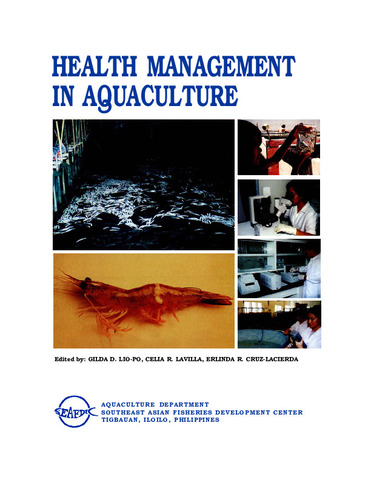
    Health management in aquaculture 

    Lio-Po, Gilda D.; Lavilla, Celia R.; Cruz-Lacierda, Erlinda R. (Aquaculture Department, Southeast Asian Fisheries Development Center, 2001)
    A textbook on diseases of cultured warmwater fish and shrimps in the Philippines. Eleven chapters cover essential information on the basic principles of disease causation, major diseases of cultured fish and crustaceans, particularly shrimps, and methods of prevention and control. Emphasis is made on major diseases that occur in the Philippines and other countries in the Asian region. Included also are topics on harmful algae, immunology and molecular biological diagnostic techniques.
  • Thumbnail

    Country status of aquatic emergency preparedness and response systems for effective management of aquatic animal disease outbreaks in Myanmar 

    Oo, Kyaw Naing; Cho, Yi Yi (Aquaculture Department, Southeast Asian Fisheries Development Center, 2019)
    Myanmar is one of the OIE members and the Department of Fisheries (DoF) is highly concerned with transboundary aquatic animal pathogens. Therefore, the Aquatic Animal Health & Disease Control Section has already been formed not only for field diagnostic surveys but also for border control especially at international airport and border trade areas by checking and counter checking export and import of aquatic animals and products. At the moment, the DoF is stressing an issue of some transboundary diseases for finfish such as Gyrodactylus sp., Dactylogyrus sp., Argulus sp., Trichodena sp., Streptococcus sp., Aeromonas sp., and for crustacean are MrNV/XSV and WSSV. In addition, the DoF is facing challenges with parasitic disease and bacterial disease problems due to poor water quality management at culturing fish ponds. For the prevention and control of fish diseases within the country, the DoF is issuing Health Certificates by physical and microbiological examination of fishes and fisheries products. At the same time, Quarterly report on fish disease has being regularly submitted to NACA, OIE since 1998 until now. Although the DoF has no specific law and legislation on the control of quarantine pest and disease of aquatic animal, a good aquaculture practice has been implemented and code of conduct responsible for aquaculture is being followed in the country. The aquatic health management is a challenging issue in aquaculture development. Myanmar is still needing technical assistance to improve quarantine system especially for importation and exportation of live aquatic animals. Moreover, monitoring and surveillance programs with harmonized aquatic emergency preparedness and response system are required to boost up not only for Myanmar but also for effective management of transboundary disease outbreaks in Southeast Asia.
  • Thumbnail

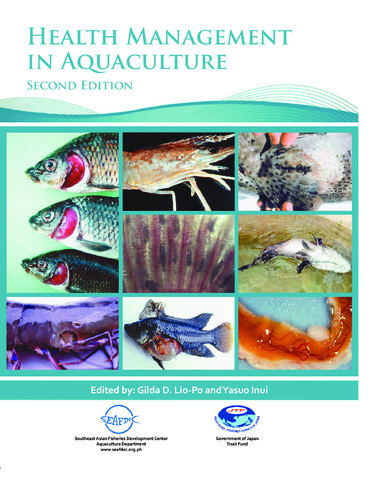
    Health management in aquaculture 

    Lio-Po, Gilda D.; Inui, Yasuo (Aquaculture Department, Southeast Asian Fisheries Development Center, 2010-07)
    A textbook on diseases of cultured warmwater fish and shrimps in the Philippines. Eleven chapters cover essential information on the basic principles of disease causation, major diseases of cultured fish and crustaceans, particularly shrimps, and methods of prevention and control. Emphasis is made on major diseases that occur in the Philippines and other countries in the Asian region. Included also are topics on harmful algae, immunology and molecular biological diagnostic techniques.

© SEAFDEC/AQD  2026
Send Feedback | Subscribe


Browse

All of SAIRCommunities & CollectionsBy Issue DateAuthorsTitlesSubjectsThis CollectionBy Issue DateAuthorsTitlesSubjects

My Account

LoginRegister

Statistics

View Usage Statistics

© SEAFDEC/AQD  2026
Send Feedback | Subscribe


Export citations

Export the current results of the search query as a citation list. Select one of the available citation styles, or add a new one using the "Citations format" option present in the "My account" section.

The list of citations that can be exported is limited to items.

Export citations

Export the current item as a citation. Select one of the available citation styles, or add a new one using the "Citations format" option present in the "My account" section.

Export Citations

DOCUMENT REQUEST NOT AVAILABLE

This publication is still available (in PRINT) and for sale at AQD bookstore. The library is currently restricted to send PDF of publications that are still for sale.

You may contact bookstore@seafdec.org.ph or visit AQD bookstore for orders.

FILE UNDER EMBARGO

This file associated with this publication is currently under embargo. This will be available for download after the embargo date.