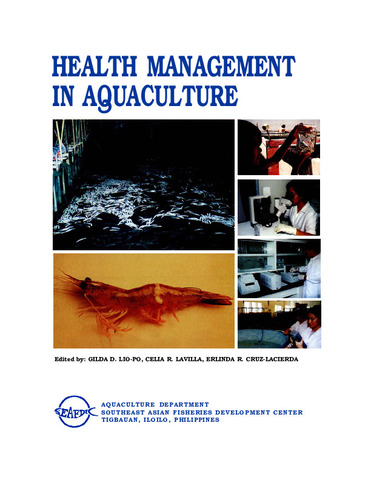
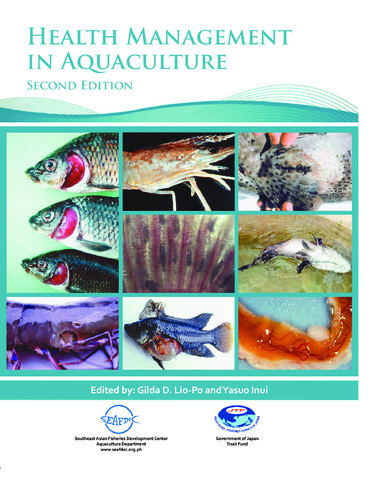
Health management in aquaculture

Share
Abstract
A textbook on diseases of cultured warmwater fish and shrimps in the Philippines. Eleven chapters cover essential information on the basic principles of disease causation, major diseases of cultured fish and crustaceans, particularly shrimps, and methods of prevention and control. Emphasis is made on major diseases that occur in the Philippines and other countries in the Asian region. Included also are topics on harmful algae, immunology and molecular biological diagnostic techniques.
Description
A textbook on the major diseases of cultured fish and crustaceans, as well as prevention and control methods and diagnostic techniques for these diseases. New chapters on histology, probiotics, and epidemiology were added in this edition.
Other versions
1st Ed.Suggested Citation
Lio-Po, G. D., & Inui, Y. (Eds.). (2010). Health Management in Aquaculture (2nd ed.). Tigbauan, Iloilo, Philippines: Aquaculture Department, Southeast Asian Fisheries Development Center.
Type
BookISBN
9718511458Format
xv, 316p. : ill. (some col.).
Collections
Related items
Showing items related by title, author, creator and subject.
-
Health management in aquaculture
(Aquaculture Department, Southeast Asian Fisheries Development Center, 2001)A textbook on diseases of cultured warmwater fish and shrimps in the Philippines. Eleven chapters cover essential information on the basic principles of disease causation, major diseases of cultured fish and crustaceans, particularly shrimps, and methods of prevention and control. Emphasis is made on major diseases that occur in the Philippines and other countries in the Asian region. Included also are topics on harmful algae, immunology and molecular biological diagnostic techniques. -
Country status of aquatic emergency preparedness and response systems for effective management of aquatic animal disease outbreaks in Myanmar
(Aquaculture Department, Southeast Asian Fisheries Development Center, 2019)Myanmar is one of the OIE members and the Department of Fisheries (DoF) is highly concerned with transboundary aquatic animal pathogens. Therefore, the Aquatic Animal Health & Disease Control Section has already been formed not only for field diagnostic surveys but also for border control especially at international airport and border trade areas by checking and counter checking export and import of aquatic animals and products. At the moment, the DoF is stressing an issue of some transboundary diseases for finfish such as Gyrodactylus sp., Dactylogyrus sp., Argulus sp., Trichodena sp., Streptococcus sp., Aeromonas sp., and for crustacean are MrNV/XSV and WSSV. In addition, the DoF is facing challenges with parasitic disease and bacterial disease problems due to poor water quality management at culturing fish ponds. For the prevention and control of fish diseases within the country, the DoF is issuing Health Certificates by physical and microbiological examination of fishes and fisheries products. At the same time, Quarterly report on fish disease has being regularly submitted to NACA, OIE since 1998 until now. Although the DoF has no specific law and legislation on the control of quarantine pest and disease of aquatic animal, a good aquaculture practice has been implemented and code of conduct responsible for aquaculture is being followed in the country. The aquatic health management is a challenging issue in aquaculture development. Myanmar is still needing technical assistance to improve quarantine system especially for importation and exportation of live aquatic animals. Moreover, monitoring and surveillance programs with harmonized aquatic emergency preparedness and response system are required to boost up not only for Myanmar but also for effective management of transboundary disease outbreaks in Southeast Asia. -
Parasitic diseases
(Aquaculture Department, Southeast Asian Fisheries Development Center, 2004)A wide variety of parasitic organisms have been reported as causing significant problems in grouper aquaculture. In the hatchery and nursery stages, parasitic diseases of groupers are caused predominantly by protozoans, particularly the ciliates. When grouper fry are transferred to grow-out facilities, they are subjected to handling and transport stress. These fish often carry a large variety and high intensity of ciliated protozoans, skin and gill monogeneans and caligid copepods. This chapter deals with the major parasites of cultured groupers including infections caused by protozoans, monogeneans, didymozoid digeneans, nematodes, caligid copepods, isopods and leeches.